



For many people in Japan, the most pressing economic issue today is how to contain inflation. From the perspective of economics, there are two approaches to curbing inflation. One is to suppress aggregate demand, and the other is to increase aggregate supply.
The demand-suppression approach involves raising policy interest rates, correcting the yen exchange rate toward appreciation, and slowing the economy to bring prices down. If nominal wage adjustments are delayed, real wages can rise. These price adjustments through short-term monetary policy are expected to be made based on the economy’s existing potential growth capacity.
In August 2025, the government published the Economic and Fiscal Projections for Medium to Long Term Analysis. Under the projections, Japan’s potential growth rate based on past performance is only around 0.5% (“Projection of Past Trend (PP) Case”). In the “Transferring to a New Economic Stage (TN) Case” and in the “Higher Economic Growth (HG) Case” under the projections, the projected growth rates are around 1.5% and slightly under 2%, respectively.
If Japan is to pursue price stability while achieving the growth rates projected in the TN and HG cases, it is essential to strengthen supply capacity.
The example of rice makes this easy to understand. The increase in rice prices since 2024 is partly attributable to supply shortages caused by reductions in planted acreage. Therefore, one way to achieve price stability is to increase rice supply by restoring productive rice paddies that had been reduced through the government’s rice production reduction policy. Increasing supply capacity on an economy-wide basis is an approach that applies the economic mechanism observed in the rice example to the macroeconomic context.
◆◆◆
At the macroeconomic level, instead of restoring rice paddies to production, increasing labor and capital is the key to increasing supply. The figure below shows a comparison of Japan with the United States and Germany in terms of capital intensity, which represents the ratio of the capital amount to total working hours, with the based year 2000 set as 100. The changes in capital intensity indicate changes in the balance between labor and capital over time in each country.
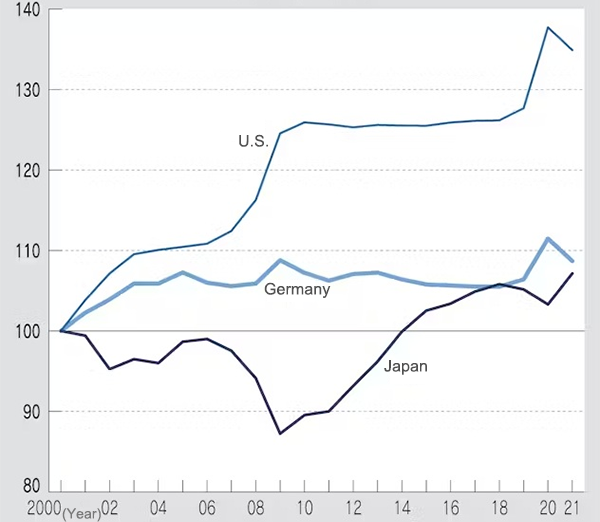
If the curve slopes upward, it means capital has increased relative to labor. If the curve slopes downward, production relies more on labor relative to its dependence on capital. The figure indicates that in the 2000s and 2010s, the Japanese production system depended more on labor than on capital compared with the U.S. and German systems.
This was influenced by the continuing adjustments to excess capital associated with the bursting of the bubble economy and Japanese employers’ inclination to maintain jobs compared with employers in other countries, even during the global financial crisis. That tendency was corrected through the labor market reform implemented under the Abenomics policy. However, as the reduction of per-capita working hours was offset by an increase in the number of mainly women and elderly employees, total working hours did not decrease steeply.
In addition, Japan’s capital growth over the period was the lowest of the three countries. Relative to the low growth in capital, there remains a high degree of dependence on labor, meaning that Japanese workers as a whole have continued to work very hard.
However, amid the decline in birthrates, increasing supply capacity based on labor is not sustainable. It is necessary to shift from labor dependence to capital accumulation The most promising path forward is labor-saving through digital technology. This point has been recognized since the Abenomics era, when policies emphasizing work-life balance and increased minimum wages were implemented to promote the shift from the easy dependence on labor to the use of capital.
Now, compared with the Abenomics era, the economic environment has become more favorable for domestic capital accumulation. In terms of capital investment financing, real interest rates were zero or slightly positive in the 2010s but have now fallen into negative territory as the inflation rate has remained above 2%.
That means that companies’ accumulated cash reserves continue to lose value in real terms, a situation that makes it necessary to shift to other asset classes. In addition, fixed assets are increasingly under-depreciated, as their depreciation is based on the acquisition cost. If companies fail to take action during the ongoing inflation, it will become ever-increasingly difficult to replace facilities and equipment, raising the risk that companies may be forced to withdraw from or scale down operations in their existing business areas.
It is also essential to correct the imbalance between outward and inward foreign direct investment (FDI). Due to the yen’s appreciation during the global financial crisis in 2008, Japanese companies increased their outward FDI, rising to a level around 10 times as high as the amount of inward FDI.
However, because of the tariff policies adopted by President Trump, who took office in 2025, exports to the United States via Southeast Asia and Central and South America are not necessarily as advantageous as exporting from Japan directly to the United States. The time has come for Japan to reconsider the FDI policy tilted toward outward investments and promote inward FDIs.
◆◆◆
Given that capital is seen as relatively scarce, is it necessary or wise to continue to advance unilateral capital accumulation? Some considerations are warranted regarding this perspective. One is that research and development investments no longer translate to productivity improvements to the degree that they used to.
This was highlighted in a 2020 article in the American Economic Review by a group led by Professor Nicholas Bloom of Stanford University, and a similar trend in Japan was confirmed by Assistant Professor Takayuki Ishikawa of Kanagawa University and myself.
Indeed, the provision of new services in the field of artificial intelligence (AI), the construction of data centers, and the development of new drugs require enormous investments. Digital services have some similar characteristics to public goods, so users can improve productivity through the benefits obtained from digital services, but profitability for investors is uncertain. President Trump’s calls for investments from Japan and South Korea, which come in parallel with the tariff negotiations, may reflect growing uncertainty over the benefits of investments for advanced technology.
Another point of caution is that digital investment is not sufficiently visible. The progress of digitalization is not adequately captured in macroeconomic statistics. For example, while Japanese investments in digitalization (the total sum of investments in information and communication equipment and software programs) stagnated in the 2010s, from the mid 2010’s onward, Japan’s external balance deficit in communication, computer, and information services surged. Presumably, digitalization in Japan has advanced more through the use of digital services than is indicated by the increase in investments.
Furthermore.as indicated in the June 30, 2025 column by Adjunct Professor Kiyohiko Nishimura of the National Graduate Institute for Policy Studies and Professor Masahito Higo of the University of Tokyo, the current estimation of digital investments underrepresents the actual investment amount, and the possibility has been pointed out that the amount of digital investments may be revised upward as a result of the revision of the standards for gross domestic product (GDP) statistics in December 2025.
Capital investment affects the economy in two ways: it not only increases supply in the long term but also stimulates demand in the short term. Therefore, focusing only on the supply side may end up temporarily overheating the economy. The government and the Bank of Japan should implement fiscal and monetary policies that take into account these invisible investments and the dual nature of investment.
Despite the remaining problems described above, there is no doubt that the domestic investment environment has changed considerably compared to the pre-COVID-19 era. According to the interpretation of Keynesian economics by Joan Robinson, the late University of Cambridge Professor, human beings live in historical time and their decision-making occurs in the break between an irreversible past and an unknown future.
Japanese corporate managers appear to have been heavily influenced by irreversible past decisions. Now that the investment environment is changing, it is time for these business managers to exercise their wisdom and shift to future-oriented decision-making.
>> Original text in Japanese
* Translated by RIETI.
November 17, 2025 Nihon Keizai Shimbun
