



In major countries around the world, primary balance (PB) deficits have taken root and are unlikely to become surpluses in the near future. However, there has been little news of government bonds crashing in value in those countries.
In recent years, a growing body of research has argued that the current government bond markets, where the value of government bonds has remained steady despite PB deficits, can be explained as a persistent government bond bubble. Such research could bring about significant changes in how fiscal management and discipline are understood.
◆◆◆
In the standard government bond model, a future PB surplus is considered the source of the value of government bonds. If this standard model is applied to Japan, it must be concluded that achieving fiscal sustainability would require an extremely large increase in taxation or spending cuts. As noted in this column on August 24 by R. Anton Braun, a senior professor at the National Graduate Institute for Policy Studies, Japan would need to raise the consumption tax rate to as high as 25%.
However, politically speaking, such a goal is extremely difficult to achieve, and thus, many people have likely assumed that fiscal soundness is a fanciful ideal rather than a realistic policy goal.
If the government bond bubble can persist, however, extreme tax increases will no longer be required to achieve fiscal soundness (stabilization of government bonds). As long as there is moderate fiscal discipline, stability in the government bond market can be maintained, making fiscal soundness a genuinely realistic policy goal.
It has long been claimed that actual government bond prices far exceed the fundamental value represented by a future budget surplus. Princeton University professor Markus Brunnermeier and coauthors in papers published in 2022 and 2024 on “The Fiscal Theory of the Price Level with a Bubble” explain this excess as a bubble.
In their model, households face idiosyncratic income risks that cannot be hedged by insurance and hold government bonds as assets as insurance against those risks. This “insurance function of government bonds as a safe asset” creates great value and becomes the source of the bubble.
Because the government bond bubble adds value to the fundamental value, government bond prices remain stable at high levels. A similar model has been proposed by University of Chicago professor Greg Kaplan and coauthors.
However, these studies do not argue that governments can hold unlimited fiscal deficits. Rather, they argue that government bond bubbles can be sustained under appropriate levels of fiscal discipline.
These studies demonstrate through quantitative analyses that in the case of the U.S., PB deficit as a percentage of gross domestic product must remain between lower than 2% to nearly 5% in order to maintain a government bond bubble equilibrium where the government debt-GDP ratio is stable. If the PB deficit grows larger than this figure, the government bond bubble can no longer support it, leading the economy to collapse.
If a government bond bubble equilibrium exists concurrently with a bubble-free equilibrium, it is unclear which equilibrium will prevail and for how long, meaning that it is unknowable when the government debt bubble might burst. Brunnermeier and coauthors explain that this instability can be avoided through government commitment by allowing a government bond bubble to continue stably.
This government commitment means that the government promises that, if a crisis arose in which bonds are at risk of collapsing (i.e. a long-term interest rate spike), it will generate fiscal surpluses through tax increases, supporting the value of the government bonds.
Under such government commitment, only a stable government bond bubble equilibrium remains with the other equilibrium disappearing, removing the need to raise taxes. This is a theory of equilibrium selection, where the government commitment causes the bubble equilibrium to be selected among multiple equilibrium choices.
In contrast, researchers have also discovered that under some conditions, a bubble equilibrium may become the only equilibrium. It is known that asset bubbles inevitably occur whenever certain conditions are met in an economy. Hirano Tomohiro, an associate professor at Royal Holloway, University of London, and Toda Alexis Akira, a professor at Emory University published this result in 2025 as the “Bubble Necessity Theorem.”
In a joint study with the author, University of Tokyo professor Nakajima Tomoyuki applied this theorem and proved that “if there is even a very small fiscal surplus, the government bond bubble equilibrium exists as the only equilibrium (no other equilibrium exists).”
Such research strongly suggests that government bond bubbles are not temporary pathologies but can persist stably as a normal feature of markets. The theory of government bond bubbles therefore offers several new visions for fiscal policy.
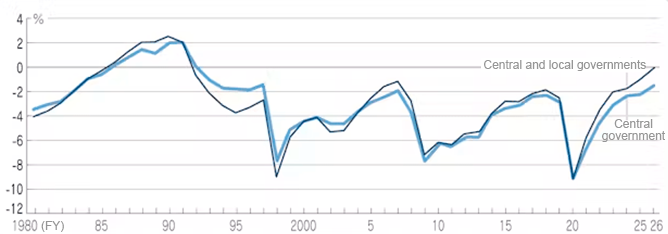
First, it may be possible to maintain a stable government debt-GDP ratio without achieving the enormous fiscal surpluses that are so politically unachievable. If the government can commit to tax increases in times of emergency, it can maintain a PB deficit of between 2% and nearly 5% of GDP. On the other hand, if it maintains even a small PB surplus, a government bond bubble will persist automatically. This means that fiscal discipline which is sufficient to stabilize the value of government bonds (see the figure regarding Japan’s PB) does not require drastic fiscal reform, which implies that politically feasible fiscal reforms may be sufficient to maintain confidence in government debt.
Furthermore, if a government bond bubble can be maintained stably, there will be fiscal space for flexible spending on growth strategies and other policy measures. This could in fact lead to a “high debt and high growth” equilibrium where a government bond bubble is balanced with economic growth.
◆◆◆
How do bond market participants perceive the government bond bubble? In their study in 2026, University of Southern California Assistant Professors Ricardo Delao and Wenhao Li conducted a poll in which market participants were asked where the value of government bonds lies.
In the poll, nearly half of respondents answered that the value lies in the convenience of government bonds as a safe asset. Furthermore, about one-third of bond investors answered that a future PB surplus provides little support for the value of government bonds. In financial markets, the existence of a government bond bubble is likely to have already been implicitly understood.
This means that a major paradigm shift in fiscal management is already underway behind the scenes. The shift is comparable to the transition of the currency system from the gold standard to the fiat currency system. Under the gold standard, it was believed that the value of currency should be fully guaranteed by gold. Under the fiat currency system, however, the value of currency is determined by market supply and demand.
Similarly, traditional fiscal theory held that the value of government bonds should be fully guaranteed by future PB surpluses. With appropriate fiscal discipline, however, a government bond bubble can remain stable through market supply and demand.
Just as the replacement of the gold standard with the fiat currency system did not destroy the global currency system, the normalization of government bond bubbles is unlikely to cause catastrophic events like a sovereign bond market crash. The market mechanisms that sustain a government bond bubble equilibrium seem to be stronger than we assumed.
>> Original text in Japanese
* Translated by RIETI.
October 12, 2026 Nihon Keizai Shimbun
