


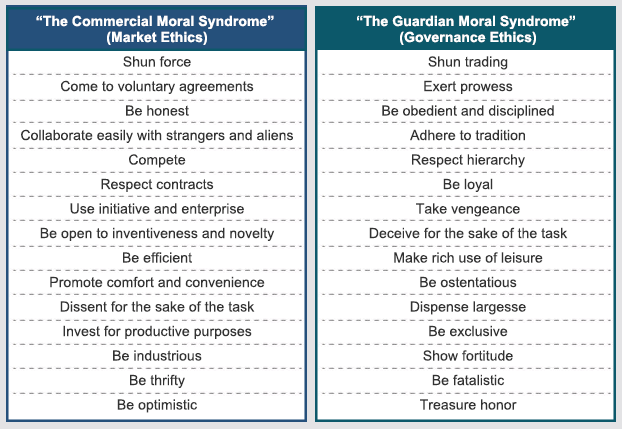
I would like to discuss President Trump's interventionist economic policy, which defies conventional wisdom, from the perspective of changes in liberalism. Systems of Survival: A Dialogue on the Moral Foundations of Commerce and Politics (1992) by Jane Jacobs, an independent urban economist, questioned government market intervention from an ethical standpoint. In this book, she pointed out that the code of conduct for commercial transactions and other market activities is entirely different from the code of conduct governing political activities by nations or communities.
The idea that behavioral norms for commerce differ from that of politics was also discussed as early as in Plato’s Republic. According to Jane Jacobs, not only are market ethics and governance ethics entirely different; they are mutually contradictory. Therefore, when the ethics of governance is applied to the ethics of market activities, or vice versa, it brings about significant corruption and dysfunction in human society.
◆◆◆
In the governance activities of nations or communities, the shun trading precept, is a fundamental principle. In short, if a regulatory authority engages in “transactions” with companies that they regulate and softens regulations, it would be condemned as bribery and corruption. Those responsible for governing must strictly “shun trading” in performing their duties.
On the other hand, in market activities, trading is a positive. Moreover, for market participants, the principle “be honest” is an essential rule for concluding appropriate transactions, and when violated, those participants are denounced as frauds. However, in governance activities, lying in the interest of national security is sometimes praise-worthy.
It can be said that market ethics serve as the code of conduct to be applied in positive-sum situations such as economic activities in public where everyone gains through transactions. In contrast, the ethics of governance represents norms that regulate people's conduct in zero-sum situations like the distribution of resources within families or organizations.
Jane Jacobs argues that not blurring the boundaries between commercial and political activities, by applying commercial morals to political activities or vice versa is essential for the healthy functioning of human society.
If we say that market ethics are essentially the values of liberalism, it becomes easier to understand the interventionist economic policy of the Trump administration. The ethics of governance, on the other hand, represent the values of communities (families and local communities). In recent years, and especially after the end of the Cold War, the movement of liberalism has aimed to expand the domain of the ethics of the market to cover communities, including families, while eroding the domain of governance ethics.
In the meantime, a liberal market order has failed to prevent the expansion of income disparities, and liberal politics have failed to achieve effective redistribution to correct these disparities. A backlash against such circumstances may have generated populism in Western countries, represented by the Trump administration and other similar movements.
I would like to discuss President Trump's interventionist policy can be described as an attempt to revive traditional governance ethics within the domain of market ethics expanded by liberalism and to combat that expansion. Movements of totalitarianism and communism in the first half of the 20th century can also be interpreted as movements aiming to push back the domain of market ethics and re-expand the domain of governance ethics. Such commonality also explains the affinity between populism and totalitarianism.
Friedrich Hayek, who defended liberalism, called people's nostalgia for community "the remnants of tribal society" and, in a tone that endorsed its destruction, provoked advocates of totalitarianism and communists. Hayek might have thought that communal sentiments were an innate human trait that could not be destroyed regardless of how much it is attacked.
Has liberalism excessively aimed to expand the domain of market ethics and taken for granted that the domain of governance ethics would diminish in response? With the emergence of the Trump administration and the boom in populism in Europe, a rebalancing may occur. The proliferation of rightwing ideas in America suggests that such a possibility exists.
In a book authored by political scientist Hirotaka Inoue, professor at Kobe University, he categorizes Peter Thiel, a famous U.S. entrepreneur and investor, as a techno libertarian or a tech-rightist. Thiel is optimistic about the future of technology and seeks freedom as a libertarian to pursue technological progress without restriction, but at the same time, he states that companies (peers, communities) that create new technologies are similar to feudal states.
The key tenet of Thiel's idea lies in optimism for the future, which he sees as something that should be actively chosen. If there are only two options for the future of human beings, being optimistic (unlimited advancement of technology and takeoffs) or being pessimistic (leading to catastrophe and extinction), we should choose to act now to achieve a takeoff. This is the principle of liberalism.
“Be optimistic” is one of the precepts for Jane Jacob's “commercial moral syndrome.” Thiel says that we should be optimistic about the future and act now in order to “find a one-time method of creating something new (…) and shape a better future.”
When people are pessimistic about the future, the world seems to be more zero-sum, and populist movements aiming to expand governance ethics to various domains become more likely to spread. On the contrary, when people are optimistic about the future, the world seems to be positive-sum, and the expansion of market ethics, or liberalism, is promoted as a result.
In general, Americans are boundlessly optimistic about the future and they intentionally choose to be optimistic. As long as such strong optimism lies in the American mindset, the liberalism that the United States has fostered is expected to survive.
However, Thiel's theory is not a simple one. A free entrepreneur cannot achieve their dream alone; a team is required. Thiel's particular view is that the governance structure of such a team resembles a monarchy. His ideas may provide some hints concerning a possible rebalancing between market ethics and governance ethics.
◆◆◆
Friedrich Hayek, who consistently defended classic liberalism, also suggested the need for communal ethics in his discussions on parliamentary reforms in later life. He proposed the introduction of the bicameral system of an upper chamber and a lower chamber, wherein the upper chamber should be a conference of eminent people composed of representatives of each generation. Regarding generational representatives, he proposed forming fellowship organizations for each generation, like the Rotary Club, from which representatives would be nominated.
Forming generational communities and sending representatives from those communities to a conference of eminent people, whether realistic or not, could be an effective framework to complement the ethics of liberalism (market ethics) with communal ethics (governance ethics).
Establishing a post-liberal form of liberalism which can reconfigure the position of market ethics and governance ethics through diverse cycles of trial and error may become a great challenge for the world in the future.
>> Original text in Japanese
* Translated by RIETI.
October 14, 2025 Nihon Keizai Shimbun
