



With a landslide victory in the recent House of Representatives election, the Sanae Takaichi administration will likely strive to achieve high economic growth through the “responsible and proactive fiscal policy.” Traditionally, fiscal policy measures such as corporate tax reductions and public investments have been emphasized for their usefulness as methods of stabilizing aggregate demand through temporary demand-side support, and were assumed not to affect long-term productivity and economic growth trends.
However, in 2025, Luca Fornaro, an adjunct professor at Universitat Pompeu Fabra in Spain, in a research paper titled “Fiscal Stagnation” that he co-authored, pointed out that expansionary fiscal policy can raise productivity and economic growth on a permanent basis.
Meanwhile, a study conducted in 2022 by Professor James Cloyne of University of California, Davis and his coauthors, showed that corporate tax reductions increase investment over the long term. According to a study conducted in 2022 by Juan Antolín-Díaz, an assistant professor at the Massachusetts Institute of Technology, and his coauthor, public investments in research and development trigger long-term increases in private-sector investment and productivity.
◆◆◆
The findings of those studies appear to support the Takaichi administration’s policy line by showing that expansionary fiscal policy has the effect of promoting economic growth. However, what has been shown by the studies is that public-sector research and development and investment tax incentives promote economic growth by raising productivity on the supply side, and reducing the consumption tax will not have that effect. If consumption tax cuts increase private-sector research and development activity, the economy may grow. However, simply expecting that to happen is wishful thinking.
The paper co-authored by Fornaro also cautions that the resulting increase in government debt from expansionary fiscal policy can negatively affect growth. If government debt grows, the government is eventually forced into raising taxes in order to service the debt. Consequently, expansionary measures are stifled by a negative feedback loop whereby the difficulty of implementing corporate tax reductions, public investments, and other fiscal policy measures leads to lower economic growth, which in turn reduces tax revenue and further increases government debt. This low-level equilibrium is called “fiscal stagnation.”
On the other hand, if government debt is initially minimal, high economic growth can be realized through expansionary fiscal measures including increased investments in areas such as public-sector research and development. In that case, high growth increases tax revenues and makes it possible to maintain low levels of government debt. That is a state of “growth equilibrium,” in which economic growth continues to be high and debt remains small. The paper co-authored by Fornaro pointed out that depending on a country’s fiscal management, the economy could either achieve growth equilibrium or enter fiscal stagnation (see the figure below).
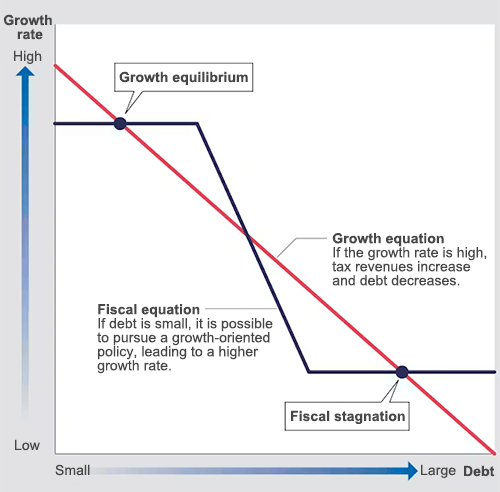
Outside of this theoretical framework, some studies suggested the possibility that an increase in government debt may cause growth rates to become stagnant due to concerns over future fiscal crises (e.g., a 2022 co-authored by Professor Kozo Ueda of Waseda University and myself). In order to escape fiscal stagnation, it is necessary to significantly reduce government debt. The paper co-authored by Fornaro argued that as a policy approach, it is necessary to choose one of two options—first implement fiscal austerity to reduce debt, or achieve economic growth through expansionary fiscal policy, reducing debt through increased tax revenue.
In Japan’s current situation, it may be said that with the massive accumulation of government debt, the country is moving toward fiscal stagnation. It is difficult to decide which path Japan should take to escape this situation. In theory, the strategy of pursuing growth through proactive fiscal policy would be effective if confidence in fiscal sustainability were present, while austerity should be implemented if there is no such confidence. However, it is not easy to determine the extent of such confidence among the Japanese people and companies.
When economic models do not provide such solutions, the only option is to examine the lessons of history. What is notable about Japan’s fiscal policy is the “responsible” part of “responsible and proactive public finances.” Reflecting on past policy failures, such as Japan’s decision to enter the war against the United States in 1941 and the postponement of the disposal of non-performing loans in the 1990s following the bursting of the economic bubble, there is a common pattern of entrusting the success or failure of a policy to events far beyond the control of the policymakers themselves.
Japan’s decision to wage war against the United States was predicated on the wishful thinking that an initial success by Japan would cause the United States to lose the will to fight and concede to an early truce. The problem was that the policymakers failed to prepare effective contingency plans for the case where their expectation for an early truce proved incorrect. In reality, American morale soared, while Japan had no plan other than to fight to the bitter end. In retrospect, we must say that the series of policy decisions that followed the outbreak of the war were irresponsible.
Regarding the disposal of non-performing loans in the 1990s, there were expectations that prices of assets such as stocks and land, which fell after the bubble burst, would rise again soon. The idea was that the non-performing loan problem caused by huge quantities of bad loans created by falling asset prices would be resolved if asset prices recovered. At that time, postponing the write-offs did not appear to be an irrational decision. However, the success or failure of the policy depended on asset price recovery, an exogenous factor outside of the government’s control.
As stock and land prices are determined by market forces, expecting swift price recovery is wishful thinking. In fact, both stock and land prices remained low, but no proactive contingency measures were taken and the authorities merely continued to react passively. Only when Japan faced the risk of a full-scale banking crisis in the autumn of 1997 and later, did the government embark on the initiative to fundamentally resuscitate the financial system. Even so, the disposal of the non-performing loans dragged on and the situation was only normalized in 2005. The fact that a period of as long as 15 years was wasted on foot-dragging over the non-performing loan problem left a long-lasting scar on the Japanese economy.
In the case of Sweden, where the bubble burst at around the same time as Japan, the disposal of non-performing loans was completed in roughly four years. Furthermore, the decision paralysis that continued in Japan in the 1990s, based on the idea that the non-performing loan problem was too overwhelming to deal with, corresponds to today’s feeling about government debt—that the debt is too large to be discussed realistically. For example, Richard Anton Braun, a senior professor at the National Graduate Institute for Policy Studies, in the Nikkei article published on December 11, 2013, pointed out that in order to stabilize the ratio of government debt to GDP, it might be necessary to raise the consumption tax as high as 53%, highlighting the difficulty of working out a realistic solution.
◆◆◆
Historical precedents demonstrate the following: making responsible policy decisions means anticipating what proactive measures may become necessary in the absence of good fortune. Whether expansionary fiscal policy can achieve economic growth by promoting private-sector investments and research and development activity depends on how private-sector companies respond. In other words, policy success or failure depends critically on market forces, which are beyond the policymaker’s control, as was true with past cases of failure.
Responsible fiscal policy requires demonstrating what fiscal policy will be pursued if the optimistic scenario fails to materialize. For example, it is advisable for the government to prepare a concrete revenue procurement plan, specifying how revenues will be recovered starting from a given year, if high growth is not realized despite expansionary fiscal policy.
Only when the Japanese people are firmly convinced that Japan’s economy and fiscal situation will be manageable regardless of what happens will they respond to expansionary fiscal policy and effectuate economic growth. Responsible policymaking requires providing such confidence.
>> Original text in Japanese
* Translated by RIETI.
February 10, 2026 Nihon Keizai Shimbun
