


Deterring shirking within organizations, providing appropriate performance incentives, and fostering cooperation, collaboration, and trust between workers are all essential considerations for businesses. Providing performance-based motivation is one of the core elements of organizational institutional design. Regarding compensation, there are various pay schemes, including piece rates, tournament systems, which determine the amount of pay based on relative rankings of co-workers, and revenue-sharing schemes. Previous research has shown that higher monetary incentives—that is, more intense intra-company competition—can increase workers’ effort choices and labor productivity. However, excessive levels of performance-based pay schemes also have the negative effect of generating large wage differentials within companies.
Substantial wage differentials not only cultivate non-cooperative norms in the workplace, but they can also trigger behavior that interferes with co-workers’ productive activities. Such counterproductive behavior is referred to as “sabotage.” If employees spend time engaging in sabotage rather than in activities that improve productivity, then morale and harmony in the workplace suffer. Edward Lazear (Note 1) argued that because sabotage is detrimental to companies’ productive activities, deliberately narrowing wage differentials between employees (pay compression) to curb sabotage may therefore serve corporate interests under certain conditions.
To what degree do large wage differentials trigger counterproductive behavior among workers? To what extent do people take sabotage risk into consideration when deciding which company to work for? Together with Professor Subhasish Dugar at the University of Utah, I conducted a field experiment in India to examine these questions (Note 2). Field experiments are generally considered to have higher external validity than traditional laboratory experiments (Note 3). In this column, I briefly introduce the results of that experiment. The findings suggest that people have a strong aversion to workplaces with strong norms of sabotage.
Economic experiments
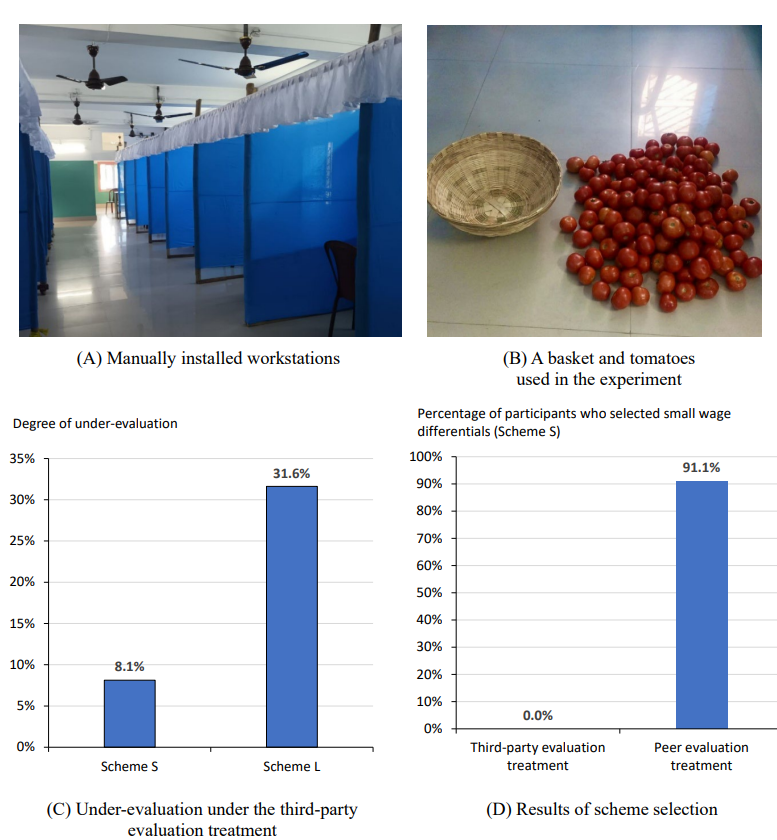
We recruited participants for the experiment from residents of nine villages in Basirhat in the Indian state of West Bengal. The experimental sessions were conducted in three cycles: December 2023, June 2024, and November 2024. Participants were adults (aged 18 or older) with at least six months of prior experience in vegetable or fruit packing. We solicited applications for a 60-minute shift of part-time work. As a result of recruiting, the participants had an average of 3.4 years of packing experience. On each day of the experiment, we rented a whole building and set up the workspace described in Panel A of Figure 1 on each floor, where participants packed tomatoes into baskets (Panel B). After the experiment, the packed tomatoes were transported for sale to nearby towns and the city of Kolkata, the capital of the state of West Bengal.
In the experiment, participants were randomly and anonymously assigned to groups of three, and each participants packed tomatoes independently. They performed the packing task three times. Compensation was determined by a tournament scheme based on participants’ relative performance rankings within each group.
In the first two stages, participants performed the packing work under the following two pay schemes in a randomized order: Scheme S featured a small wage differential, while Scheme L featured a large wage differential.
- Scheme S (Small): The top performer in each group was to receive 600 Indian rupees, and the other two group members were to receive 400 Indian rupees each.
- Scheme L (Large): The top performer in each group was to receive 1,000 Indian rupees, and the other two group members were to receive 200 Indian rupees each.
After experiencing both compensation schemes, participants chose which scheme they preferred to work under. They then performed a third packing task under their preferred scheme.
The purpose of this experiment was two-fold: (a) to examine the relationship between wage differentials and sabotage behavior, and (b) to examine the relationship between sabotage norms and workplace choice. To this end, we designed two treatments to vary the extent to which sabotage opportunities are available. Participants were randomly assigned to either treatment and completed the tomato-packing task only under the treatment to which they were assigned (between-subjects design).
The first treatment condition involved objective evaluation of participants’ performance by an independent third-party evaluator. The evaluator hired for this role had more than 10 years of packing work experience. The evaluator not only counted the number of tomatoes packed but also assessed the quality of the packing. Under this treatment, participants were unable to directly influence the performance evaluations of other participants. This treatment is referred to as “third-party evaluation” in this column.
The second treatment condition involved peer evaluation, in which group members evaluated each other’s performance. As in the first treatment, participants not only counted the number of tomatoes packed; they also rated the quality of each other’s packing. For each participant, performance was evaluated based on the average of the evaluations provided by the other two members within the group. We called this treatment “peer evaluation.” Under this treatment, participants could increase their own probability of winning by assigning unfairly low evaluations to others, creating a strong incentive for sabotage. To measure the extent of such under-evaluation in the peer evaluation treatment, the same independent evaluator who participated in the “third-party evaluation” treatment also independently and secretly assessed participants’ performance in this treatment.
Did sabotage behavior (measured by the degree of under-evaluation) differ between Schemes S and Scheme L? How did workers’ scheme preferences differ between the third-party evaluation treatment and the peer evaluation treatment?
Results and implications of the experiment
Overall, villagers who participated in the peer evaluation treatment assigned lower ratings to each other compared with the assessments by the third-party evaluator (Panel C of Figure 1). The degree of under-evaluation was an 8.1% decrease under Scheme S and a 31.6% decrease under Scheme L, indicating that sabotage becomes more prevalent as the tournament scheme becomes more unequal.
Sabotage norms in the work environment significantly affected people’s preferences over pay schemes. Under the third-party evaluation treatment, which eliminates opportunities for sabotage, all participants selected Scheme L – the scheme with greater wage inequality (Panel D of Figure 1). This suggests that experienced packaging workers prefer a system with strong performance-based incentives. Performance data from participants’ tomato-packing tasks conducted prior to their pay scheme choice suggest that they are able to achieve higher productivity under Scheme L than under Scheme S.
In contrast, under the peer evaluation treatment, in which sabotage was possible, 91.1% of participants selected Scheme S (which featured smaller pay differentials), due to their aversion to interference from other participants under Scheme L. In other words, participants’ scheme preferences differed markedly depending on the presence or absence of sabotage risk. This finding suggests that people have a strong aversion to work environments in which sabotage norms are strongly entrenched. It also suggests that institutional design of pay schemes that emphasize narrowing wage inequality and ensuring fairness (Lazear, 1989) may better align with workers’ preferences.
The reversal in preference has significant policy implications. The desirability of compensation systems may depend heavily on the monitoring environment of each workplace. In workplaces where employee performance can be objectively evaluated and co-worker sabotage is unlikely, tournament schemes involving large wage differentials may work well. However, in workplaces where monitoring or curbing sabotage proves challenging, alternative schemes or additional countermeasures may be necessary. The findings of our experiment suggest that narrowing wage differentials may foster workplace harmony and help attract more productive workers. Moreover, since people tend to value both fairness and high pay for better performance, realistically, it may be beneficial to design compensation schemes that limit opportunities for sabotage while maintaining appropriate performance-linked pay, possibly complemented by institutional mechanisms such as penalties (e.g., wage reductions) if sabotage is detected, in order to discourage such behavior from becoming entrenched as a workplace norm.
Companies cannot merely introduce strong performance-based systems or promote intra-firm competition without considering how people react. Our findings underscore the importance of enhancing the objectivity and transparency of personnel evaluation systems. For example, the use of external evaluators or the development of quantitative performance indicators may curb arbitrary under-evaluation and workplace sabotage. Moreover, the optimal design of compensation systems may depend on the nature of the work performed. For example, in workplaces where team-based production and collaboration are important, pay schemes based on team performance and policies that foster cooperation may improve worker productivity more effectively than pay systems that place excessive emphasis on competition between individual employees by introducing large pay disparities. In addition, developing appropriate corporate culture and workplace norms is an important policy issue. By cultivating and reinforcing norms that do not tolerate sabotage, organizations may create environments in which workers voluntarily refrain from counterproductive behavior. A collaborative and fair workplace environment can itself be a significant non-monetary attraction for workers. Designing competition systems without undermining cooperation, harmony, or morale is a critical challenge for corporate organizations.
[Click to enlarge]
May 21, 2026
>> Original text in Japanese
