



Smartphones have become an indispensable part of the infrastructure of everyday life. Through smartphones, we have access to a wide range of services, including social network services (SNS) and video streaming. Many people would find it difficult to go about their daily lives without constantly carrying a smartphone.
Against this backdrop, concerns have arisen over the fact that access to a wide variety of apps is controlled by the platforms operated by major IT companies. To address the competition policy issues stemming from this situation, the Act on Promotion of Competition for Specified Smartphone Software (the Mobile Software Competition Act (MSCA)) came into full effect in December 2025.
This article reviews the background to the enactment of the Act and examines its expected benefits as well as the challenges that remain.
◆◆◆
Foundational software, such as operating systems (OS), app stores, and search engines serve as gateway through which users acquire and use smartphone apps.
In Japan, the dominant smartphone OS are, Android, developed by Google, and Apple’s iOS. These platforms enable users to access the apps they need while maintaining level of security. In that respect, digital platforms play an important social role.
At the same time, concerns have been raised-particularly by smaller app developers-about the fact that this foundational software is controlled by only a handful of major IT companies.
These concerns include changes to contractual terms without adequate explanation or prior consultation; a lack of transparency in app review criteria; and the restriction that prevents developers from using payment systems other than those provided by platform operators, together with complaints that associated fees are excessively high.
If app developers are denied access to an app store, they lose a vital distribution channel for reaching users. Furthermore, if established platform operators prevent the use of alternative app stores or external payment services, competition among smartphone-based services may be weakened, ultimately reducing consumer choice and convenience.
Although such concerns could be addressed under the Anti-Monopoly Act, it is often difficult for competition authorities to detect problematic conduct in a digital market from outside the platform.
Much of the information relating to contract terms, app review criteria, search results, and the mechanisms governing the display of apps is held by platform operators. As a result, it has been considered difficult for the conventional approach-under which information is collected and individual violations are established only after anti-competitive conduct has occurred-to deal adequately with such conduct or to provide prompt relief for the resulting harm.
The MSCA has two principal features designed to address these challenges.
First, the Act establishes, in advance, certain prohibited conduct and compliance obligations for designated platform operators, namely Apple, its subsidiary iTunes, and Google. Specifically, it provides nine categories of prohibited conduct, including prohibiting interference with the provision of alternative app stores, and five compliance obligations, including measures requiring the disclosure of changes to technical specifications.
Violations of these ex-ante regulations are subject to administrative surcharges of up to 20% of relevant sales, a rate that is higher than that under the Anti-Monopoly Act. The purpose is to enhance the effectiveness of regulation against market-dominant conduct by major IT companies.
On the other hand, if ex ante regulation is applied too rigidly, it may hinder innovation in the mobile market. For this reason, the MSCA does not simply detect and sanction violations, as under the conventional framework of the Anti-Monopoly Act. Instead, it introduces a mechanism under which competition authorities engage in continuous dialogue with designated platform operators and encourages improvements in their business models and business practices. This represents the second key feature of the MSCA and may be described as “public-private joint regulation.”
More specifically, the designated platform operators are required to submit compliance reports, while the Japan Fair Trade Commission (JFTC) reviews their contents in light of information provided by app developers and other stakeholders. Where problems are identified through this process of continuous monitoring, the JFTC encourages voluntary improvements.
In other words, rather than unilaterally issuing administrative orders, the Act seeks to encourage changes in the behavior of designated platform operators through dialogue with them.
Although these initiatives have only recently begun, signs of behavioral changes are already beginning to emerge among designated platform operators. Some improvements have been made with respect to app store commissions and the use of third-party services (see the table below). While some of these changes reflect compliance with regulatory developments in overseas jurisdictions, it is nevertheless noteworthy that broader changes are beginning to emerge in the competition environment surrounding app distribution in Japan.
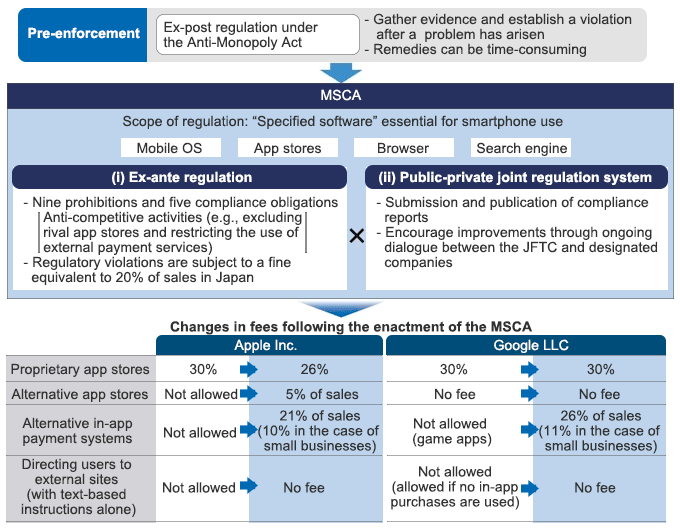
Note: The fees are imposed on app developers.
◆◆◆
In Japan, where many app developers, including game companies, are active, there has long been strong interest in the terms of conditions governing app stores. In particular, concerns have focused on the so-called abuse of a superior bargaining position, where platform operators unilaterally impose unfair terms on businesses that are in a weaker bargaining position.
In December 2018, in response to these concerns, Japan became the first country in the world to establish basic principles for developing rules governing platform operators.
Building on these basic principles, the Act on Improving Transparency and Fairness of Digital Platforms (the Transparency Act) was enacted in 2020. The Act requires platform operators to disclose their transaction terms, establish systems for handling complaints, and submit reports on their operational practices. By reviewing and evaluating these reports, the Ministry of Economy, Trade and Industry (METI) has sought to encourage voluntary improvements by platform operators.
Initially, the Act applied to large-scale online malls and app stores. In 2022, its scope was expanded to include digital advertising.
Building on these earlier regulatory efforts, the MSCA introduced clearly defined prohibited conduct and substantial administrative surcharges. This represents a major step forward in Japan's regulation of digital markets. The MSCA may be regarded as combining the ex- ante regulatory approach of the European Union’s Digital Markets Act with the public-private co-regulatory approach pioneered in Japan under the Transparency Act.
The MSCA stipulates a review process after three years of operation. Looking ahead, a key challenge will be how to establish a more comprehensive legal framework suited to a digital society.
Competition issues in digital markets are not confined to smartphones. Personal computers and tablets are also important channels through which digital services are provided, and new types of devices such as wearables may become widely adopted in the future.
In addition, the Transparency Act, which was enacted prior to the MSCA, applies only to certain sectors including large-scale online shopping malls and digital advertising. As new business models and forms of market dominance emerge, questions remain as to how flexibly the law will be able to respond.
The essential concerns arising from the market power of digital platforms do not change depending on the communications medium or business models; they should be understood as issues affecting digital markets as a whole. From this perspective, one cannot help but feel that the scope of both the Transparency Act and the MSCA have been unduly narrowed.
As generative AI (artificial intelligence) spread rapidly, the competitive landscape surrounding digital platforms will continue to evolve. Japan needs to further develop its own regulatory framework that secures competitive environment while achieving a balance between user convenience and the promotion of innovation.
At the same time, it is necessary to deepen discussion toward a comprehensive regulatory framework that is appropriate for consumers and businesses in Japan while maintaining coordination with global regulatory trends.
>> Original text in Japanese
* Translated by RIETI.
June 4, 2026 Nihon Keizai Shimbun
