



Social implementation, or the materialization of R&D results into real-world applications, takes an extremely long time in the field of healthcare (including drug development, medical devices, health-tech, etc.). What can then be done to ensure that academic R&D effectively leads to social implementation?
As the final installment of a three-part series on healthcare ecosystem development, I recently wrote a report titled “Key Points of Social Implementation in Healthcare Development” (Note 1; referred to hereafter as “the Report”), based on an awareness of the current challenges facing Japan. I will introduce the key points of the report below.
1. Science and the Exit
In the field of healthcare, it is often pointed out that Japan excels in science, with many Nobel laureates, but is weak when it comes to translating research into practical applications.
I also agree with this, but I wonder why Japan faces this problem, considering that the efforts by individual academic institutions do not seem to be significantly lacking.
One approach to addressing this problem would be for external experts to provide support, and this is likely the best solution for Japan at present.
However, compared with overseas modalities, this is not necessarily a major approach in the field of healthcare. Instead, addressing these problems within academia seems to be more common. Why this has not become the norm in Japan has not been sufficiently discussed.
My basic position is that researchers should devote themselves to science. While it is of course desirable for researchers to have a certain understanding of social implementation and commercialization processes and business issues, they do not necessarily need to be experts.
Nevertheless, researchers will not reach the "exit" without some expertise. The "exit" is, in essence, how products and services are delivered to patients. A startup exiting through an M&A is one way of reaching an exit, but strictly speaking, this is not the true exit if the objective is returning R&D benefits to patients.
In that sense, there isn’t a large gap between what researchers are pursuing and the end goal I define here. However, as the path to the end goal is both very long and technical, a disconnect often occurs between research and social implementation.
2. Divergence between Academia and Business
Next, let us consider how the finance sector and business companies view opportunities originating from academia.
From the finance sector perspective, depending on the venture capital (VC) firm’s approach, investors examine what data sets or clinical study processes are required in developing a drug or medical device, what processes must be followed and timelines this implies.
On the other hand, corporations will flexibly adjust their individual portfolios and will consider, for example, in conducting an M&A, how to incorporate projects supported from a VC perspective into their development pipelines.
These business perspectives are often unfamiliar to academia, resulting in a divergence between projects emerging from academia and criteria prioritized by businesses.
To eliminate this divergence within academia, several elements are required. Questions of who will bring a project into the clinical study process and how this will be done are always points of contention. However, practical knowledge in areas such as technology transfer and IP (intellectual property) protection are indispensable to that process.
Furthermore, knowledge related to managing projects for commercialization is also necessary. This includes skills in project management, fundraising, and organizational operations.
Such knowledge and skills are not natural extensions of individual researchers’ career paths.
3. Individuals, Organizations, and Society
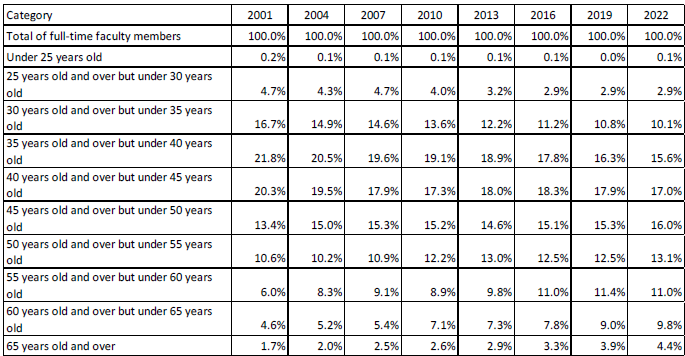
Figure 1 shows a decline in the percentage of young faculty members at universities, which suggests that their career paths may become increasingly constrained because posts are limited to some extent.
If career paths as researchers can be diversified, new roles could emerge beyond leading research and development, including providing education and project support capabilities that facilitate social implementation through tech transfer and IP protection activities.
If that becomes possible, in addition to individual researchers deepening their scientific expertise, it will be important for them to learn what is required to bring research outcomes to the practical application stage in order to reach an exit.
On an organizational level, each institution needs to develop systems to continuously foster personnel capable of selecting, promoting, and supporting projects from the perspective of social implementation. Actions toward this outcome are gradually being prepared, but they should preferably be developed in ways that are consistent with researchers’ career paths. Collaboration industry and foreign institutions will also be necessary.
At the societal level, instead of leaving these initiatives to individual organizations, universities and research institutions should work together to carry out initiatives, avoiding fragmented or isolated approaches to related education and human resources development. With this framework, promoting the return of talent from overseas will also be important.
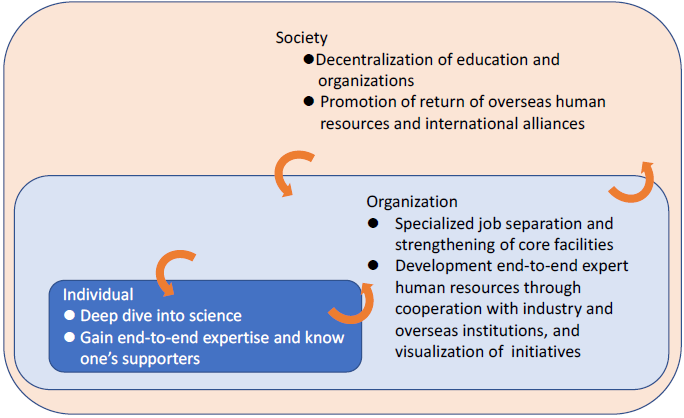
Figure 2 shows the relationships among individuals, organizations, and society. Because the challenges are difficult, individuals, organizations, and society need to complement one another.
The growth of individuals contributes to the energizing and revitalization of organizations, and collaboration among organizations facilitates societal development. Society supports collaboration among organizations, and organizations support the growth of individuals.
The continuation of this cycle will effectively promote social implementation in the field of healthcare.
August 5, 2026
>> Original text in Japanese
