



As nearly four years have passed since the release of ChatGPT in November 2022, the use of generative artificial intelligence (AI) has become widespread among both individuals and companies. In the past year or two, AI agents and physical AI focused on automation have attracted significant attention.
While expectations for AI are growing stronger, concerns and pessimism about AI’s economic and social impacts seem to be rising. At this point, I would like to reconsider the impacts of AI on the economy and society in light of the latest academic research.
◆◆◆
A recent notable development is runaway AI. In July, an incident occurred where an AI system under development by OpenAI in the United States launched a cyberattack contrary to the intentions of its controllers. As OpenAI CEO Sam Altman has pointed out, it is no exaggeration to say that the “singularity,” a turning point where AI gets out of human control through its explosive evolution, has grown increasingly realistic.
In another notable trend, major U.S. tech companies have been accelerating their personnel downsizing, laying off thousands of employees. There are also reports that young people in Generation Z in the United States are opting not to pursue four-year university degrees, instead aiming to obtain vocational qualifications for blue-collar jobs such as electrical work, plumbing, welding, and air conditioning at community colleges and vocational schools. Many observers believe that this appears to signal the long-feared arrival of an era in which AI displaces white-collar workers.
However, caution is needed regarding employment trends. Some analysts argue that companies are engaging in “AI washing,” blaming AI as the reason for layoffs, when in fact excess staffing from previous over-hiring and slowing growth are to blame. Even when AI is presented as the explanation, there are many cases in which companies use layoffs to free up resources for AI investment, rather than replacing workers themselves with AI.
Additionally, young people began to seek skilled trade jobs before the introduction of generative AI, citing excessive student loan repayment pressures for university as a factor behind their pursuit of vocational qualifications for skilled trades.
To accurately understand the impact of AI on employment, we must refer to the growing body of academic research accumulated since the introduction of generative AI, based on real data. Here, I would like to discuss three key findings from empirical studies on the impact of generative AI on employment mainly focusing on the U.S.
First, multiple studies have found clear employment declines among (1) entry-level young workers (aged 22-25) and (2) freelancers (including highly skilled workers) in the online labor market for jobs that are susceptible to AI, although no significant impact on overall employment has been observed. This finding can be interpreted as demonstrating that workers with less tacit knowledge tied to their specific companies or organizations are more likely to be replaced by AI.
Second, findings show that performance improvements through generative AI are often higher among low-skilled employees than among high-skilled ones. They indicate that AI, unlike previous technological innovations, potentially works toward narrowing skill-based disparities among workers.
Third, researchers have begun to reevaluate the simple approach of linking each job’s average AI exposure rate (an average of AI replacement rates for tasks constituting each job) to estimate job-loss potential, based on the awareness that each job consists of interconnected tasks.
Tasks within a job do not exist in isolation. If one task is automated, the value of others may increase, allowing the workers to devote more time to them, in effect increasing the wages for that occupation.
In fact, recent research constructed two indicators for each occupation: the average AI exposure rate by task for each job and the concentration of AI exposure labor on certain tasks, finding that that the former tends to decrease employment, while the latter tends to increase employment. The finding clearly shows that workers may redistribute their efforts to tasks that are difficult to automate and shift priority to them, offsetting any reduction in demand for the relevant job.
In 2016, Geoffrey Hinton, often referred to as the “godfather of AI,” argued that because deep learning would surpass the skills of radiologists within five years, training new radiologists should be stopped. How does this prediction look 10 years later?
In fact, both demand and salary levels for radiologists have increased since then. Although this is largely because AI can only replace some of a radiologist’s tasks, researchers also cite limitations of AI-based radiological diagnosis and lingering distrust in fully autonomous models as factors. This case clearly indicates that AI experts cannot foresee all impacts of AI.
The impact of AI on employment and related issues changes depending on which specific tasks within a job are replaced (see the figure). If highly specialized tasks are automated, the expertise requirements for that job may in fact decrease, allowing inexpert workers to enter the occupation (increasing employment) while creating downward pressure on wages.
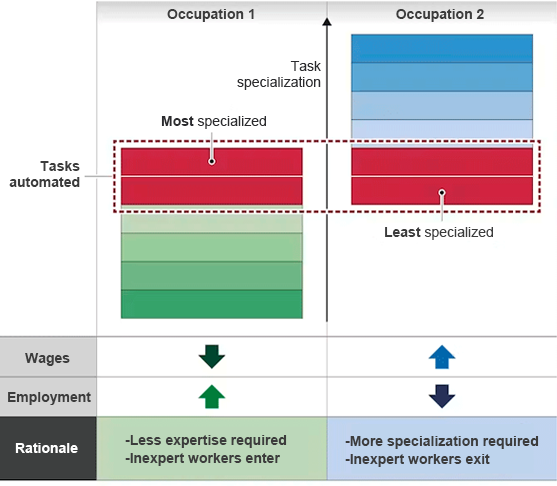
If lower-skill tasks are automated, lower-skilled workers will be forced to exit the occupation (reducing employment), requiring more specialization in the occupation and increasing wages. In reality, both types of automation are occurring simultaneously, making it difficult to determine the impact of AI on employment.
Discussions of the impact of AI on employment are always met with pessimism. However, any job consists of multiple tasks and not all of them can be automated. No matter how much AI advances, moreover, we should not forget the principle that technological advances in AI can create new occupations, drive growth in AI-using companies, and increase related employment.
◆◆◆
On the other hand, there is a matter of concern that should be taken even more seriously than AI’s impact on employment: the negative impact of AI on knowledge accumulation. Recent theoretical research has shown the possibility of a “knowledge collapse,” where general knowledge shared across society may be lost as people’s reliance on AI continues to increase. In essence, human reliance on AI for acquiring contextual knowledge that would otherwise be done through personal effort could lead to a decline in individual knowledge production, affecting the stock of knowledge shared by society.
Some theoretical research has found that AI automation for entry-level young workers inhibits the important mechanism of economic growth where young workers contribute by assisting experienced workers, learning directly from them, and acquiring tacit knowledge that is shared and disseminated widely throughout the economy.
Using experiments in which university students were randomly grouped by whether they had access to AI, research confirmed that the group of students with unlimited access to AI exhibited less interest in learning and weaker understanding of course materials.
In this context, professor David Autor of the Massachusetts Institute of Technology and colleagues recently released a paper warning about a widespread concept of giving top priority to using AI for automation.
The paper emphasizes the role of AI as “collaborator” which enhances human judgment, enables new tasks, and accelerates skill acquisition rather than a substitute for human labor, and calls for promoting AI investment that benefits workers. This is a recommendation that is worthy of consideration.
>> Original text in Japanese
* Translated by RIETI.
September 15, 2026 Nihon Keizai Shimbun
