



In any era, universities have played a significant role as a bridge to society. However, the environment surrounding universities is becoming increasingly difficult.
Since the 1990s, despite an annual decline in the population of 18-year-olds, the number of universities continued to rise. In light of the current shortfall in the number of enrolled students relative to the admission capacity at more than half of all private universities, the Ministry of Finance has indicated that by 2040 it will be necessary to reduce the number of universities by at least around 250.
Within this context, the total number of four-year women’s universities in particular declined by around 30% from the peak of 98 in 1998 to 66 in 2025, because of such factors as a shift to co-education, the discontinuation of new admissions, and school closures. While both co-educational universities and women’s universities must consider strategies for survival, some women’s universities in particular have begun to launch new human resources development initiatives.
◆◆◆
First, Nara Women’s University, Ochanomizu University, and Japan Women’s University have established engineering faculties. Second is a rush to design data-science faculties, beginning with Kyoto Women’s University, followed by Otsuma Women’s University, where I teach, and Showa Women’s University. In this column, amid the continuing trend toward coeducation, I consider from an economics perspective what advantages women’s universities offer.
In the United States as well, the number of women’s universities has fallen from more than 200 in the 1960s to approximately 30 in recent years. Among them, the most prestigious are the seven colleges known as the “Seven Sisters,” of which five have retained their status as female-only universities and maintained their prominence.
A prime example is Wellesley College, the alma mater of former Secretaries of State Hilary Clinton and Madeleine Albright. It is a small liberal arts university characterized by small classes and close relationships between faculty and students.
Notably, Wellesley has achieved significant results in terms of leadership education. Because students can take on leadership roles in campus institutions, organizations, and projects, they have more opportunities to gain leadership experience. According to the Women’s College Coalition, around one-third of all female board members of Fortune 1000 companies and more than 20% of all female members of the U.S. Congress are alumni of women’s universities.
From those data, some people may conclude that women’s universities are effective in fostering leadership. However, one must be cautious of the possibility of self-selection bias. In other words, rather than this university education creating this effect, it is possible that students who already possess these high leadership skills choose those universities. In that sense, simple, direct comparisons between women’s universities and coeducational institutions is not appropriate.
Strictly analyzing what differences may exist between female-only education and coeducation, for institutions at various ages and levels of education, requires an empirical analysis conducted in a natural experiment environment—that is, in this case, a situation where students are randomly assigned to either women’s universities or coeducational institutions. Naturally, in the real world, there are very few situations like this, but particularly in economics, research using these methods has become the mainstream since the 2010s in single-gender educational research. Let us look at some concrete examples.
At a certain Swiss coeducation high school, due to an excess of female students, female students are randomly assigned to either co-educational classes or female-only classes. An analysis using this natural experiment environment found that female students assigned to female-only classes showed improved performance in mathematics, with that effect being more prominent among female students who already possessed a high level of mathematical skills.
At a British coeducational university, students who had finished the first year were randomly assigned to attend, for one hour each week off campus, a male-only class, a female-only class, or a coeducational class and their subsequent progress was analyzed. The results found that students in the female-only class achieved higher grades and credit acquisition rates than coeducational class attendees, but their submission rates for voluntary assignments and attendance were also higher than among those in the coeducation class. In the case of male subject students, no such differences were observed.
A case in Seoul became the subject of analysis for many empirical studies due to its suitability in terms of being a natural experiment.
In South Korea, since 1974, a high school equalization policy was introduced in order to correct inequalities in educational opportunity. In Seoul, where the proportion of single-gender schools was particularly high, students were randomly assigned by lottery within their school district to male-only schools, female-only schools, or coeducational schools. This creates an environment that is very similar to a natural experiment, providing researchers with an ideal environment to examine the effects of single-gender education, leading to a large body of research.
Despite this situation, studies conducted until the 2020s did not show particularly strong positive effects of single-sex education, unlike natural experiments in other countries. Rather, analyses using long-term data indicated that women who had attended single-sex schools received significantly lower future incomes.
In contrast, looking at new empirical research published over the past few years, while no clear effects have been observed for boys, an increasing number of studies have shown positive effects for girls in single-sex education. For example, while it is generally known that women tend to avoid competition more than men, it was found that female students in single-sex education showed marked improvements in academic performance (particularly in mathematics) in competitive and stressful situations, such as when preparing for college entrance exams.
There are also some studies showing that among female students in single-sex education, those with high academic achievement show greater benefits in psychological well-being and are thus more likely to benefit from such single-sex environments. Other studies have shown that female students receiving single-sex education have a higher political participation awareness and are more likely to take on leadership roles.
◆◆◆
Meanwhile, what are the long-term effects of single-sex education for girls and women? According to an analysis controlling for school districts and cohort effects, single-sex education had positive effects only in the case of female students, with the income level for those who studied at female-only institutions being 12 to 16% higher compared with those who studied at coeducational institutions. That is influenced by the fact that women who graduate from female-only high schools tend to have higher levels of education and longer periods of vocational training.
According to an analysis that focused on various life outcomes in addition to wages, women in their 30s and 40s who received female-only education are more likely to have higher educational attainment; work full-time; have a stronger preference for competition and risk; and have a positive stance toward working mothers. Since this analysis targeted particular countries/regions, careful interpretation of the findings is necessary. Even so, as it concerns an Asian country where gender role divisions are generally stronger than in Western countries, the findings can be considered relevant to Japan.
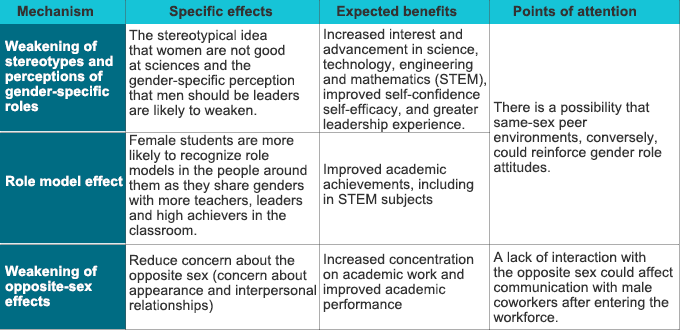
The usual explanation offered for the positive effects of female-only education is that female students are free of the stereotypes of women being not good at STEM, the gender-specific role expectation that leadership roles should be taken by men, and from the presence of the opposite sex, a factor that could undermine commitment to academic work (see the table above). On the other hand, regarding negative effects, it has been pointed out that problems could arise with respect to communication with male coworkers in the workplace due to a lack of such experience.
However, high-achieving women who graduated from coeducation institutions in particular might have the tendency to consciously restrain themselves and defer to men in a tacit manner. On the other hand, for women, gaining confidence and self-efficacy in a single-sex environment, and becoming able to actively engage with the opposite sex may encourage a different form of communication and engagement.
>> Original text in Japanese
* Translated by RIETI.
May 12, 2026 Nihon Keizai Shimbun
