



In the academic year 2026, a total of 38 national and other public universities adopted a so-called “female student quota” for admission into STEM (science, technology, engineering and mathematics) undergraduate courses. On social media, the rapid expansion of the female student quota program raised relentless criticism for “reverse discrimination” against male student applicants. Proponents of the female student quota point out that female students face constraints in educational and career choices.
To consider this issue, it is necessary to answer three questions. First, is there a gender gap in enrollment in STEM courses? Second, is there a need for policy action, and if so, is there a need and scope for taking such action? Third, if policy action is to be taken to resolve the gap, is creating a female student quota an effective approach?
◆◆◆
The existence of a gender gap in enrollment is a fact (see the figure below). Compared with the situations in other countries, Japan has a particularly low percentage of females enrolling in STEM courses. Importantly this gap cannot be fully explained by gender differences in academic performance or subject preference. Researchers point to external factors that distort female students’ decision-making, such as stereotypes prevalent among teachers and parents and a lack of female role models.
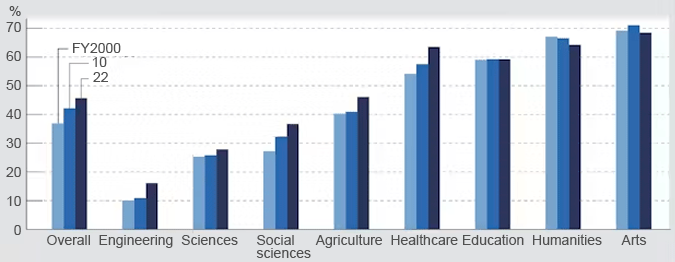
In a large-scale experiment conducted in France, an hourlong speech delivered by a female researcher at a senior high school led to a statistically significant increase in the number of female students who chose to enroll in STEM courses. This suggests that there is scope for policy intervention to influence educational changes.
Is introducing the female student quota an effective policy measure? To answer this question, it is useful to draw on the extensive body of economic research conducted with respect to affirmative action programs adopted in university admissions in the United States. Most of those studies focused on preferential measures targeted at specific racial groups, such as African Americans, but many of the underlying issues also apply to gender-based preference.
Affirmative action aims to resolve inequality by enabling beneficiary students to enroll in universities that provide education of higher quality. Beneficiaries can accumulate human capital in a favorable educational environment, and after graduation, they can find better jobs and earn higher incomes. That is known as the “quality effect” of affirmative action.
On the other hand, if students are admitted into highly selective universities where their actual academic preparation falls short of their peers, they could be forced to repeat a year, change majors, or drop out due to underperformance. This is known as the “mismatch effect.”
Whether or not individual students actually benefit from affirmative action depends on which of these two effects is stronger. The consensus conclusion from past studies is that while the quality effect certainly exists, the mismatch effect is not necessarily significant.
However, findings concerning the effects in STEM courses are more mixed. Several studies have shown that the negative effects of the mismatch effect are far from negligible in STEM fields. That is because subjects such as mathematics require cumulative learning and are mandatory requirements in those courses, making it difficult for students who fall behind in the first year to catch up later.
In the U. S., a federal Supreme Court ruling in 2023 determined that the use of race-specific affirmative action in university admissions is unconstitutional. One reason cited was the ambiguity regarding how long and to what extent race should be considered as a factor for admission before the policy could be regarded as achieved? Another point cited as a problem with race-specific affirmative action is that given the fixed capacity of regular admissions, providing preferential treatment on the basis of race to some applicants inevitably puts others at a disadvantage on the same basis, which is also problematic.
Regarding gender, a U.S. federal education law known as Title IX [A2.1]prohibits gender-based discrimination in public education, so it is impossible for public universities to introduce the equivalent of a female student quota in admissions. Therefore, there is no influential research that verifies causal effects of gender-based affirmative action using U.S. data.
◆◆◆
With respect to gender-specific affirmative action, two studies examining gender-based affirmative action programs in India and Chile, respectively, have identified the causal effects of female quotas, and their findings are very insightful.
Institutes of technology in a certain Indian state introduced a program with quotas for different caste groups, also allocating a third of each caste quota to female applicants. A research paper that examined the consequences of this program based on data concerning some 120,000 test-takers presented the following three findings.
First, the program increased university enrollment among women belonging to socially disadvantaged castes, who would not have enrolled in STEM courses otherwise. Secondly, the program enabled more women to enroll in higher-quality universities.
Third, there was little evidence of mismatch effect. Rather, women who received preferential treatment under the program were more likely than non-beneficiaries to show improved performance in standardized tests taken at the end of the freshman year. In addition, female beneficiaries were more likely to apply for highly competitive majors, such as electronics and telecommunications engineering.
However, the study also clearly demonstrates the costs of the program. As a result of the program, 5,702 male students and 1,053 female students belonging to upper castes were put at a disadvantage. Those students either failed to advance to university or enrolled in lower-quality university and showed reduced performance in standardized tests taken at the end of the freshman year. Given the fixed regular admission capacity, if more beneficiaries of the program are admitted, the number of non-beneficiaries admitted also decreased.
The findings in Chile provided a contrast to the results in India. The program introduced in the academic year 2024 created a women’s quota in the form of additional admissions above the regular admission capacity, rather than allocating a certain portion of the regular admission capacity to female students. First, the regular admission capacity was filled with students admitted in the descending order of test scores regardless of gender, and then, from among the female students who failed to pass the cut-off point, additional students were admitted, up to the equivalent of 20% of the regular intake. Individual universities decided whether to adopt the female student quota and for which faculties.
Research taking advantage of this situation found that the percentage of female students in total admissions rose by between two and four points for faculties that adopted the female student quota. Conversely, the percentage of female students declined in faculties that did not adopt the quotas, meaning that the overall number of female students in STEM fields did not increase. In short, merely creating female student quotas does not automatically lead to an increase in women’s enrollment in STEM courses.
On the other hand, the percentage of female students admitted through regular admissions processes to highly selective universities also increased by approximately 3 percentage points. This suggests the possibility that creating the female student quota may have changed application behavior among women who previously had not considered elite universities as viable options.
The women’s quota may have functioned less as a relaxation of admissions standards and more as a signal encouraging female students to change their application behavior. A program which introduces additional admissions above the regular admission capacity, like the one in Chile, is worth considering, although it may be difficult to adopt such a program in Japan, where the regular admission capacity is strictly controlled for the moment.
If individual universities intend to maintain female student quotas in the future, they should also indicate what criteria would constitute success and provide justification for ending the quotas. Regarding Japan, it is not clear whether the quality effect or the mismatch effect is stronger. It is important to conduct follow-up surveys on the beneficiaries’ post-admission academic performance and performance until graduation so that the policy’s effects can be rigorously verified.
If the findings of follow-up surveys raise concerns over the mismatch effect, it will be necessary to take measures to minimize the effect. Multiple studies have shown that on the whole, academically weaker students tend to underestimate the extent to which their pre-admission academic preparation affects post-admission performance.
Universities could disclose to applicants how differences in the probability of graduation after four years of study varies by the level of pre-admission academic preparation, avoid applications based on unrealistic expectations. Disclosure would not only discourage unprepared applicants. It could encourage female students who have underestimated their own abilities to make more ambitious application decisions.
Japanese female students perform just as well as male students in mathematics and science. Therefore, it is necessary to continue efforts to encourage more female students to aspire to join STEM fields, inside or outside the admissions process.
Inequality in university admissions is not limited to gender. In England, contextual admissions policies evaluate applicants’ academic achievements together with their socioeconomic and educational backgrounds. In Japan, too, how to address disadvantages unrelated to gender is an issue that deserves discussion, but separately from the debate over female quotas.
>> Original text in Japanese
* Translated by RIETI.
September 21, 2026 Nihon Keizai Shimbun
