


Starting this summer, days with maximum temperatures exceeding 40℃ are defined as “extreme heat days.” Climate change risks are no longer distant future threats. The decline in labor productivity caused by heat stroke has become a real threat directly affecting companies’ daily business operations.
In reality, analysis of human mobility data by spatial unit shows that a temperature increase of merely 1℃ results in approximately 400,000 fewer outings in central Tokyo. Clearly, a visible economic loss is already occurring.
Additionally, concerns over a stable supply of fossil fuel triggered by geopolitical instability are forcing changes in the energy structure from the perspective of economic security.
With growing interest in climate change issues, what viewpoints should business owners and policymakers adopt? They definitely must break away from treating environmental obligations as merely “paper-based disclosure” (such as compliance with the European Corporate Sustainability Reporting Directive (CSRD)).
The challenge now is appropriately predicting substantial financial risks and proactively reshaping supply chains. What is necessary is autonomous, action-based sustainability management. Disclosure is not the goal, but merely a starting point.
◆◆◆
The United Nations (UN) is now developing indicators of wealth, or the Inclusive Wealth Index, which extends beyond Gross Domestic Product (GDP), as a core of next-generation Sustainable Development Goals (post-SDGs). Related global initiatives have already begun.
For years, economic prosperity has been measured only by GDP as a flow of value created in one year. However, now that the climate crisis and collapse of ecosystems are becoming increasingly serious, GDP no longer adequately serves as an indication of the true sustainability of a nation or company.
A more all-encompassing viewpoint is required. The “Inclusive Wealth Index” combines three types of capital stocks, namely, physical capital (infrastructure, etc.), human capital (health and education), and natural capital (forests, water, resources, etc.). This represents a comprehensive evaluation of prosperity (Beyond GDP).
In a UN report submitted this May, “Beyond GDP” is officially positioned as an indicator of sustainability and resilience.
If GDP corresponds to a company’s sales for the current term, the new Inclusive Wealth Index corresponds to its net assets. Even if the sales increase, if a company exhausts its assets, the business is not sustainable.
The same logic applies to nations and local communities. Deforestation may provide income, but if natural capital disappears, long-term wealth declines. GDP hides this relationship.
Research targeting 38 nations and regions conducted by the author and colleagues revealed that the richness of human and natural capital in the region where a company is located has a positive impact on the share prices. In short, investments that support healthy communities and resilient ecosystems work to enhance the corporate value of companies located in that local community in the long term.
That point is further illustrated by another case where the opposite was true. In 2020, Rio Tinto, a leading global mining company based in the UK and Australia, upon expanding its iron ore mine in Australia, destroyed natural capital, including Aboriginal cultural heritage sites, which drew international condemnation. The development project was legal, but that company’s management approach triggered backlash among institutional investors.
As a result, Rio Tinto’s share prices declined and senior executives were forced to resign. This case showed that the destruction of natural capital is no longer only a reputational risk; it has evolved into a risk that can undermine the foundation corporate value.
What, then. should companies do specifically? First, they should focus on developing forecasting technologies for assessing future risks.
We created a system that used proprietary generative AI to forecast monthly temperatures and demographics up until 2050 at the world’s finest spatial resolution (a 5-kilometer square grid).
The system enables us to ascertain future summer heat conditions and population trends at the regional level five to twenty years in the future, and the results may be utilized in planning infrastructure projects and procurement strategies. Unlike conventional climate models that only provide mean values at the national or regional level, our system makes it possible to estimate climate impacts for each factory or distribution base.
For example, a forecast by the UN only shows that the average temperature in August 2050 in the Kanto region will be 34.5℃. On the other hand, our system forecasts more specifically that the average temperature around Nogata Station in Nakano Ward, Tokyo, will be 40.9℃ (see the Figure below). Real-world decision making requires data at a level of specific addresses, and therefore, it is important to make data more granular.
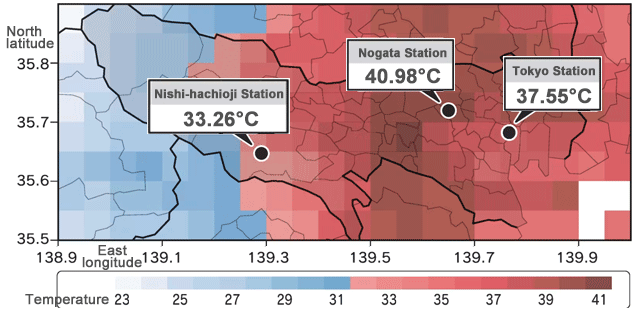
Using this system makes it possible for individual companies to specifically identify areas along their supply chains where productivity losses due to extreme heat are likely to occur in the future. They will be able to map out their suppliers’ risks in advance.
In the meantime, the Corporate Sustainability Due Diligence Directive (CSDDD) was enshrined into law in Europe. Simply delivering questionnaires to subcontractors is increasingly seen as an unreasonable burden. Without substantial action, an initiative may be deemed “greenwashing” and subject to a financial penalty.
◆◆◆
Japanese companies cannot treat this as somebody else’s problem. They need to incorporate highly accurate AI forecasting into the foundation of risk management, identify genuinely high-risk regions and suppliers, and engage in meaningful dialogue and improvement efforts.
Collaborative emissions-trading schemes between local governments and companies, and construction of smart cities that digitally predict urban wellbeing have been implemented in various locations. These initiatives are not merely environmental measures; they have an influence on the cities’ competitiveness and residents’ quality of life.
The key is to ascertain physical environmental changes through objective data, quantify changes in human capital and natural capital in monetary terms, and reflect the results in business decisions. Establishing such forecast- and action-based management indicators will be essential for overcoming the climate crisis and driving quality growth.
These initiatives are not only for large companies or large cities. They raise extremely important questions especially for local governments that are facing rapid population decline.
In the same manner as climate change, we also forecast population trends until 2100 at a resolution of 500 square meters. The future shown as a result of the forecast was severe. The population will continue declining drastically across most areas in Japan.
Faced with this fact, regional cities should squarely accept a fundamental truth in their survival strategies: natural capital is their greatest asset.
Because rich natural environments remain, rural areas can ensure economic viability by employing new measures such as the carbon credit system that visualizes and monetizes CO2 emissions, and the nature credit system, which makes the ecological value of the ocean and village forest landscapes visible. In the private sector, multiple regions have already begun creating and trading those credits.
If companies agree with the value of natural capital and commit seriously to regional revitalization, benefits extend beyond economics. New industries and communities are created at relevant locations, nurturing future generations of leaders. Investment in natural capital is inherently also an investment in human capital.
The transition occurring now is from a 20th-century model of management aiming to maximize the flow of GDP to a 21st-century model focusing on cultivating stocks, namely, human capital, natural capital, and physical capital. Only companies and nations that anticipate and succeed in this shift will possess true competitiveness in the world of 2050. The extremely hot summers of today confront us with that major turning point.
>> Original text in Japanese
* Translated by RIETI.
July 29, 2026 Nihon Keizai Shimbun
