



The Basic Policy on Economic and Fiscal Management and Reform 2026 was published. Major developed countries are implementing industrial policies involving large-scale fiscal expenditures. The basic premise of the Basic Policy is that in light of that trend, the government should also exercise initiative in promoting investments in strategic sectors in Japan.
This article provides an overview of the current status of investments in Japan. It then assesses whether the Basic Policy can lead to sustainable wage increases.
The figure below shows the capital investments and investments in intangible assets by private-sector companies as a proportion of gross domestic product (GDP).
According to the figure, since 2010, capital investment as a proportion of GDP has been trending upward. This mainly reflects an increase in computer software investment. On the other hand, investment in intangible assets other than research and development and computer software has remained on a downward trend.
As shown in the figure below, investment in intangible assets in Japan as a proportion of GDP is small compared with the amounts in the United States and Germany. In particular, investments in human resources and organizational restructuring are notably low.
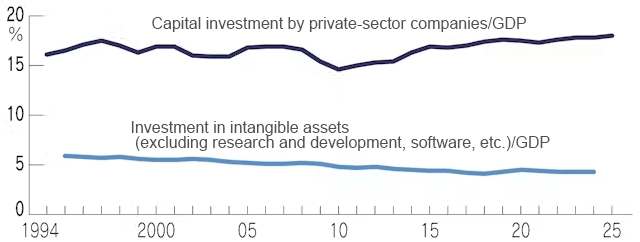
Source: Prepared by the author from the System of National Accounts, published by the Cabinet Office, and JIP Database 2026, published by the Research Institute of Economy, Trade and Industry.
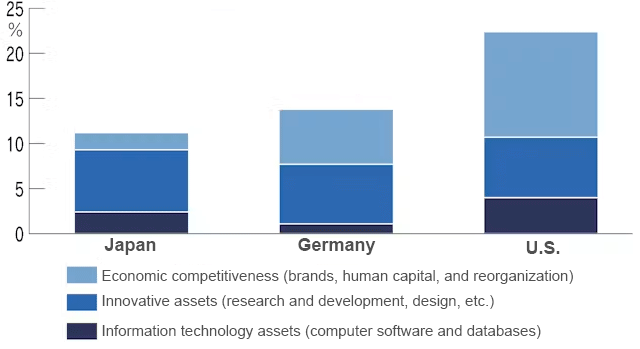
Source: Prepared by the author from EUKLEMS & INTANProd-Release 2025.
Under these circumstances, the government has selected 17 strategic sectors, including artificial intelligence (AI) and semiconductors, and plans to allocate a total of more than 370 billion yen in public- and private-sector investments to those sectors through FY2040.
Will this growth strategy lead to sustainable wage increases? Let us consider two aspects of real wage growth—increases in value added per worker (labor productivity) and wage growth relative to labor productivity.
Private-sector investment in the development of AI models and digitalization and the formation of human capital capable of adapting to new technologies are important component factors of intangible assets. A large body of research has shown that investments in intangible assets contribute to productivity growth.
In addition, a recent study by the author and Professor Yohei Yamamoto of Hitotsubashi University indicated that investment in intangible assets, including computer software and employee training, strengthens workers’ bargaining power in wage negotiations and can lead to wage growth that outpaces productivity growth.
For example, considering the shortage of personnel needed to implement AI, companies that lack the necessary personnel may have to offer wages that exceed the productivity that those workers actually provide.
As explained above, policy measures that encourage investment in intangible assets such as AI systems and other items that complement them, such as data centers, are expected to produce sustained increases in real wages. Moreover, because firms’ investments have significant spillover effects for other firms, there is an economic rationale for providing governmental support for such investment.
On the other hand, the strategic sectors selected by the government extend far beyond AI. Support for investments across such a broad range of sectors could have both positive and negative effects on real wages.
On the positive side, the introduction of equipment embodying advanced technologies can raise productivity.
An ongoing study by this author, Associate Professor Kenta Yamanouchi of Kagawa University, and Professor Miho Takizawa of Gakushuin University found that foreign direct investments in developing countries tend to strengthen companies’ bargaining power in wage negotiations in the local labor markets, thereby restraining wage increases.
If government support encouraged some of that outward foreign direct investment to return to Japan, workers’ bargaining power would increase in the Japanese labor market. In that case, wage increases equaling or even outpacing productivity growth could occur.
◆◆◆
On the negative side, broadly speaking, there are three major downsides and risks.
First, investments in the 17 strategic sectors include not only growth investments that promote innovation, but also crisis management investments related to economic security. Such investments may strengthen the economy’s resilience over the long term and contribute to sustainable growth; however, in the short run, such investments could create upward pressure on prices by raising costs.
For example, what would happen if the government prioritized domestic production of specific goods or domestic development of specific technologies? From an economic perspective, doing so means abandoning the benefits of the division of work based on international comparative advantage and shouldering higher production costs. Trade-offs between long-term resilience and short-term efficiency require careful consideration.
Secondly, lengthy reliance on subsidies and tax breaks will distort market competition. As a result, inefficient companies will be kept afloat, and their existence will impede the market entry and growth of innovative companies. Japan already lacks a dynamic environment of entries and exits. What is required of the government is to design the system of industrial policy in ways that invigorate competition, rather than selecting specific companies and continuing to provide them with subsidies.
Thirdly, there is a very serious risk of a large fiscal burden that could be imposed on the government. Although the actual scale of fiscal expenditures remains uncertain, the Cabinet Office estimated that from FY2027 onward, fiscal expenditures amounting to 10 trillion yen per year will be required on the real term to implement the growth strategy.
Since media reports about a draft of the Basic Policy circulated in late June, concerns about fiscal sustainability raised the yields on long-term Japanese government bonds and contributed to yen depreciation. Higher long-term interest rates curb investment, while the yen’s depreciation reduces real wages by raising inflation.
The yen-boosting effect of the coordinated exchange market intervention conducted by the Japanese and U.S. governments in late July is likely to prove temporary. The yen-boosting effect of policy interest rate hikes will also be unsustainable unless accompanied by a decline in the people’s inflation expectations. Furthermore, the funding source for implementing the consumption tax rate reduction for food products, scheduled to start in FY2027, is unclear.
The administration of Prime Minister Sanae Takaichi has abandoned the goal of achieving a single-year primary balance budget surplus under the Basic Policy. On the other hand, the policy of lowering government debt as a proportion of GDP in a stable manner, which is a focus of the administration, appears to rely on the natural tax revenue increase resulting from economic growth, which is an unstable financial source.
Under these circumstances, allocating substantial fiscal resources to the growth strategy could inhibit private-sector investment by heightening uncertainty in financial markets. To avoid such consequences, it is necessary to clarify the scale of fiscal expenditure and their funding sources at an early time.
After all, Japan, with its small fiscal space, will find it difficult to raise real wages through subsidies and tax breaks designed to increase investments, including investments in intangible assets. It is important to narrow the focus and rethink the design of the system of industrial policy based on the measurement of the effects while giving due consideration to the risks and negative side effects.
◆◆◆
Finally, let us discuss the planned minimum wage hikes. The Basic Policy calls for increasing the national average minimum wage to 1,500 yen as early as possible in the first half of the 2030s. To reach that level, minimum wages would annually need to grow by between 3.3% and 6% (the rate varies depending on the year when the target level is achieved), up from the national average in FY2025 (1,121 yen).
That growth range is roughly comparable to the rates of increase seen in the past five years (the average of 4.4% in 2021-2025) and is higher than the rate of increase in the consumer price index.
The author, together with Associate Professor Hiroko Okudaira of Doshisha University and others, analyzed the effects of minimum wages, using data concerning manufacturing industries from 2002 through 2016, when deflationary pressures still persisted.
The results show that minimum wage increases that exceed the level of inflation or the labor market conditions reduce both employment and corporate profits. We also found that workers may reduce working hours to avoid the annual income thresholds for tax and social security benefits.
Under current inflationary conditions, there are concerns that rising labor cost may be passed onto product and service prices, resulting in a decline in real wages. Another important policy objective is therefore to prevent workers from refraining from working longer hours by reforming the tax system to create a virtuous cycle of increased labor supply leading to higher household incomes.
>> Original text in Japanese
* Translated by RIETI.
August 26, 2026 Nihon Keizai Shimbun
