



Artificial intelligence (AI) continues to evolve at a breakneck speed. Anthropic unveiled Claude Mythos in April 2026, but the company took the step of limiting the release for a certain period on the grounds that a public release of this powerful new AI model would heighten security risks. Afterwards, in June 2026, Anthropic released Fable 5, a Mythos-class model, but suspended its public release just several days later, as the U.S. government designated the model as subject to export controls. As this indicates, AI is beginning to exert a broad influence beyond the scope of any single technology. AI is even starting to affect white-collar jobs, which had until now been considered immune from mechanization or automation, so a wide range of socio-economic impacts such as job losses and widening inequality are expected to emerge, despite productivity increases.
Looking back at human history, there have been many general-purpose technologies that have had profound, economy-wide impacts, such as the steam engine, electricity, the computer, and the internet. By raising productivity, those technologies dramatically changed how people work and how society functions, but despite the changes, we have continued to work. While technology has changed how humans work, it has not resulted in a situation where work has disappeared completely (Miyamoto, 2026). In light of that, the appropriate response to the advance of AI is to adapt to it to the best of our ability and embrace it in ways that enhance social welfare. In this context, changes in work practices and skills development become critical. The government has launched the Inter-Ministerial Liaison Conference on the Promotion of Human Resource Development and Workforce Securing in Strategic and Social Infrastructure Sectors indicating the beginning of full-scale efforts in this area.
The importance of worker training and reskilling is indisputable. Unfortunately, past experience suggests that their effectiveness has not necessarily been satisfactory. Katz et al. (2022) argued that most policy initiatives to promote college enrollment and vocational training programs for youth or disadvantages adults have been ineffectual. However, one important exception has been sector-focused training programs. This article examines the key points of sector-focused training programs and explores why they have been so effective, in an attempt to gain useful insights for Japan’s worker training and reskilling policy initiatives.
“Year Up”: A Sector-Focused Training Program
Put simply, sector-focused training programs are targeted specifically at industries and occupations where labor demand is strong and wage increases and career advancement are expected. While most worker training and reskilling programs have failed to deliver anticipated outcomes, many sector-focused training programs have generated significant effects. “Year Up” is a prime example of such a program (Katz et. al., 2022).
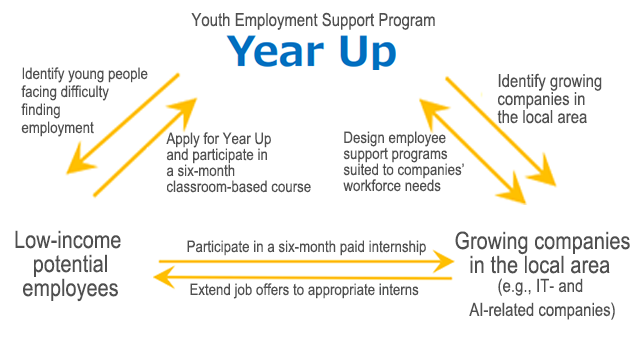
Year Up is a workforce development program launched by entrepreneur Gerald Chertavian in order to support youth employment. It is targeted mainly at low-income individuals aged between 18 and 24 with a high school diploma. Figure 1 illustrates how Year Up works. The first step is to identify growing companies in the local area. Next, employment support programs are designed to meet the workforce needs of those companies. For example, today they would implement a program to help acquire AI skills. The program then recruits young people facing difficulty in finding employment and provides them with a six-month classroom-based course. During the course, trainees acquire the skills required by the companies. After finishing the classroom-based course, trainees participate in a six-month paid internship. Internships provide opportunities both for trainees to apply their acquired skills to practical work, and for trainees and the companies to determine whether they have formed a complementary working relationship. Following the completion of internships, the companies extend job offers to the interns they wish to employ.
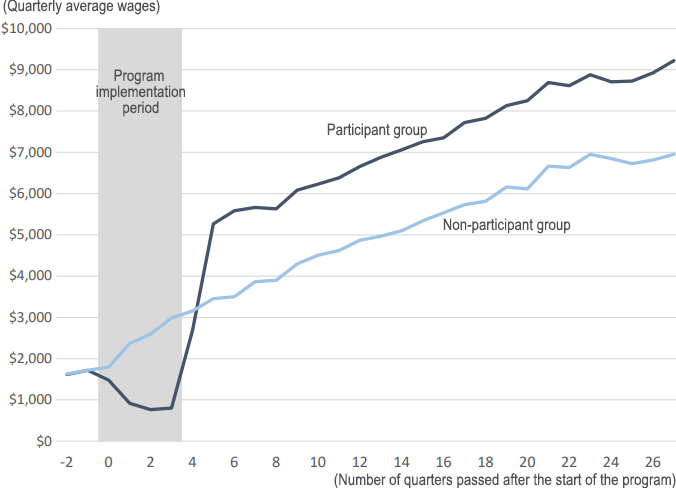
The impacts of Year Up are particularly remarkable. Figure 2 shows the results of the randomized control trial conducted by the U.S. Department of Health and Human Services to evaluate the effectiveness of the program. The figure shows the average wage trajectories for a group who participated in Year Up (participant group) and a group who did not (non-participant group). For the one-year period (Quarter 0 to Quarter 3) during which trainees undergo the classroom-based instruction and internship, the wages of the participant group were lower because of the training period, but over the following period, the wages of the participant group were consistently higher, with an average wage premium of around 40% above the non-participant group throughout the observation period. That effect did not diminish even seven years (28 quarters) after the start of the program. As employment eliminates unemployment insurance benefits, the program generated benefits of approximately $34,000 (or 5 million yen equivalent) over the seven-year period. This translates to a return equivalent to about 2.5 times the policy’s implementation cost.
Why has Year Up been so successful?
Why has Year Up been successful in delivering significant effects when most other worker training and reskilling programs have failed to produce expected effects? The following five points are worth mentioning.
First, the program invests in highly transferable skills. Acquiring broadly applicable skills, including AI and IT skills, increases competitiveness in the labor market and tends to facilitate job mobility. As a result, individual companies tend to be reluctant to invest in highly transferable skills as it makes such employees more attractive to external companies. Year Up and other sector-focused training programs correct for that market failure in that they target skills that are transferable and in demand within specific sectors.
Second, the program incorporates the workforce needs of employers into the education and training design. Even when training is provided, if there is no demand for the acquired skills, better employment outcomes are not achieved. By designing the curriculum based on companies’ needs, Year Up has succeeded in supplying workers with the skills that match demand.
Third, under Year Up, the program combines both classroom instruction and internships. As participants first acquire foundational knowledge through classroom learning that is then put into practice through the internship, participants gain professional experience and worker-company mismatches can be avoided. This reduces recruitment risk for companies.
Fourth, Year Up promotes labor mobility. Even when workers improve their skills, , the benefits do not materialize unless they are actually used and reflected in wages. As Year Up is designed to facilitate labor mobility, it allows participants to utilize their newly acquired skills to improve their labor outcomes.
Fifth, Year Up incorporates formative evaluations aimed at continuous improvement. As mentioned earlier, Year Up’s effectiveness has been verified through a randomized controlled trial. However, evaluations are aimed at making improvements, rather than simply verifying whether Year Up is effective (summative evaluation). In other words, Year Up continually makes ongoing improvements and updates based on evaluation results.
As technological progress accelerates, significant changes in the nature of work are expected all over the world. Adapting work practices while making the best use of technological advances will be critical in this environment. In that sense, the importance of human resource training and reskilling will continue to grow. However, given the history of failure of such policy initiatives, policymakers should incorporate the experiences of sector-focused training programs like Year Up into the design of effective employment support systems and reskilling initiatives.
June 29, 2026
>> Original text in Japanese
