



I. Introduction
China's venture capital (VC) and private equity (PE) market has changed dramatically over the past twenty-plus years (Note 1). During the 2000s and early 2010s, as overseas capital flowed in, foreign fund management companies dominated the market and played a major role in introducing a U.S.-style start-up ecosystem. However, since the late 2010s, tighter data regulations and anti-monopoly policies, as well as increasing U.S.-China friction have prompted foreign investors to curb VC/PE investment in China (see BOX). Meanwhile, the presence of state-owned capital and state-owned fund management companies has been growing rapidly.
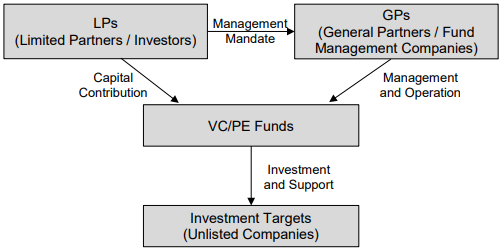
The VC/PE market consists of four types of entities: limited partners (LPs), who provide capital; general partners (GPs), who are entrusted by LPs to manage investments; VC/PE funds, which are formed with capital from LPs and managed by GPs; and unlisted companies that are targeted for investment and support (Figure 1). The investment targets and risk appetite of these funds are largely determined by the characteristics of the LPs and the terms of their investments. Therefore, in understanding the changes in market structure, it is extremely important to know which entities provide capital as LPs.
State-owned LPs, which have become the dominant players in China's VC/PE market, can be broadly classified into three types: government-guided funds, government investment platforms, and non-financial state-owned enterprises. They tend to prioritize policy goals, such as developing strategic sectors that include semiconductors and achieving technological independence, over maximizing profitability. The GPs (mostly state-owned fund management companies) that are entrusted with management by these state-owned LPs are required to align with this policy. As a result, the VC/PE market, which should originally nurture the firms chosen by the market through the efficient allocation of risk capital, has been transformed into a mechanism for channeling capital into sectors selected by the government. The impact of this shift has extended to the industrial structure and the macroeconomy.
II. Genealogy and Roles of Three Types of State-owned Capital Suppliers (LPs)
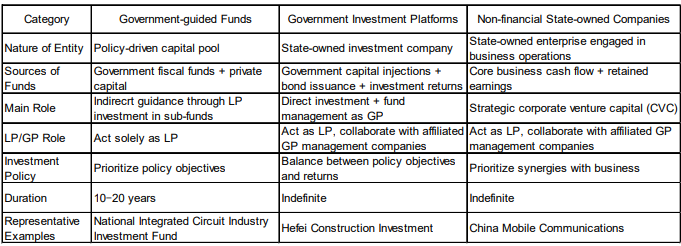
State-owned LPs, such as government-guided funds, government investment platforms, and non-financial state-owned enterprises, have grown through different historical processes, but their roles are mutually complementary (Figure 2).
1) Government-guided funds
Government-guided funds are capital pools established by the central government or local governments, using public funds as a catalyst for attracting private and other sources of capital. They prioritize alignment with national strategies and invest in strategic sectors from a long-term perspective. The lifetime is usually 10-20 years.
The origins of government-guided funds date back to the search for public venture capital in the 1980s. During the institutional development period from 2005 to 2014, it was formally positioned as a "policy tool to guide private capital and promote start-up investment." It then rapidly expanded following the implementation of "Made in China 2025" in 2015, with successive establishments from the central government down to the county level. Since 2024, government-guided funds entered the stage of "qualitative development" with extended lifespans and a clearer characterization as "patient capital."
The essence of government-guided funds lies in the integration of institutional mechanisms, organizations and capital. As institutional mechanisms, they replace existing direct subsidies and grants with market-based equity investments, and direct capital toward strategic areas. As organizations, they assume rights and obligations including contract formation and execution, shareholding, and commercial registration. Funds raised by government-guided funds are pooled into a mother fund (Fund of Funds), and, through investments in sub-funds, guide private capital into strategic sectors such as semiconductors, new energy, and biotechnology. (Note 2) Private capital mainly participates through equity contributions (investments) into sub-funds.
Key incentives for attracting private capital include both contractual and policy-based mechanisms. Contractually, a widely adopted structure allows state-owned LPs to take subordinated positions, enabling private LPs to receive preferential treatment in terms of distribution. Specifically, when distributable funds are generated from investment exits or fund liquidation, the principal and the predetermined preferential return are first allocated to the private LPs, and the remainder is then distributed to the state-owned LPs. On the policy side, the provision of policy benefits such as subsidies, land supply, and various certifications to investee companies, as well as "political capital" in the form of connections to local governments, have become incentives that attract private investors.
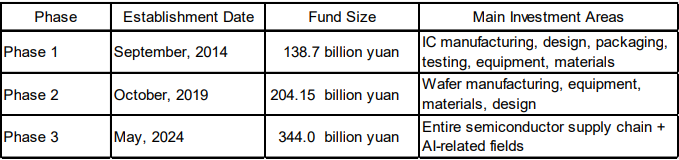
A prime example of a government-guided fund is the China Integrated Circuit Industry Investment Fund, established in 2014 with the aim of fostering the semiconductor industry. Major investors include the Ministry of Finance, China Development Finance, China Tobacco and China Mobile. The fund has contributed significantly to building the foundation of China's semiconductor industry, investing a total of about 700 billion yuan in the semiconductor manufacturing, design and equipment materials sectors over three phases. (Figure 3).
2. Government Investment Platforms
Government investment platforms are state-owned investment entities established with funding from the government or government-affiliated institutions, and their formation paths can be broadly divided into at least three categories.
The first category originated in the financing platforms established by local governments since the 1990s for infrastructure development and urban construction. By the early 2010s, in response to local government debt concerns, these platforms gradually shifted their function from securing financing to investment and capital management. Hefei Construction Investment Holding (Group) Co., Ltd. is one such example.
The second category originated from the reform of state-owned enterprises launched in 2013, especially the reform of state-owned capital investment and operating companies piloted after 2014. In this process, existing state-owned enterprise groups were transformed into capital operation entities, while others were newly established. China Merchants Group Limited, China Resources (Holdings) Co., Ltd., and China Reform Holdings Corporation Ltd. all fall into this category.
The third category originated from government-backed industrial investment companies and venture capital firms established by local governments to cultivate local industries and support technological innovation. Shenzhen Investment Holdings Co., Ltd. is a representative case of this type.
The primary sources of funds for government investment platforms are capital injections by the government, bond issuances, and retained earnings from investment income, often supplemented by bank loans. Unlike government-guided funds, many government investment platforms not only act as LPs and invest in other funds, but also perform GP functions through their affiliated fund management companies, and in some cases make direct investments themselves. Their investment approach aims to balance policy objectives with profitability.
Taking Hefei Construction Investment Holding (Group) Co., Ltd. as an example, the company’s original core business was financing infrastructure investment, but in 2008 it shifted its business focus to VC/PE investment. Using its own funds, it made direct investments in enterprises such as NIO and BOE Technology, injecting substantial capital into strategic sectors (Note 3). At the same time, it also invested as a limited partner (LP) in multiple funds, including the Hefei Investment Promotion Fund, the Anhui “Three Major, One Innovation” Industrial Development Fund, and the Anhui Integrated Circuit Industry Investment Fund.
3. Non-financial state-owned enterprises
Non-financial state-owned enterprises (including central SOEs and local SOEs) are the main actors conducting VC/PE investment to generate synergies with their core businesses, and they can invest flexibly in adjacent technologies and supply-chain-related sectors. During the process of industrial restructuring toward digitalization and the green economy, non-financial state-owned enterprises have actively deployed strategic corporate venture capital (CVC) as a means of compensating for the limitations of traditional business models. In recent years, the trend of multiple central SOEs jointly establishing large-scale funds has also become increasingly prevalent.
VC/PE investment by non-financial state-owned enterprises is funded by cash flows from their core businesses and retained earnings. Investment approaches can be divided into two types: direct investment through investment subsidiaries, and indirect investment in collaboration with other investors through VC/PE funds (sub-funds) established by such subsidiaries. In addition, investment companies of these state-owned enterprises may participate not only as LPs but also as GPs in fund management, either directly or through their affiliated fund management companies.
Among the non-financial state-owned enterprises that actively engage in VC/PE investment, China Mobile Communications Group is a typical example. Through its investment subsidiary, CMCC Capital Holdings (a subsidiary), the company made direct investments in major cybersecurity firm Venustech and acquired controlling stakes in it (Note 4). At the same time, it also established multiple VC/PE funds (and sub-funds). Among them, the Beijing CMCC Digital New Economy Industry Fund, together with CMCC Capital Holdings and several other LPs, made indirect investments in companies such as Seres Automobile.
III. Impact on the VC/PE Market
Under the leadership of state-owned capital, in the VC/PE market, the primary investment objective of LPs and thus the criteria for assessing GPs have shifted from returns on investment to contributions to policy objectives, and GPs have increasingly come to be dominated by state-owned fund management companies.
1. Changes in the LP-GP relationship
It is common for state-owned entities (government-guided funds, government investment platforms, and non-financial state-owned enterprises) with shared policy objectives to participate jointly in VC/PE funds as LPs, including the sub-funds of government-guided funds. By serving as catalysts, they attract and mobilize other sources of capital, particularly private capital, thereby expanding the overall pool of investible funds.
The growing presence of state-owned capital has also significantly changed the relationship between LPs and GPs in the VC/PE market. First, state-owned GPs have emerged, and their share of the total of market funds under management has reached about 70% as of the end of 2025 (Note 5). Second, the criteria for assessing GPs shifted from the return on investment to the contribution to policy objectives. Furthermore, when government investment platforms or non-financial state-owned enterprises are involved, decision-making is increasingly integrated, although LPs and GPs remain formally separate entities.
A representative case of a state-owned GP is Shenzhen Capital Group Co., Ltd. Established in 1999 under the leadership of the Shenzhen municipal government, the company is entrusted with managing the Shenzhen Municipal Government Guided Fund and other state-owned funds. It has successively invested in national strategic sectors such as semiconductors, AI, and new energy. As of March 2026, it managed a cumulative fund size of more than RMB 500 billion and had invested in more than 1,700 enterprises in total, among which 279 had already gone public (Note 6).
2. Contradictions with market mechanisms
While state-owned capital-led systems can powerfully mobilize funds toward strategic areas, it also contains structural problems arising from discrepancies between policy objectives and market principles.
First, there is the distortion of resource allocation caused by "local reinvestment obligations.” When local-level government-led funds invest in sub-funds together with other LPs, they generally require that a certain multiple exceeding their own investment amount be directed toward local enterprises. However, this mechanism may constrain the behavior of GPs, which are supposed to select the optimal investment targets, and may reduce the quality of investments.
Second, institutional constraints specific to state-owned capital undermine the efficiency and agility of investments. First, the obligation to "preserve and increase the value of state-owned assets" is fundamentally at odds with high-risk venture investment. While non-state-owned GPs actively take risks through diversified investment, state-owned GPs tend to adopt conservative investment strategies, such as focusing on low-risk, mid- to late-stage projects to avoid being held responsible for "the outflow of state-owned assets." In addition, the administrative nature of government-focused investment decisions and complexity of procedures create significant issues. In many cases, approval from multiple government agencies is required even after approval is obtained from the investment committee, causing delays and missed investment opportunities. These institutional constraints have created an ironic situation in which the capital injected by the government for "policy guidance" fails to fulfill its role as “risk capital.”
These problems interact in complex ways, making it difficult to execute exit strategies and causing the realization of returns to stall. As overseas listing routes narrow due to tighter regulations, and the time required for domestic IPOs lengthens because of stricter review standards, state-owned VC/PE funds are often compelled to enforce repurchase clauses agreed upon with their investee companies. (Note 7). There is an urgent need to develop exit strategies other than IPOs, such as M&A and secondary sales, but the complex decision-making structure of state-owned GPs hinders their effective implementation.
As a result, although government-guided funds were originally intended to attract private capital, the amount of private capital actually invested in the mother funds and sub-funds is limited.
IV. Impact on Industry and the Macro-Economy
These changes in the VC/PE market have also had significant impacts on industry and the macro-economy.
First, while China has successfully mobilized capital in strategic sectors such as new energy vehicles and solar panels, " duplicative investment" by local governments and state-owned enterprises has created overcapacity on a national scale, fueling trade tensions. The more successful the policy guidance, the more excessive the concentration of capital in specific industries, which undermines the supply and demand adjustment function of the market mechanism.
Second, state-owned capital support has accelerated catch-up innovation, while investment in frontier research and disruptive technologies has remained limited. Governments are only generally capable of selecting from existing technological domains, whereas highly uncertain technologies that could change the industrial structure in the future are typically generated through market-based selection and competition. Once the cycle of imitation, improvement, and iteration has been exhausted in existing technologies, government-led investment schemes may no longer be able to generate the next round of innovation.
Third, the retreat of foreign capital from the VC/PE market reflects the broader process of U.S.-China decoupling. As a result, the market’s function in mediating access to global knowledge and networks has diminished, raising the risk that Chinese startups may diverge from international best practices. Government-led capital allocation promotes the formation of domestically self-contained innovation ecosystems, but it also risks isolating the country from international knowledge and competition.
Fourth, there are concerns regarding fiscal sustainability. Local government-guided funds often fail to generate sufficient returns, thereby straining public finances, and there have been reports of disputes over unmet capital commitments. When losses occur, they are ultimately borne by taxpayers.
Thus, while the VC/PE market centered on state-owned capital serves as a powerful tool for government-led market guidance, it also reveals new structural challenges and necessitates a reconsideration of the relationship between government and market in the allocation of resources.
BOX The rise and fall of foreign capital in China's VC/PE market
The development of China's VC/PE market, which began to take shape in the early 2000s, was led by foreign capital until the first half of the 2010s. At the time, China lacked domestic capital to provide startups with long-term risk capital, and foreign fund management companies such as IDG Capital and Sequoia China were the main providers of foreign capital and the core GPs in the market. These firms introduced practices such as phased investment, investor protection through preferred shares, involvement in corporate management, and exit strategies based on overseas listing, making significant contributions to the institutional framework and market practices in the Chinese VC/PE market. In particular, the VIE scheme supported the growth of companies such as Alibaba and Tencent by enabling foreign capital investment in Chinese companies and overseas listings even under foreign capital controls (Note 1).
However, since the late 2010s, the institutional and international environment surrounding China has changed significantly. In particular, the performance of platform companies deteriorated and their attractiveness as investment targets weakened following the development of the Data Security Law, the Personal Information Protection Law and anti-monopoly regulations. In addition, the escalating U.S. - China friction directly affected the behavior of overseas LPs who support foreign fund management companies. Long-term capital such as U.S. pension funds and university funds began to see China-related investments as exposed to geopolitical risks and stopped or scaled back new investments. As a result, the share of foreign capital raised in China's VC/PE market fell sharply from 91% in 2006 to 2% in 2025 (Note 2).
(Note 1) The VIE scheme is a "contract-controlled" listing scheme used by Chinese companies in industries subject to foreign capital regulations to raise funds in the U.S. market. Under this structure, an offshore holding company—often incorporated in the Cayman Islands—serves as the listing vehicle. Through a series of contractual arrangements, such as loan agreements, service agreements, and voting rights proxy agreements between the Chinese VIE and the onshore foreign-invested subsidiary, the economic benefits and control rights of the VIE are effectively transferred to the offshore entity without a direct equity holding.
(Note 2) Zero2IPO Research Center, "Research Report on the Development History of China’s Equity Investment, " April 2023, "2025 China Equity Investment Market Research Report " January 2026.
First published in Japanese on May 11, 2026. English version updated on August 7, 2026.
