


I. Introduction
President Trump made headlines when he used the term "G2" to refer to the October 2025 U.S.-China summit held in Busan, ROK, suggesting a new diplomatic strategy for the United States. Whereas the conventional G2 concept advocated U.S.-China co-governance and a rules-based approach, the "Trump-style G2" is characterized by a division of U.S. and Chinese spheres of influence and deal diplomacy.
The emergence of the Trump-style G2 has serious implications for the international order. First, multilateralism has been set back, hollowing out multilateral institutions such as the United Nations, the World Trade Organization, the World Health Organization and the Paris Agreement. As a result, U.S. allies are losing the negotiating power they have relied on in multilateral institutions and shared values, and are being forced to increase defense spending and cooperate in sanctions against China in exchange for U.S. security commitments. Meanwhile, many developing countries are forced to choose between the two powers.
The future of U.S.-China relations is complicated by the coexistence of cooperation and competition. Looking ahead, there will be a cosmetic easing in the trade area, while competition will increase in the technology area and uncertainty will increase in the security area. Moreover, the Trump-style G2 is inherently fragile, lacking institutional guarantees and relying only on personal relations between leaders, risking easy collapse with a change of government or a simple change in a leader's disposition.
II. The Emergence of the Trump-Style G2
On October 30, 2025, U.S. President Donald Trump and Chinese President Xi Jinping held a summit meeting in Busan. Ahead of the meeting, President Trump wrote on his social network Truth Social: "THE G2 WILL BE CONVENING SHORTLY!" (Note 1).
What is noteworthy about this post is that it does not use neutral expressions such as "summit" or "bilateral talks" but rather emphasizes the "Group of Two" (G2), which positions the United States and China as the two most important countries in the world. The G2 was raised as an initiative in the late 2000s, but it disappeared without being institutionalized. The revival of this expression is indicative of the intention to portray the Busan meeting as a special political event and a significant departure from the norm.
Furthermore, the expression "will be convening shortly" has the effect of emphasizing that the talks are serious negotiations that are about to begin at the discretion of the leaders themselves, rather than a diplomatic event that has been coordinated by bureaucrats. This expression is consistent with Trump's style of politics, which views diplomacy as a direct negotiation and deal between leaders rather than an institution or procedure.
III. Interpreting the Trump-Style G2 Through the 2025 National Security Strategy
Although President Trump's G2 statement was initially taken as an impromptu message, the National Security Strategy 2025 (NSS2025), which was subsequently released, provides a rationale for placing the statement in a more systematic strategic context, as it is highly consistent with the deal diplomacy presented in Busan although it does not explicitly use the term G2 (Note 2).
A clue to the strategic intent of this communication is that NSS2025 redefines China as a "near peer." In other words, China is neither an enemy to be defeated nor a target to be suppressed by uniting with allies. While not fully equal to the United States, it is regarded as a power whose capabilities and influence are approaching those of the United States. China is seen not only as a strategic competitor, but also as a counterpart with which escalation of bilateral confrontation should be avoided. Based on this understanding, the United States may find that direct negotiations between the leaders of the two countries can become a more reasonable option for problem-solving, rather than managing relations indirectly through multilateral institutions (including international organizations, treaties, and agreements) or coordination with allies. The term G2 is a clear illustration of this strategic way of thinking.
Redefining China as a "near peer" is a major shift in U.S. foreign policy strategy. NSS2025 enshrines the "America First" principle, dismissing democracy exports and universal extension of values as "elite illusions" while placing the reshoring of manufacturing, job creation, and maximization of economic gains at the core of national security. Accordingly, foreign and security policies are being reconfigured on the basis of national interests and short-term achievements, rather than on the basis of an ideologically driven sense of mission.
In addition, while NSS2025 scales back the role of the United States as the “world’s police force,” it proposes what could be called the "Trump-era version of the Monroe Doctrine" that regards the Western Hemisphere as the sphere of influence of the United States (Note 3). By implication, this suggests that the United States will effectively tolerate China having a certain sphere of influence in Asia.
IV. Historical Transition of the G2 Concept
To understand the peculiarities of the Trump-style G2, it is necessary to survey the historical transition of the G2 concept and analyze the factors behind its evolution.
The argument for viewing U.S.-China relations as a "G2" - that is, a framework in which the two major powers, the United States and China, bear a special responsibility in stabilizing the international order - has not been established as a single theory or coherent policy concept. Rather, against the backdrop of the transformation of the international order after the end of the Cold War, and in particular the rapid rise of China and the decline of the relative influence of the United States, they encompass a range of proposals that have been gradually formed based on distinct perceptions of various problems.
The term "G2" was first proposed in 2008 by Fred Bergsten of the Peterson Institute for International Economics, as a framework in which the United States and China jointly lead the world economy through "shared responsibility." He argued that “G2” should act as a catalyst for inclusive multilateral cooperation rather than exclusive great power dominance (Note 4).
The global financial crisis that followed soon thereafter elevated the G2 initiative into the realms of policy. In 2009, strategist Zbigniew Brzezinski, who served as National Security Advisor under the Carter administration, proposed an "informal G2" that would aim for solutions to a wide range of global challenges, including the financial crisis and climate change, through strategic dialogue between the United States and China. (Note 5) He envisioned a framework in which the United States and China would jointly provide global public goods, acting as "equal partners."
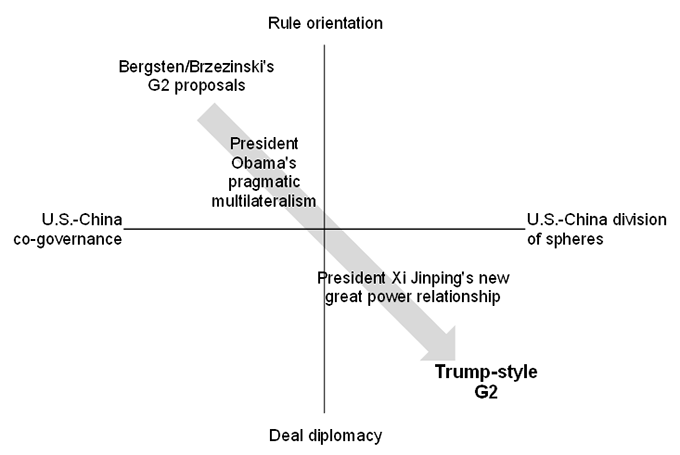
The Obama administration (2009-2017) did not officially adopt the G2 framework, citing concerns from allies, China's own caution, and political resistance in the United States. But in effect, the United States and China sought to coordinate their efforts. In terms of climate change, the 2014 U.S.-China Joint Statement paved the way for the adoption of the Paris Agreement in 2015, and the institutionalized framework of the U.S.-China Strategic and Economic Dialogue (S & ED) functioned as an institutionalized platform. Thus, the Obama administration's foreign policy strategy, which can be called "pragmatic multilateralism," is similar to the G2 proposals of Bergsten and Brzezinski in that it sought to balance the "U.S.-China co-governance" and multilateralism, although there are differences in degree.
Around the same time, Chinese leader Xi Jinping proposed a "new type of great power relationship" consisting of three pillars: avoiding conflict and confrontation, mutual respect for core interests, and win-win cooperation. However, the United States refused to accept the proposal, fearing that "mutual respect for core interests" would lead to a division of U.S. and Chinese spheres of influence. Since 2013, China's land reclamation and artificial island construction in the South China Sea, its push for the Belt and Road Initiative, and its increased military activity in the East China Sea have worsened U.S.-China relations, and the G2 concept has waned.
During the first Trump administration (2017-2021) China was defined as a "revisionist power" and the U.S.-China trade war intensified along with the struggle for technological hegemony. The Biden administration (2021-2025) pursued cooperative competition with China by strengthening coordination with allies, advancing the “small yard, high fence” policy that meant a total blockade of cutting-edge technology to China (Note 6). During this period, references to the G2 disappeared completely from the media.
The Trump-style G2 that emerged last year differs from the original G2 proposals in that it focuses on spheres of influence and deal diplomacy and seeks to replace rather than supplement the existing multilateral institutions.
The various G2 concepts to date can be organized around two axes (Figure 1). The first axis is the "U.S.-China co-governance" versus the "U.S.-China division of spheres." "U.S.-China co-governance" means that the two powers share responsibility for providing global public goods through cooperation, while the "U.S.-China division of spheres" refers to the two sides dividing regions into spheres of influence and recognizing each other's authority. The second axis is "rule orientation" versus "deal diplomacy." "Rule orientation" refers to respecting existing international organizations, treaties and agreements, while "deal diplomacy" seeks to resolve issues through direct deals between leaders. Seeing this in context, the G2 discussions have unfolded along the gradient from "U.S.-China co-governance plus rule orientation" represented by Bergsten/Brzezinski's G2 proposals and the Obama administration's pragmatic multilateralism, toward the pole of "U.S.-China division of spheres plus deal diplomacy" represented by President Xi Jinping's new great power relationship, and the Trump-style G2.
V. The Future of the International Order
The biggest impact on the international order from the emergence of the Trump-style G2 is the retreat of multilateralism and the resulting scarcity of global public goods.
The Trump administration has consistently emphasized bilateral deals in its foreign and economic policies and has maintained a distance from multilateral institutions. Emblematic of this is its withdrawal from the World Health Organization (WHO) and the Paris Agreement. Regarding the World Trade Organization (WTO), despite the prolonged paralysis of the Appellate Body, the Trump administration has not taken active steps to restore its functions, effectively accepting the deterioration of the multilateral trading system.
As a result, while multilateral institutions may survive in their essential forms, there is a growing possibility that it will gradually lose effectiveness. Specifically, in the United Nations, the reduction of U.S. financial contributions and prioritization of power politics have weakened the core functions of conflict mediation and peacekeeping. In the area of trade, bilateral negotiations are replacing dispute resolution processes, eroding the binding power of common rules. On global issues such as climate change and public health, the United States' distancing from institutional frameworks has made it difficult to maintain international cooperation. These changes represent the regression of the existing inclusive international order, in which various actors were incorporated into the coordination process through multilateral institutions.
Another impact of the Trump-style G2 on the international order is the decline in the strategic autonomy of third countries, including U.S. allies and developing countries.
U.S. allies have, until now, maintained a certain level of bargaining power in international negotiations, supported by multilateral institutions and shared values. But the new order is about to overturn that premise. With its stronger America First stance, the United States has been pressing its allies to shoulder additional burdens in exchange for security commitments, and in the context of U.S.-China confrontation, seeks their cooperation in sanctions against China.
In addition, in an era of "division of spheres," in which the United States and China recognize each other's spheres of influence, the "balanced diplomacy" that many developing countries have been pursuing, in which China represents the economy and the U.S. security, will no longer be possible. They will be forced to choose sides and accept their place in that sphere of influence.
Moreover, with the hollowing out of multilateral institutions, international law, which is the greatest safeguard for third countries, whether allies or developing countries, is weakening. As rules-based coordination in resolving international issues halts, replaced by bilateral power relations, other states will lose strategic autonomy.
VI. The Future of U.S.-China Relations
Under the Trump-style G2, the U.S.-China relationship is neither a simple "easing of tensions" nor a "growing confrontation," but a complex one of "cooperation and competition."
In the economic sphere, U.S.-China relations will be partly relaxed through deal-making and will be accompanied by continued structural competition. Under the Trump-style G2, economic relations are unlikely to improve in one direction: it is likely that different governing principles will dominate different fields.
In trade relations, tensions are likely to ease in the short term. The Trump administration is prioritizing reducing the trade deficit and tangible achievements, and could make concessions on tariffs if China buys more U.S. farm products, LNG, aircraft and other goods. However, the issues that are considered to be the sources of "unfair competition" in China, such as subsidies to state-owned enterprises, industrial policies, asymmetry in market access, and forced technology transfer, are not likely to be solved through short-term deals, and it is unlikely that they will be fundamentally corrected. Under the Trump administration, the trend of prioritizing quantifiable outcomes while demands for institutional reforms and structural adjustments in China are set aside is likely to continue.
Competition will be fierce in the technology space. The need for a technology blockade against China in strategic technology areas such as semiconductors, artificial intelligence, and quantum computing has become a shared view of both the Republican and Democratic parties. China, on the other hand, is expected to continue to pursue its stated goal of becoming more independent and strengthening its science and technology under a whole-of-nation system, with the aim of overtaking the United States. The technological competition between the United States and China is tied to military and geopolitical factors as well as economic rationality, so there is limited room for compromise.
In the investment and financial sectors, the situation of partial opening and mutual caution will continue in parallel. China is likely to continue opening non-strategic sectors such as financial services and healthcare, while remaining cautious in areas such as energy, telecoms and infrastructure. The United States will also restrict Chinese investment in the United States in high-tech and security sectors, while keeping other sectors loosely regulated.
VII. Structural Uncertainties of Concern
The greatest problem with the Trump-style” G2 lies in the following forms of structural uncertainty.
First, the framework lacks institutional backing, meaning that the management of U.S.-China relations depends heavily on the decisions of individual leaders and the relationship between them. In the absence of a permanent coordination mechanism through bureaucratic channels or multilateral institutions, policy continuity and predictability are significantly lower. Under the Trump administration, there is always the possibility that foreign policy could change abruptly depending on the President's comments or the results of negotiations, making it difficult for China to build stable expectations over the long term.
Second, the risk of a change of government has further increased this uncertainty. If the Democratic Party wins the U.S. presidential election in 2028, it is possible that value-based diplomacy and an ally-centric approach would reemerge, and a tougher stance toward China cannot be ruled out. Similarly, there is no guarantee that the Chinese leadership after Xi Jinping would honor agreements reached with President Trump. Domestic nationalist public opinion and the power balance among elites may constrain Beijing's policy toward the United States.
Third, the lack of institutionalized crisis management channels increases both the risk of miscalculation and accidental conflict. Close encounters between the U.S. and Chinese militaries in the Taiwan Strait and the South China Sea present a potential risk of unintended military escalation.
Thus, the Trump-style G2 should not be understood as a framework for stable management of U.S.-China rivalry, but as a stopgap measure to coordinate short-term interests between the two countries. While deal diplomacy between leaders can bring about a temporary easing of tensions, it does not guarantee the stability of bilateral relations or the international order, as it lacks institutionalized rules and mechanisms to incorporate third countries into the coordination process.
Under such circumstances, as a self-defense measure, third countries need to maintain multilateralism and strengthen cooperation with countries that share their values and interests, while reducing their dependence on the two major powers of the United States and China (Note 7). The question is whether Japan, together with the EU, can play a central role in this "third axis."
First published in Japanese on February 12, 2026. English version updated on March 10, 2026.
