



1. The generative AI shock has already begun.
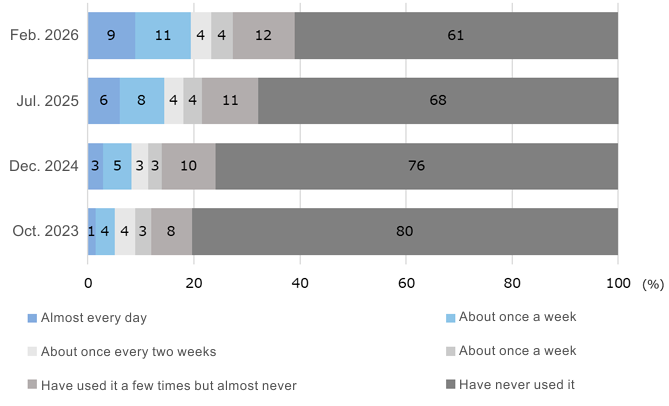
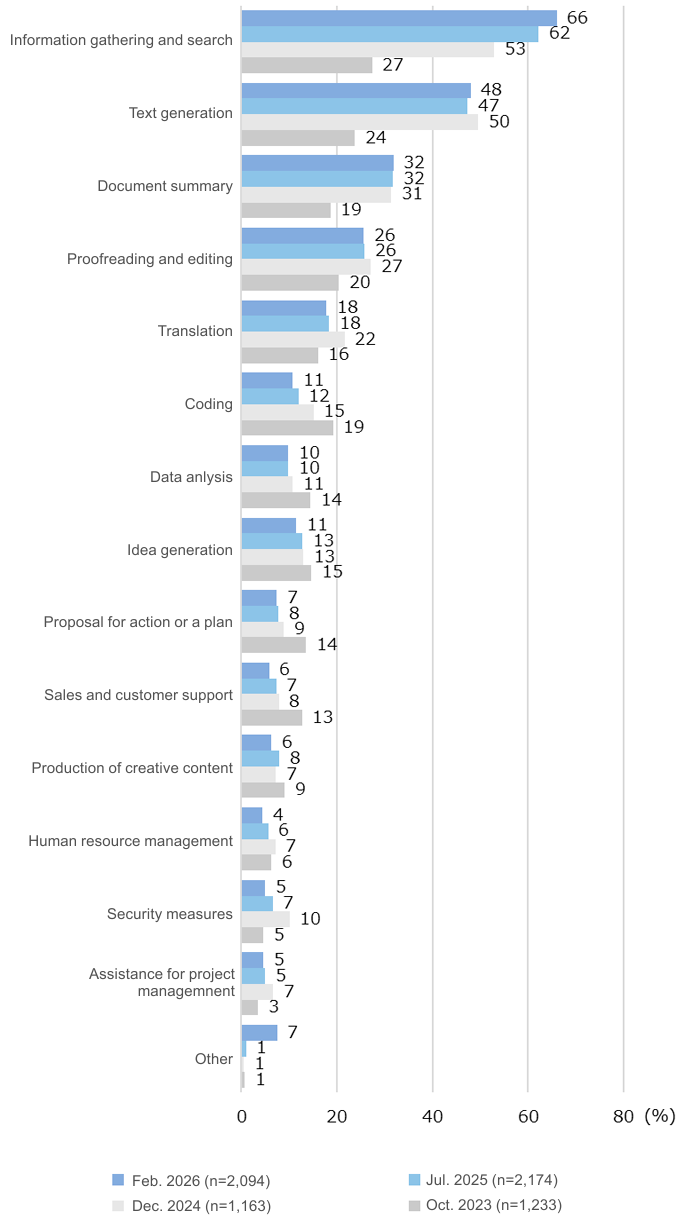
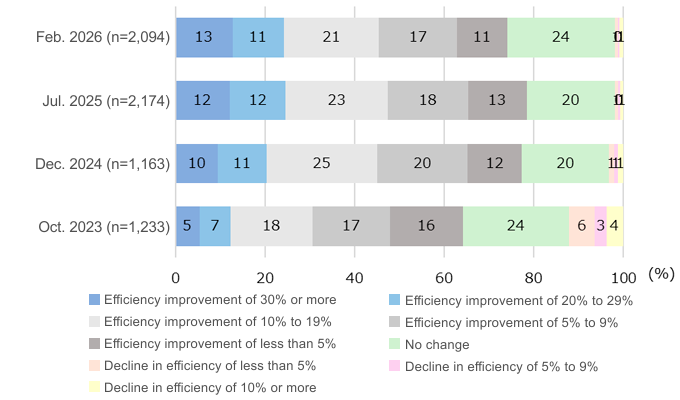
Since the emergence of ChatGPT in December 2022, generative AI has been rapidly spreading throughout society. Generative AI is used in various types of clerical work, such as document preparation, information gathering, translation, and programming, and its use is expanding not only within firms but also among individual users. AI is no longer a technology used only by certain professionals: it is now becoming a general-purpose technology that is used by ordinary people in their everyday lives. The panel survey targeting employed workers which was conducted by the author (OKUBO Toshihiro, Professor, Faculty of Economics, Keio University) and the Nippon Institute for Research Advancement (NIRA) (the 14th survey conducted from February to March 2026) also presents clear evidence of this change. For example, the percentage of workers using generative AI in their work has been steadily increasing over time (Figure 1). As of March 2026, 27% of respondents used generative AI at least once a month, but the frequency of use varies significantly. Some respondents seldom use generative AI, while 9% report using it almost every day. The main uses are to support clerical and cognitive tasks including document preparation, information gathering, and organizing ideas (Figure 2), indicating that generative AI is becoming embedded in actual work practices rather than being used merely out of curiosity. Furthermore, a substantial share of users report productivity gains, although the magnitude of the reported gains varies considerably (Figure 3). When looking at changes in work efficiency only for workers who regularly use generative AI in their work, 74% answered that their work efficiency improved, 24% answered that there has been no change, and 2% answered that their work efficiency worsened. Needless to say, generative AI-based increases in productivity do not necessarily lead directly to increases in wages. However, there is a possibility that workers who utilize generative AI more effectively might achieve better outcomes, receive stronger performance evaluations, and ultimately enjoy higher earnings. It may be too early for the disparities created by the use of generative AI to have become sufficiently observable. Nevertheless, the mechanisms that generate those disparities, or in other words the “source of inequality” seem to be appearing. Accordingly, the truly important question is not “How many people are using generative AI?” Rather, when some people benefit from using AI while others do not, will people believe that those benefits should be shared across society as a whole, or will individuals expect to achieve success alone and therefore become less supportive of redistribution? As the AI revolution progresses further, this question will become unavoidable when considering future institutional design.
Note: As multiple answers were allowed, the total exceeds 100%.
2. What society do people prefer in the AI era?
Research on the economic effects of the spread of generative AI, particularly the impact on productivity and employment, has accumulated rapidly (Brynjolfsson, Li, and Raymond, 2023, etc.). On the other hand, less is known regarding how generative AI may affect people's political attitudes, in particular their support for redistributive policies such as universal cash transfers or income redistribution through tax cuts. Intuitively, if AI leads to greater income or employment inequality, people might become more supportive of redistributive policies. However, from an economics perspective, the answer is not obvious. Based on previous political economy literature, there are at least three major hypotheses on this issue.
The first is the "Compensation Hypothesis" presented by Rodrik (1998). According to this perspective, globalization and technological innovation increase the productivity of the economy as a whole, but impose significant adjustment costs on certain industries and workers. Accordingly, people support economic growth itself but come to demand redistribution and social security measures in order to ensure that the benefits are shared across society as a whole. Applied to AI, this perspective suggests that as uncertainties over the future increase, people's support for redistribution may follow suit.
The second hypothesis is the "Prospects of Upward Mobility" argument presented by Bénabou and Ok (2001). People who can better utilize AI may come to expect improvements in their future income and career prospects, and as a result, become less supportive of redistribution and taxes which they themselves may have to finance in the future. In short, support for AI and support for redistribution are not necessarily compatible.
The third is the hypothesis concerning "Fairness" presented by Alesina and Angeletos (2005). What is important is not the existence of inequality itself, but how people understand and evaluate that inequality. If AI-driven success is viewed as an outcome of ability and effort, then the rewards generated will be recognized as legitimate, and support for redistribution might actually weaken. On the contrary, if the benefits of AI are seen as arising from luck, environmental circumstances, or unequal access to AI, support for reducing disparities through redistribution may strengthen. Perceptions of fairness may also be linked to social capital, including social trust and connections with local communities, which makes this issue particularly relevant when considering policies in the AI era.
3. The ChatGPT shock changed people's attitudes toward redistribution.
Because these theories yield competing predictions, the direction in which AI diffusion will shift political attitudes is ultimately an empirical question. To address the situation empirically, Okubo and Wagner (2026) used the Okubo-NIRA Worker Panel Survey, which is a nationwide survey targeting approximately 10,000 employed workers in Japan. The panel survey has been conducted continuously since 2020, allowing researchers to track the same respondents over time to examine changes in their attitudes. Okubo and Wagner (2026) especially focus on the emergence of ChatGPT in December 2022. The emergence of ChatGPT transformed generative AI from a technology used only by researchers, professionals and IT engineers into a technology that can be used by the general public. In other words, the launch of ChatGPT constituted an “AI shock” that dramatically altered people's perceptions of AI within a short time.
Using this AI shock as an empirical setting, Okubo and Wagner (2026) uncovered an interesting finding. The analysis yielded two main findings. First, individuals who became more supportive of promoting AI also became more supportive of redistribution. Second, following the ChatGPT shock, workers in occupations that are more exposed to AI increased their support for redistribution relative to workers in less-exposed occupations. Furthermore, this tendency was not limited to support for more direct and specific redistribution policies, such as cash transfers or tax breaks. Similar attitudes were observed with respect to other redistributive policies, including reducing income disparities and strengthening taxes on high-income earners. Of the three hypotheses introduced in the previous section, this result is most consistent with Rodrik's Compensation Hypothesis. The results also provide some support for the fairness mechanism discussed by Alesina and Angeletos (2005): the association between support for AI and support for redistribution was weaker among respondents who viewed success primarily as the result of effort rather than luck. In other words, the findings suggest that while people welcome the economic growth generated by AI, they also consider that institutions are necessary to ensure that the benefits and risks arising from AI are shared across society.
One important point to emphasize is that the study by Okubo and Wagner (2026) does not conclude that AI necessarily requires greater redistribution. Rather, the study identifies changes in people's preferences. The contribution of the study lies in demonstrating, based on Japanese data, the direction in which people’s institutional preferences could evolve as AI becomes increasingly widespread in society. Of course, such preferences do not automatically translate into policy. A significant gap may remain between what people prefer and the institutions that political processes ultimately produce. This remains one of the central, unresolved challenges in the political economy of the AI era. The ChatGPT shock therefore raises questions that reach beyond the diffusion and adoption of new technologies and toward "What society will people prefer?" and "How can people's aspirations be translated into concrete systems and policies?"
4. Can we apply the lessons of globalization in the AI revolution?
As explained above, Okubo and Wagner (2026) suggest that public preferences may be shifting toward greater support for redistribution. However, the institutions that people prefer are not necessarily realized. What we are reminded of here is our experience of globalization. Since the 1990s, the liberalization of trade and investment has proceeded rapidly around the world, with the world economy becoming increasingly borderless. Globalization contributed significantly to global economic growth and rising income levels in many countries. China and India, in particular, saw dramatic development, contributing to what has been called “the Great Convergence” of the world economy. In the meantime, in many countries, but mainly in advanced countries, the benefits and burdens of globalization were not distributed evenly among domestic industries, regions, and workers. Rodrik (1998) was quick to point this out. His Compensation Hypothesis argues that as globalization deepens and trade and investment expand, greater compensation and redistribution to people who bear adjustment costs will become necessary. According to his view, the promotion of free trade and strengthening of government-led redistribution are not inherently conflicting policies, but two sides of the same coin.
However, in reality, such institutional arrangements were not always implemented. Although the benefits of globalization were significant, it is difficult to argue that the fruits of globalization were sufficiently shared across affected populations. As a result, public discontent regarding income inequality and regional disparities grew in many countries, contributing to the rise of protectionism and populism, and more recently to trends described as global fragmentation and “deglobalization.” Needless to say, globalization was not a mistake. Its benefits were enormous from the perspective of the world economy as a whole. Nevertheless, the failure to develop institutions that are capable of sufficiently sharing the benefits broadly across society was one factor behind the political and social fragmentation seen today.
The AI revolution seems to be facing a similar crossroads. Findings from the Okubo–NIRA Worker Panel Survey indicate that more frequent users of generative AI are more likely to report productivity gains. While generative AI may improve efficiency across the economy as a whole, its benefits may not be distributed evenly. People may therefore be beginning to support not only AI-driven growth, but also institutions that enable the benefits of AI to be shared more evenly across society as a whole.
However, whether these preferences are translated into actual institutions is a completely separate matter. Even when strong preferences exist, how they are debated, aggregated, and reflected in policy is far from simple. The experience of globalization demonstrates that a significant gap can form between public preferences and institutional outcomes. Because institutional design lagged behind, political and social divisions increased. Accordingly, the central question in the era of the AI revolution is not simply whether to promote the use of AI or not. Rather, it is whether institutions can be developed alongside the technological progress to ensure that the benefits brought about by AI can be shared broadly across society as a whole. The lessons of globalization suggest that the costs of postponing such institutional design will be considerable.
5. Conclusion
The author examined how the dissemination of generative AI may be changing people's attitudes toward redistribution, based on a study using relevant data for Japan. While AI has enormous potential to increase productivity, its benefits may not be distributed evenly across society. What is important is not to stop the technological revolution itself, but to simultaneously create institutions that are capable of sharing the gains more broadly. Globalization brought significant benefits to the world economy, but it cannot be denied that the delay in designing a system for sufficiently sharing the benefits broadly across society has become one factor in the political and social fragmentation seen today. The AI revolution is the first large-scale technological revolution in which we can utilize lessons learned from the experience of globalization. Whether Japan can successfully combine AI-driven economic growth with institutional arrangements that enable its benefits to be shared broadly will help shape the future of the country’s economy and society.
July 6, 2026
>> Original text in Japanese
