



PDF version [PDF:503KB]
Changes in the Environment Surrounding Globalization
President Donald Trump’s Tariff Policy and Global Turmoil
The tariff policies of the second Trump administration are creating significant uncertainty in the global economy. The imposition of additional tariffs and reciprocal duties is undermining the stability of the multilateral free trade system and forcing countries to respond to it. While tariff hikes are justified as protecting domestic industries and eliminating trade deficits, international economics has repeatedly pointed out that they are likely to damage long-term growth by increasing consumer costs and reducing international division of labor. Nevertheless, protectionism tends to garner political support. This disconnect between economic rationality and political logic is destabilizing the international economic order. Japan has consistently promoted free trade since the postwar era, but if anti-globalization and protectionism accelerate, it would find it harder to reap its traditional benefits. Japan is now being challenged to reexamine its own approach to globalization.
Japan’s Unique Globalization
As the turmoil in the global economy deepens, Japan’s stance on globalization is once again being questioned. Many developed nations have actively expanded the cross-border movement of goods, capital, people, and businesses alongside trade liberalization. Their approach was comprehensive, accepting immigrants and foreign workers while also attracting direct investment from overseas companies. Japan, however, has followed a somewhat different path. While consistently promoting trade liberalization since the postwar period and actively concluding free trade agreements and economic partnership agreements in recent years, its acceptance of immigrants has been limited, and its inward direct investment remains at a low level compared to major advanced economies. While Japanese companies have expanded overseas, they have been cautious about the inflow of people and capital from abroad. In other words, Japan’s globalization has been asymmetric: centered on free trade, yet cautious about accepting capital and labor. However, as protectionism grows globally, trade-dependent Japan might struggle to maintain its traditional benefits. With its severe aging and declining birthrate today, Japan is once again being asked what form of globalization it will choose.
Japanese Preferences for Globalization as Seen in Public Opinion Surveys
Free Trade and Tariff Policy
Results from the “Questionnaire Survey on Work Styles, Life and Awareness in the Digital Economy and Society” conducted in December 2024 by Toshihiro Okubo at Keio University and the National Institute for Research Advancement (NIRA) reveal Japanese attitudes toward globalization. It is important to note that respondents were employed individuals and that these attitudes predate the start of the second Trump administration.
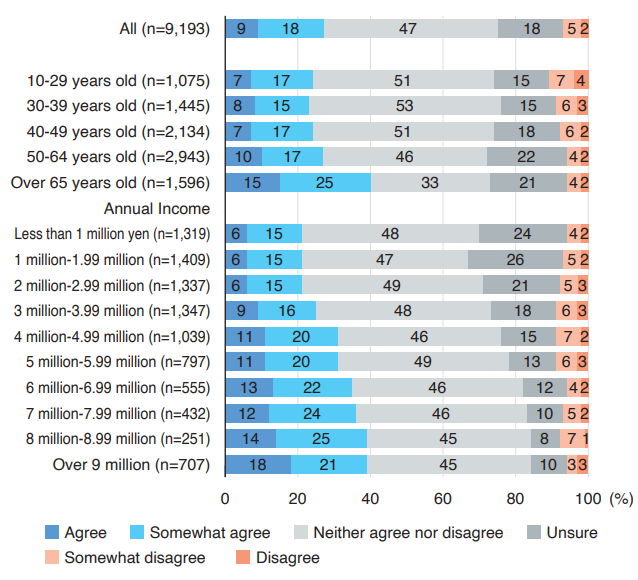
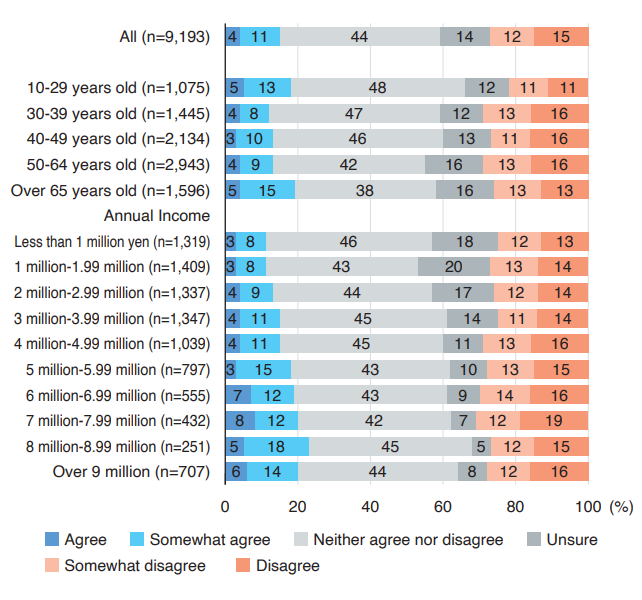
First, regarding the promotion of free trade, 27% were in favor and 7% opposed, indicating significantly higher positive sentiment (Chart 1). Conversely, regarding promoting immigration acceptance, 15% were in favor and 27% opposed (Chart 2), suggesting greater caution on labor mobility. By age group, support for free trade was relatively higher among older and higher-income individuals. This suggests that generations that have long experienced its benefits might be more positive. On the other hand, the group explicitly supporting protectionism showed little variation across income levels and remained a minority in all groups, a characteristic feature of Japan.
We further explored opinions on specific policies. Regarding tariff policy, respondents were asked which view they leaned toward: “A: Tariffs should be raised to protect Japan’s domestic industries” or “B: Tariffs should be lowered to reduce consumer burdens”. Support for raising tariffs (“closer to A” or “somewhat closer to A”) stood at 20%, while 21% supported lowering tariffs (“closer to B” or “somewhat closer to B”), indicating a close divide (Chart 3).
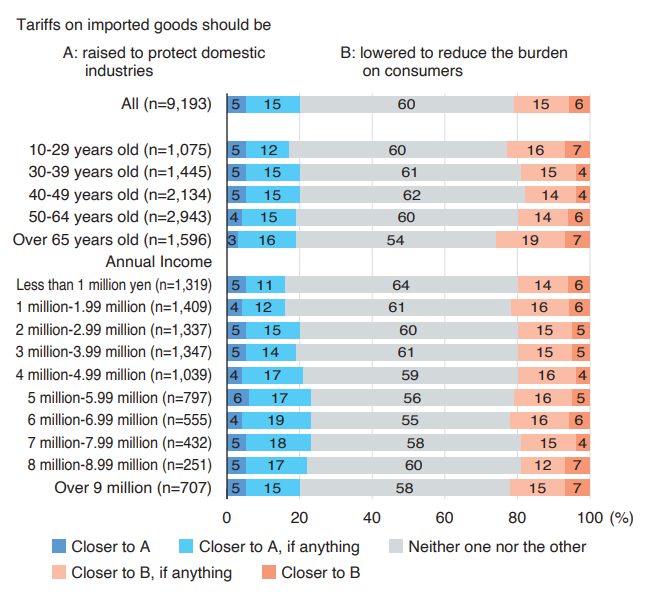
Overall, this indicates that while Japanese people generally support promoting free trade, opinions are evenly split when it comes to specific tariff policies. This might reflect a strong awareness that, while recognizing the benefits of free trade as consumers, they also feel the need to “protect domestic industries and employment” to safeguard their own jobs and income levels as producers or workers. Tariffs tend to become entrenched as a form of vested interest, benefiting specific industries or groups substantially, while spreading the burden thinly across the broader public, making it difficult for consumers to perceive tangibly. From a societal perspective, this is clearly unfair, hindering competition and distorting markets. Furthermore, in the long term, protecting domestic industries through tariffs would stifle innovation and productivity gains, eroding international competitiveness.
Opinion on Accepting Foreigners and Acquisitions by Foreign Individuals/Companies
Postwar Japan has promoted trade liberalization while remaining cautious about inflows of people and capital. However, against the backdrop of labor shortages due to a declining birthrate and aging population, as well as prolonged economic stagnation, arguments for utilizing foreign labor and capital have grown stronger. When asked about foreign workers – whether their numbers should be reduced to protect jobs or increased to address labor shortages – opinions were evenly split: 23% favored reduction and 26% favored increase (Chart 4). While a slight majority supports increasing numbers, societal views remain divided. By age group, caution was strongest among those in their 40s, while acceptance and support were relatively higher among those aged 50 and above, particularly the elderly.
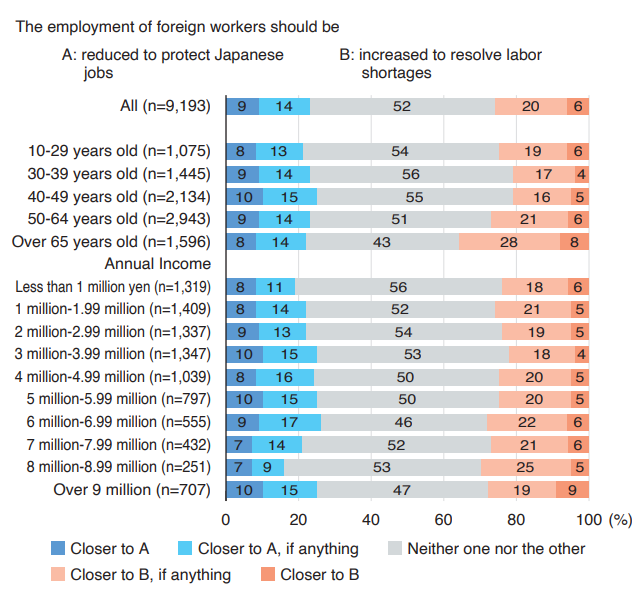
This result reflects Japan’s situation of low unemployment and severe labor shortages. It appears a pragmatic judgment is at work, prioritizing the resolution of labor shortages over the protection of domestic employment. However, this is strictly within the context of supplementing the workforce with foreign laborers; as previously indicated, opposition could increase if it involves long-term immigration acceptance.
On the other hand, negative views are strong regarding foreign capital acquisitions of Japanese companies. Responses viewing the acquisition of Japanese companies by foreign firms as “bad” reached 49%, while those viewing it as “good” remained at just 7% (Chart 5). Furthermore, 44% support restrictions on land and real estate acquisition by foreigners, with this proportion being particularly high among the elderly (Chart 6). These attitudes reflect a cautious stance toward changes in ownership structures. Beyond the recent heightened awareness of economic security, psychological factors like the endowment effect and status quo bias may also be at play. Psychological resistance to differences in language, culture, and ways of thinking could also be influencing this. In the case of land, the tendency to envision broad risks, such as impacts on local communities and national sovereignty, likely also plays a role. On the other hand, regarding Japanese companies acquiring foreign firms, opinions are more divided, with 27% viewing it as “good” and 11% as “bad” (Chart 7). Support for aggressive overseas expansion is not overwhelmingly strong, and a hegemonic desire to expand Japan’s economic advantage through foreign acquisitions does not necessarily appear strong.
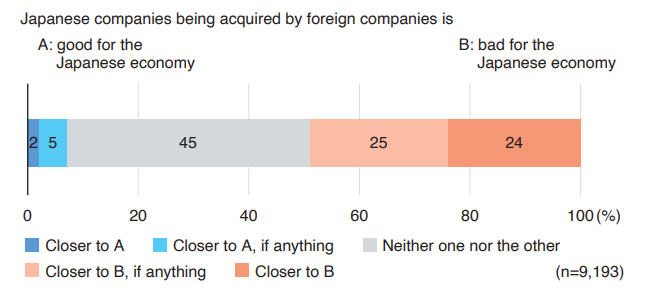
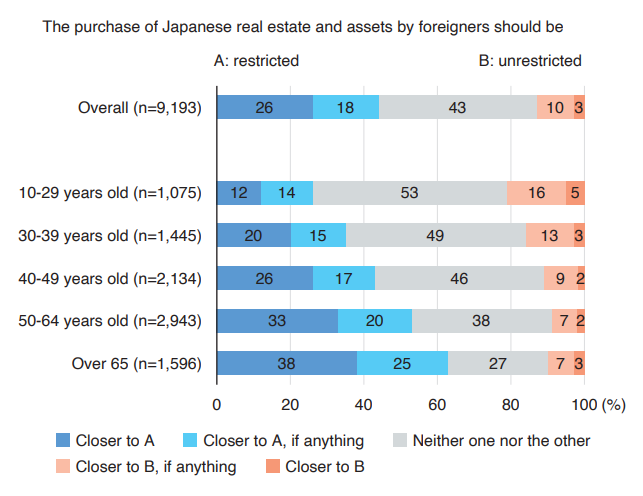
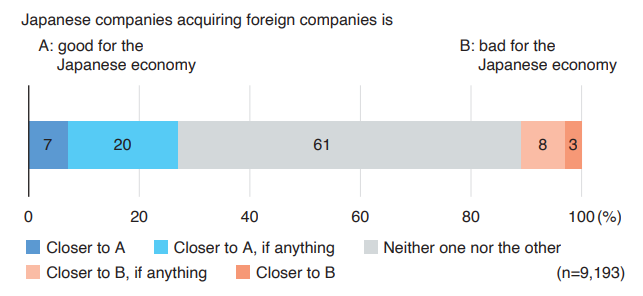
Overall, Japanese society appears open to the exchange of goods and services, yet cautious about transfers of ownership and labor mobility.
Neutral or Apathetic Segment: Apathetic Low-Income Groups More than Youth
A notable finding in the survey is the significant number of respondents who answered “neutral” or ‘unsure’ to many questions. Responses showing no clear support or opposition regarding issues like promoting free trade or accepting immigrants reached around half. In Japan, the cultural background of “the virtue of moderation” might lead to a strong tendency to choose “neutral”. Conversely, those who answered “unsure” can be viewed as an apathetic group lacking clear opinions on policies or exhibiting low political interest. Specifically, regarding the promotion of free trade mentioned earlier, 65% responded as “neutral” or “unsure”, with 47% being “neutral” and 18% “unsure”. Regarding promoting immigration acceptance, 58% responded “neutral” or “unsure”, with 44% neutral and 14% “unsure” (Chart 2). The “unsure” group generally accounted for just under 15-20%. Notably, the apathetic group is not necessarily concentrated among younger generations. Rather, a strong correlation exists with income, showing a tendency for apathy to be higher among lower-income groups. The apathetic group is relatively larger among those earning 3 million yen or less annually.
It is precisely these economically unstable groups that are most vulnerable to the impacts of globalization. While the middle and lower-income classes have formed the core support base for anti-globalization movements in other countries, this trend is not yet prominent in Japan. However, should economic conditions deteriorate, it cannot be ruled out that the apathetic segment could rapidly gravitate toward specific political positions. Therefore, in debates surrounding free trade and inward investment, attention must be paid not only to voices for and against, but also to the existence of this silent segment.
Thoughts on Future International Economic Policy
The survey results confirm a certain level of support for promoting free trade itself. Therefore, Japan will likely maintain its fundamental approach of globalization centered on free trade. However, opinions are divided on accepting foreign workers, immigration, tariffs, and foreign capital acquisitions of companies. Particularly, a strong cautious stance is evident regarding foreign direct investment into Japan and land acquisitions that involve changes in ownership structure. Japan has historically been a country with relatively low levels of foreign direct investment. Differences in language, business practices, and corporate culture have also served as barriers to entry for foreign companies. Adding to this, recent concerns about economic security and rising nationalist sentiment could make expanding inward investment even more difficult. This is because underlying public opinion is a fear that transferring ownership to foreign entities could lead to broader societal transformation.
However, the Japanese economy faces a severe labor shortage. Labor shortages are evident in many sectors, including healthcare/nursing, construction, and services, acting as a constraint on growth. Surveys also indicate some support for accepting foreign workers to alleviate labor shortages. The reality is that the economy has reached a point where accepting a certain level of labor and capital from overseas is unavoidable. Crucially, the concepts of “immigrants” and “foreign workers” should not be lumped together. The economic effects and social impacts of accepting highly skilled professionals differ significantly from those of accepting low-skilled workers for manual labor. Their complementary relationship with industries and their impact on local communities are also not uniform. Nevertheless, framing the debate as a simple binary choice between support and opposition tends to amplify social anxiety. In particular, while accepting highly skilled workers is often linked to innovation and productivity gains, accepting low-skilled workers may alleviate shortages in manual labor but has more direct impacts on local communities and wage structures. Proceeding with discussions without clarifying the nature of the needed talent and its relationship to industrial structure risks letting social anxiety take precedence.
Furthermore, as the structure of labor demand shifts with the advancement of the digital economy, future anxieties may intensify for certain occupations. While robots and AI have reduced labor demand for blue-collar workers in manual labor, recent advances in generative AI are increasingly diminishing the need for white-collar workers in administrative roles. In this context, rapidly accelerating labor mobility carries the undeniable risk that anxiety and dissatisfaction could coalesce into xenophobic sentiments. Survey findings indicating a large apathetic segment, particularly among low-income individuals, suggest public opinion could swiftly shift toward xenophobia should such changes occur.
Therefore, Japan’s inward investment policy extends beyond mere institutional design issues like deregulation or enhanced incentives. It requires careful deliberation on what form of investment and what kind of talent acceptance are desirable for society, taking into account psychological resistance to changes in ownership structures, the advancement of the digital economy, and future anxieties in the labor market. Externally, it is crucial to strengthen cooperation with countries supporting the free trade system and deepen existing free trade agreements and economic partnership agreements. Free trade agreements offer the advantage of uniting various smaller nations within a free trade framework, enabling them to challenge larger powers by achieving economies of scale. From a pro-free trade stance, it may be wise to leverage agreements like the Japan-EU EPA to strengthen ties with Europe and accelerate intra-regional trade and investment.
Japan’s globalization has followed a different path from that of Europe and the United States. With its declining birthrate and aging population, there is no guarantee it can maintain the same form from now on. Precisely for this reason, rather than a hasty debate based on simple “for or against” arguments, a gradual approach is needed, one that builds social consensus. Particularly regarding the acceptance of immigrants and foreign workers, the advancement of the digital economy will likely transform labor and occupations themselves significantly. Maintaining free trade, promoting inward investment, and redesigning labor mobility all involve balancing economic rationality with social acceptability (public attitudes toward globalization). Amidst a shaky global economy, Japan should pursue neither extreme openness nor isolation, but rather a sustainable globalization strategy shaped by thorough deliberation.
(The survey implementation and data analysis were conducted by the author, along with Atsuchi Inoue and Shoko Sekijima, senior researchers of the Nippon Institute for Research Advancement (NIRA) and Hinako Suzuki, research coordinator/researcher of NIRA.)
This article first appeared on the May/June 2026 issue of Japan SPOTLIGHT published by Japan Economic Foundation. Reproduced with permission.
May/June 2026 Japan SPOTLIGHT
