



Japan has developed important relationships with Latin America and the Caribbean through immigration, trade, and investment, but many say economic ties have lost momentum since the 1990s. With the advance of globalization, the need for direct engagement with this geographically distant region diminished, and Japan concentrated its efforts in Asia.
However, the Japanese economy is now facing three critical challenges. First, the domestic economy risks shrinking due to population decline. Second, it is necessary to reorganize supply chains in response to large-scale natural disasters, pandemic risks, and international conflicts.
Third, amid various geopolitical concerns, Japan must strengthen economic security while reaffirming trust-based partnerships with countries that share core values. Given those challenges, the importance of Latin America in Japan’s international relations is gradually growing.
As a market, Latin America has a population of 660 million people and a regional gross domestic product (GDP) of 7.1 trillion dollars. Compared with the Association of Southeast Asian Nations (ASEAN), Latin America has a similar population but an economy 1.8 times larger.
Many Latin American countries have made progress in institutional reforms, including the introduction of inflation targets and the enhancement of central bank independence. Confidence in price stability has grown, providing reassurance to foreign investors. With its enormous market, Latin America is an important business frontier for Japanese companies.
In order to further raise economic growth rates in Latin America, it is essential to improve productivity as well. There are various challenges, but they also present opportunities. The energy transition, which is regarded as an economic growth constraint for many countries, may create business opportunities for Latin America, which is rich in renewable energy sources and mineral resources.
Essential services such as healthcare, nursing care, and public transportation remain unavailable to low-income families and residents of remote areas. Many startups have emerged with the goal of resolving these pending challenges through digital technologies, with some developing into unicorn companies with billion-dollar valuations.
Japan, too, faces shortages of essential services in regions affected by population decline. Through involvement in Latin America, Japan hopes to learn from the experiences of Latin American startups that have achieved business growth by resolving such social challenges.
◆◆◆
Previously, Japanese companies’ interest in Latin America was concentrated in Mexico as a manufacturing base serving the North American market. Until the 1990s, consumer electronics was the main industry behind the relationship, but now, the automobile industry occupies that position. In the manufacturing of automobiles by Japanese companies, parts and materials like steel sheets are supplied from Japan to Mexico, while vehicles assembled in Mexico are exported mainly to the North American market. As a result, Japan’s trade relationship with Mexico has centered on exporting intermediate goods (see the table below).
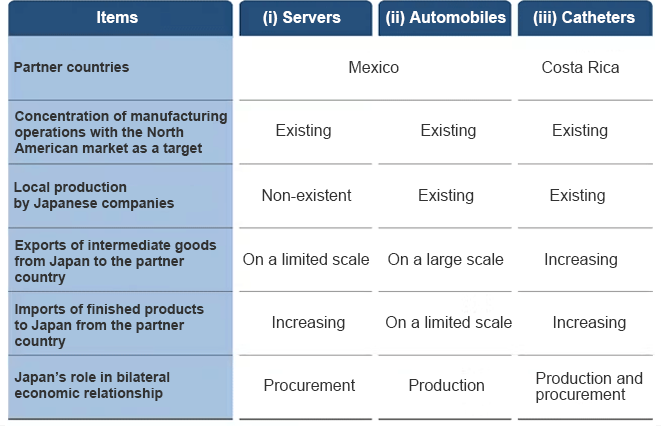
However, in recent years, Japan’s imports of manufactured goods from Latin America have also increased. In 2022-2025, the annual average value of imports of automatic data processing machinery (e.g., servers) made in Mexico and medical equipment made in Costa Rica increased by 473% and 137%, respectively, compared with the average in 2015-2018. This is a prime example of the change in Latin America’s trade structure (Ministry of Finance, Trade Statistics of Japan).
Mexico has become increasingly important as a data center hub for North America and has also become a major manufacturing base of server components. However, Japanese companies do not appear to be major manufacturers in this sector, and exports of related intermediate goods from Japan also seem limited. In server-related trade, Japan’s main role is procuring finished products from Mexico.
In the medical device sector, Costa Rica, like Mexico, is a major global exporter of catheters. As some Japanese companies conduct large-scale local manufacturing operations regarding medical equipment in Costa Rica, both Japan’s imports of finished products from Costa Rica and its exports of intermediate goods to that country are increasing.
Japanese companies’ manufacturing networks serving the North American market have expanded into Mexico and Central and South America, and the trend of near-shoring (transferring business bases to countries geographically closer to the U.S.) in recent years is accelerating their expansion. As a result, as described in the table, supply chains spanning Japan and Latin America have become more diversified, creating new supply nodes for the Japanese market. Geographically diversifying supply bases enhances the resilience of Japanese supply chains.
In August, Foreign Minister Toshimitsu Motegi made a diplomatic tour of Mexico, Panama, Ecuador, and Trinidad and Tobago. For Japan, which must step up efforts to ensure a stable energy supply because of the closure of the Strait of Hormuz, cooperation with those countries is of great significance.
When Japan needed to release part of its national crude oil reserves, the Mexican government exported 1 million barrels of crude oil to Japan as an emergency measure. Japan is willing to cooperate to expand Mexico’s oil production capacity because it would help to reduce Japan’s dependence on the Middle East as an alternative oil supplier,
When Japan wants to urgently import crude oil produced in the United States, shipments must pass through the Panama Canal. Japan maintains crude oil imports from Ecuador, albeit on a modest scale. Energy cooperation with Trinidad and Tobago also came into view as the country moves to resume its joint natural gas development project with Venezuela. According to media reports, Foreign Minister Motegi’s Latin American tour aimed to reaffirm Japan's willingness to promote economic cooperation with those countries, especially in the energy sector.
Colombia, from which Japan imported coal in the past, has expressed readiness to resume negotiations over an economic partnership agreement (EPA) with Japan. Peru, from which Japan imported naphtha on an emergency basis, has indicated willingness to strengthen its relationship with Japan, with President Keiko Fujimori arranging a visit to Japan in November. Additionally, cooperation with Latin American countries on the Pacific coast is of great significance for Japan, particularly from the perspective of economic security.
◆◆◆
This year is the 50th anniversary of Japan’s accession to the Inter-American Development Bank (IDB). To mark this occasion, the IDB, in partnership with Japan, has established the Japan Resilience Initiative as a new support framework consisting of an investment financing package for Latin America, for which a total of 14 billion dollars is expected to be mobilized, along with 30 million dollars in grant assistance targeted at critical mineral resource development. The initiative aims to develop resilient and diverse global supply chains by supporting the expansion of critical minerals refining and processing capacities and the enhancement of industrial capabilities in Latin America.
Those initiatives are expected to promote flows of private-sector investment from Japan into Latin American countries as they implement institutional reforms. In Chile, private-sector enterprises are increasingly participating in the development of lithium resources, which were previously under strong state control. Under the business-friendly administration of President Kast, in August Chile signed its first special operation contract concerning lithium to be granted exclusively to a private-sector company.
From an economic security perspective, strengthening relationships with member countries of the Southern Common Market (Mercosur), which have ample mineral resources and food production capacity, is particularly important. In June, Japan agreed with Mercosur to start EPA negotiations. Mercosur, whose five member countries include Brazil and Argentina, accounts for 40% of Latin America in terms of population and GDP, represents a significant market in its own right.
Mercosur is a South American hub, and the trading bloc is looking to develop supply chains with the European Union (EU), following the entry into force in May 2026 of its interim trade agreement with the EU.
Japan has gradually reduced its direct involvement with Latin America due to the significant geographical distance. Traditionally, the region was regarded primarily as a source of natural resources and a production base. However, in this era of declining predictability and growing uncertainty, Latin America is becoming a region that supports Japan’s growth and stability from multiple perspectives, including market access, diversifying supply chains and economic security. In particular, Mercosur is growing in importance from all three of these perspectives.
>> Original text in Japanese
* Translated by RIETI.
September 23, 2026 Nihon Keizai Shimbun
