


Under the Green Transformation (GX) Promotion Act, enacted in 2023, a total of 20 trillion yen’s worth of “GX Economy Transition Bonds” will be issued over a decade to fund research and development for decarbonization. Carbon pricing (CP), which assigns a price to carbon dioxide (CO2) emissions, is expected to play a role in promoting the adoption of decarbonization technology.
Emissions trading, which is a form of CP, has been introduced in various countries including the European Union (EU)’s EU-ETS system, and countries such as China and South Korea. In Japan as well, the Japanese version of emissions trading, known as GX-ETS, entered the trial stage, called Phase 1, in fiscal year 2023 and has become a mandatory system involving penalty-backed enforcement (Phase 2) in fiscal year 2026.
Phase 2 of GX-ETS will cover approximately 300-400 companies which have annual CO2 emission of 100,000 tons or more. The system targets “Scope 1” emissions, which are associated with a company’s own business activities. GX-ETS is a comprehensive system as it applies right from its launch not only to electric power and manufacturing industries but also to other industries, including transportation and real estate.
Emission allowances are allocated free of charge. Energy-intensive industries will receive allocations under the benchmarking (BM) approach and other industries under the grandfathering (GF) approach.
Under the GF approach, allowances are allocated to companies based on their past emissions volumes, with emissions set to be reduced by 1.7% each year. Companies that made emission-reduction investments before 2023 are entitled to additional emission allowances so that fairness can be assured across companies.
Meanwhile, under the BM approach, allowance allocations are based on the technological level of each industry. For example, in the power sector, emissions per unit of electricity generated (1 kilowatt-hour) are used, while in the steel industry, emissions per unit of steel production (per ton) are used. Initial allocations are calculated by multiplying these benchmarks by a standard level of activity (the average electricity generation or steel production volume, in fiscal years 2023-2025).
The BM approach is also used in the EU-ETS, and is considered more equitable because it reduces the disadvantages of companies that made early investments in decarbonization. Allowances for 90% of the total emissions volumes are expected to be allocated under the BM approach, with about 10% or so under the GF approach. One challenge for the five-year review will be how to expand the application of the BM approach to industries currently covered by the GF approach.
◆◆◆
The figure below shows how allocations are made under the BM approach. Based on data regarding the levels of energy efficiency for facilities in each industry, and companies are arranged from left to right in order of efficiency. The horizontal axis represents activity level and the vertical axis represents emission efficiency per unit of activity volume (the BM indicator).
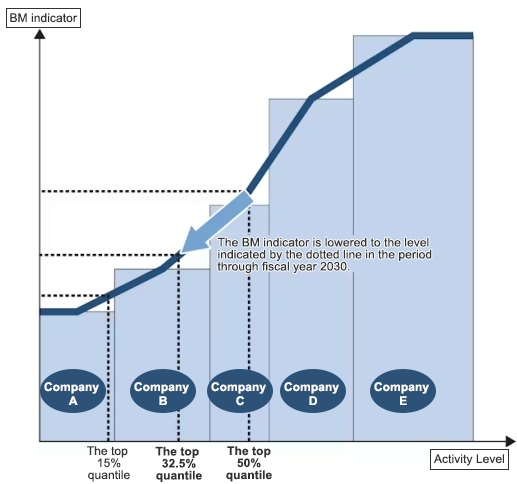
In the first year, the BM level is set to the top 50% quantile. Inefficient companies (Companies D and E in the figure) need to reduce emissions through measures such as energy saving and energy transition, or purchase emission allowances, while companies in the top 50% quantile do not. However, the BM level is lowered every year until it reaches the efficiency level of the top 32.5% quantile after five years. As a result, the number of companies that are required to reduce emissions over the years increases and decision making that takes the price of emission allowances into account will also increase. If allowance prices rise, industry realignment may also occur as a result of the pursuit of better efficiency.
In the electric power sector, emission allowances are allocated based on two concepts: “fuel type-specific BM,” and “overall-thermal power BM.” Under the fuel-specific BM, Allocations are made based on efficiency levels for each type of fuel, such as coal and natural gas and for the overall thermal power BM, based on the efficiency level of overall thermal power generation.
At launch, emission allowances are allocated under the fuel type-specific BM approach alone, but from the fourth year and beyond, a portion will shift to the overall thermal power BM approaches (20% of overall emission allowances in fiscal year 2029 and 40% in fiscal year 2030). As the share of the overall thermal power BM approach increases, companies with a higher rate of dependency on carbon-intensive coal will bear larger reduction obligations.
In fiscal year 2033, a paid auction system will be introduced for power generation companies, requiring emission allowances to be purchased from the government. Income from auctions, together with income from a fossil fuel charge system that levies charges from importers of fossil fuels (this system is scheduled to start in fiscal year 2028), will be used for the redemption of GX Economy Transition Bonds.
If companies subject to GX-ETS (applicable companies) find it difficult to reduce emissions, they may use up to 10% of their emissions in the form of government-certified emission reduction credits known as “J-Credits,” or the Joint Crediting Mechanism (JCM), which is an emission crediting arrangement between Japan and partner countries. As a way to ensure the liquidity of those credits, a carbon credit market began full-scale operation on the Tokyo Stock Exchange in October 2023.
If covered companies fail to fulfill the obligations associated with the system, they must pay a penalty equivalent to 1.1 times the upper limit price of emission allowances. In addition to reducing emissions, the companies will need to consider the possibility of using either of those carbon credits depending on price conditions.
◆◆◆
One concern with the introduction of carbon pricing is the risk of carbon leakage. This refers to the possibility that if only some countries introduce carbon pricing, industries will relocate to countries and regions with lax regulations, resulting in increased CO2 emissions in those locations.
In order to deal with this problem, under GX-ETS, for industries with high trade exposure, if the ratio of a company’s cost of purchasing emission allowances to its income rises above a certain level, an additional allocation of emission allowances is granted to the company to cover a certain percentage of its allowance shortfall. The additional allocation is supposed to partially cover a shortfall of emission allowances that could occur when production volume increases, for example.
There is also an arrangement whereby allocations of emission allowances are adjusted when the volume of an industrial activity, such as production, changes by more than 7.5% for two consecutive years. This is intended to both prevent companies from enjoying a surplus of emission allowances without making reduction efforts and to avoid impeding economic growth.
These two measures are similar to the “output-based allocation” (OBA) approach that this author has advocated as a countermeasure to carbon leakage and are suited to the industrial structure of the Japanese economy. In addition, there is also an arrangement to grant additional allocations of emission allowances to companies that actively engage in GX-related research and development.
To avoid extreme price fluctuations, lower and upper price limits have been adopted for GX-ETS, with the lower limit set at 1,700 yen per ton of CO2 and the upper limit set at 4,300 yen per ton of CO2 for fiscal year 2026.
The upper price limit is higher than the transaction prices in China and South Korea but is lower than the transaction price under EU-ETS (equivalent to 10,000 yen). Compared to the costs associated with innovative technologies, such as the use of hydrogen and ammonia, and CO2 capture, utilization and storage (CCUS), the upper price limit is not sufficient.
Also, to maintain the price floor, a reverse auction system is also being planned, under which the government will purchase emission allowances from the market if prices remain low. The specific design of the reverse auction mechanism is also a challenge.
The market for emission allowances is scheduled to open in autumn 2027, and participation of financial institutions is also expected to be allowed. Companies with surplus emission allowances can carry them over until the next fiscal year and beyond— a practice known as “banking”—instead of selling them immediately. In South Korea, ensuring the liquidity of emission allowances has become a challenge. In Japan, too, promoting participation by financial institutions and regulating banking, will be key to securing liquidity.
Another challenge is ensuring consistency with the Nationally Determined Contributions (NDCs) under the Paris Agreement. Phase 2 has been designed mainly from the perspective of the technological level, so debate on consistency with the NDCs is lacking. From the viewpoint of realizing decarbonization under the Paris Agreement, it is necessary to verify alignment with the NDCs.
After GX-ETS becomes a mandatory system, companies will have to choose optimal strategies for investment in energy saving, energy transition, and use of carbon credits while taking into consideration market carbon prices. On the other hand, it will also be necessary to appropriately pass on costs to the prices of products and services. Business partners and consumers will also need to accept some of the burden.
>> Original text in Japanese
* Translated by RIETI.
March 31, 2026 Nihon Keizai Shimbun
