



New technologies spread widely over time as companies gradually adopt them beginning with companies that are prepared for their adoption. This impression has been widely shared in policy discussions and practical settings.
However, data from small and medium-sized enterprises (SMEs) in Japan indicate that the spread is not necessarily continuous. In this column, we use data from cloud accounting services provided by Money Forward, Inc. to organize generative artificial intelligence (AI) adoption data from about 87,000 SMEs using the services since 2022 by sector, by size, and by timing, and record how generative AI is actually spreading.
Adoption levels vary widely by sector
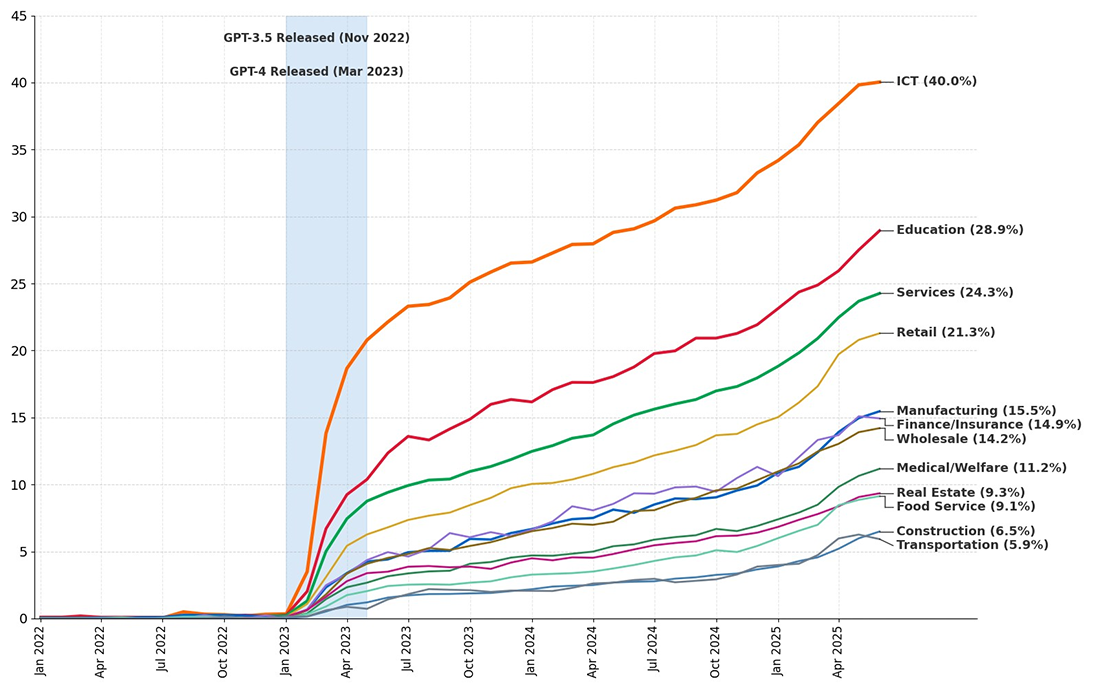
First, generative AI adoption levels differ clearly by sector (Figure 1). Adoption rates are high in such sectors as information and communications technology (ICT), education, services, and retail. In the ICT sector, in particular, the release of the GPT-3.5 and GPT-4 generative AI models triggered a rapid spread of generative AI. On the other hand, the spread has been limited to moderate levels in such sectors as construction, transportation, food services, real estate, and healthcare and welfare. In these industries, physical and face-to-face work plays a large role, making it difficult for these sectors to rapidly develop a complementary relationship with generative AI.
The manufacturing sector is somewhere in between the high and moderate AI adoption sectors. Its generative AI adoption rate, though not as high as in advanced digital sectors, is higher than in the construction and transportation sectors, and generative AI is spreading in certain business domains of the manufacturing sector. AI adoption gaps between sectors are also observed irrespective of whether business operations require face-to-face interactions or not, apparently reflecting differences in structural business tasks and digital infrastructure.
In the next section, we focus on digital infrastructure differences between companies and check utilization rates for various digital services based on such infrastructure by company size.
Generative AI adoption varies substantially across industries, yet the timing of uptake is highly synchronized, coinciding with major AI model releases rather than differing primarily by sector.
[Click to enlarge]
Source: Created by the authors using Money Forward cloud accounting services data.
Generative AI easily crosses company-size barriers
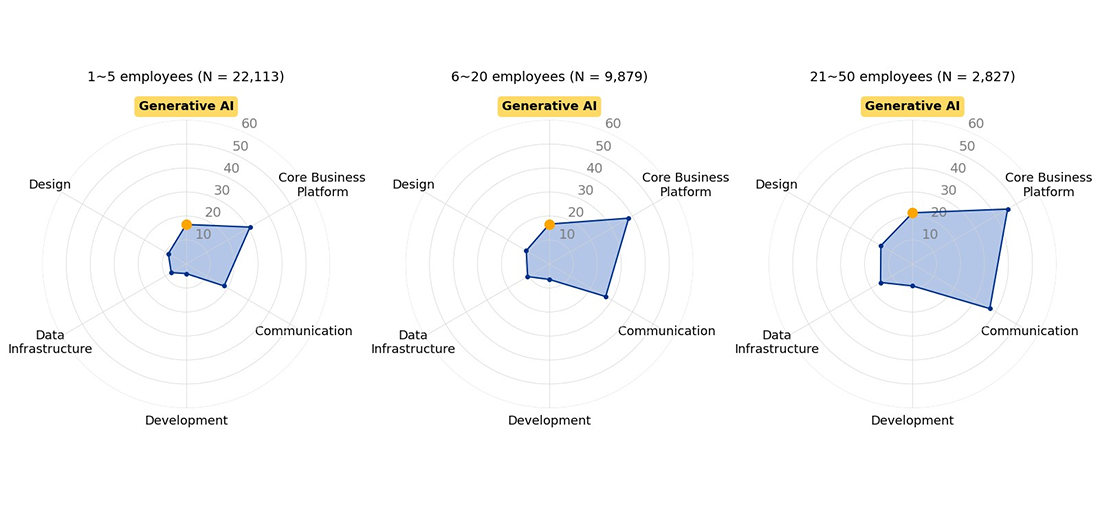
Next, we examine the utilization of digital services by company size (Figure 2). AI-related service utilization rates are higher for larger companies, while core business system and communication tool utilization rates are particularly high for medium-sized companies (with 21 to 50 employees), indicating that digital infrastructure is more developed for larger companies.
In contrast, generative AI adoption rates vary less by company size. Such rates are similar for the smallest companies with one to five employees and the second smallest ones with six to 20 employees, and they are a few percentage points higher for medium-sized companies, demonstrating that generative AI adoption requires less capital investment and organizational preparation than conventional information technology adoption, making generative AI easy even for small companies to adopt.
Most AI-related digital services show higher utilization among larger firms, while differences in generative AI adoption across firm size are relatively small.
[Click to enlarge]
Source: Created by the authors using “Money Forward Cloud” and “Money Forward Cloud Payroll” data.
Generative AI adoption timing is synchronized across sectoral boundaries and firm sizes
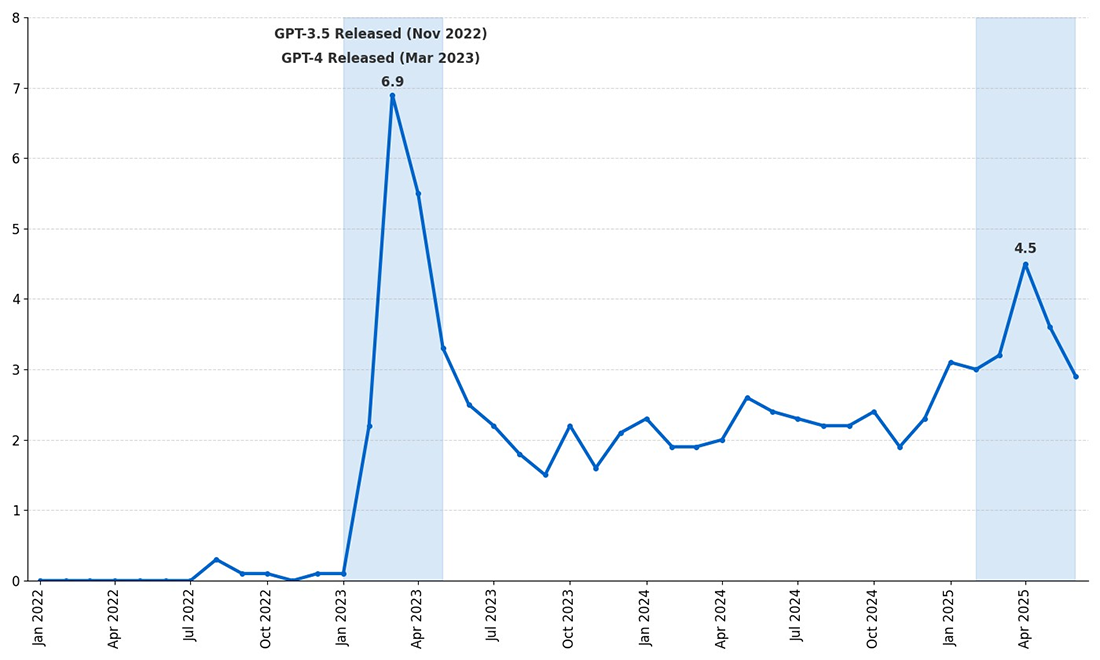
Regarding generative AI, more distinctive than adoption rates and employment sizes is the timing of adoption. Figure 3 shows monthly percentage shares for SMEs adopting generative AI from January 2022 to June 2025. Adoption was rarely seen throughout 2022. On the other hand, a sharp rise was observed in early 2023, indicating that adoption is heavily concentrated in a specific period of time.
It is an important point that, while generative AI adoption rates differ by sector, firm adoption timings are synchronized across sectors and firm sizes. Generative AI adoption has been strongly influenced by exogenous technical events, such as the release and update of large language models, indicating that adoption came in response to technological milestone events instead of spreading gradually as companies complete internal preparations. As a result, generative AI adoption is concentrated at specific points of time instead of spreading continuously. The result demonstrates that the generative AI adoption process, at least its initial phase, cannot be explained by the typical S-curve technology diffusion model.
Monthly share of SMEs that started using generative AI for the first time, January 2022–June 2025.
[Click to enlarge]
Source: Created by the authors using “Money Forward Cloud” data.
Big data used to find generative AI diffusion timings
These results show that when considering policies and measures for promoting the diffusion of a technology, it is important to focus not only on continuous diffusion trends but also to adopt a dynamic perspective of how to support companies when a technology wave arrives. As the diffusion of generative AI appears as a discontinuous leap, accurately grasping the process of the diffusion based on data will be the key to designing future support measures for SMEs and technology policies.
After generative AI becomes commonplace, it will be difficult to see the initial diffusion process and moments of concentrated adoption decisions. Big data about actual generative AI usage allow us to capture timings for such decisions and record how the diffusion process unfolded.
This research is still ongoing, and the analysis presented in this column represents the initial phase of generative AI diffusion. Empirical analyses using big data have an important role of grasping and recording data-based trends before new technologies take root in society, providing infrastructure to support future policy discussions.
Footnote
The data is handled strictly in accordance with relevant laws and the Terms of Use of Money Forward Inc. and is processed into statistical data that does not contain any personal information. For our approach to information security and the protection of personal information, please refer to the link below.
Information Security and Personal Information Protection|Money Forward, Inc.
December 25, 2025
>> Original text in Japanese
