



As governments expand industrial subsidies in the name of economic security, debate intensifies over whether such policies distort trade or enhance competitiveness. This column presents new evidence from China showing that subsidies do more than support individual firms – they ripple through domestic supply chains, boosting downstream exports and product quality. Industrial policy, it turns out, travels along value chains.
As industrial policy makes a global comeback, concerns about subsidies and trade distortions have intensified. The US Trade Representative (2024) argues that China’s subsidies harm foreign industries and may violate WTO rules. Meanwhile, Chinese policymakers maintain that such measures are legitimate and non-distortionary. At the same time, advanced economies are expanding their own subsidy programmes – from the US CHIPS and Science Act to Europe’s Net-Zero Industry Act. This renewed activism raises a fundamental question: Do industrial subsidies enhance international competitiveness, and if so, through what channels?
The existing literature provides conflicting answers. Girma et al. (2008) find that production subsidies increase export volumes among Chinese firms. By contrast, Bernard and Jensen (2004) find little evidence that US state export promotion subsidies significantly boost plant-level exports. More recently, Rotunno and Ruta (2024) show that domestic subsidies generally raise both exports and imports, though these patterns are partly driven by selection bias, as governments tend to support export-oriented and import-competing products. Yet most of this research focuses on direct recipients of subsidies. Much less attention has been paid to whether subsidies propagate through domestic production networks – potentially amplifying their effects along value chains.
In new research (Cheng et al. 2025), we address this gap by examining how both direct and upstream (indirect) industrial subsidies affect Chinese firms’ export performance.
The rise of China’s industrial subsidies and export
Industrial subsidies in China have increased dramatically, as shown in panel (a) of Figure 1. These subsidies refer to direct payments from central and local governments to the manufacturing, mining, and electricity/water/gas industries. Notably, there was a sharp acceleration in subsidy levels following the launch of the “Made in China 2025” programme in 2015 and the onset of the US–China trade war in 2018. Panel (b) shows that while China’s share of global exports increased from 3.5% in 1998 to 14.6% in 2022, China’s export unit values were typically only 40–60% of those of the rest of the world. However, lower prices alone do not explain China’s sustained export expansion. Relative export prices rose significantly after 2007, yet export shares continued to increase.
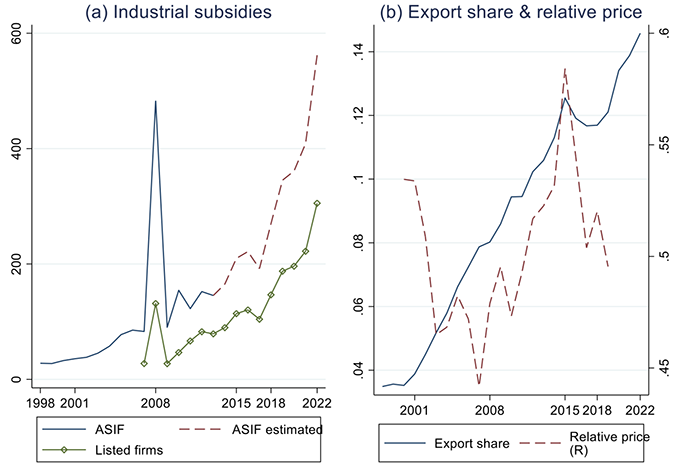
Source: Authors’ compilation based on the Annual Survey of Industrial Firms (ASIF), National Bureau of Statistics (NBS), WIND Chinese listed firms database, World Integrated Trade Solution (WITS) database, and Trade Unit Values (TUV) database, CEPII.
Looking inside the value chain
Production networks matter. Firms rarely operate in isolation; they depend on domestic suppliers of intermediate inputs. If upstream sectors receive government support, downstream firms may benefit through lower input costs, improved input quality, or looser financial constraints. Theoretical work on production networks suggests that policy shocks can propagate along input–output linkages. Liu (2019) estimates that reducing distortions in upstream sectors can generate sizeable efficiency gains in China. Yet empirical evidence linking upstream subsidies to export outcomes has been scarce.
We combine three rich data sources:
- The Annual Survey of Industrial Firms (ASIF), covering over three million firm-year observations from 1998–2013, including detailed information on production-related subsidies.
- Transaction-level Chinese customs data at the firm–product–destination level.
- Ownership-disaggregated inter-provincial input–output tables, allowing the construction of first- and second-tier upstream subsidy exposure.
The key innovation is the measurement of exposure to upstream subsidies. Instead of asking only whether a firm receives subsidies, our analysis measures the extent to which its input suppliers are subsidised.
Direct subsidies: Stronger on the intensive margin
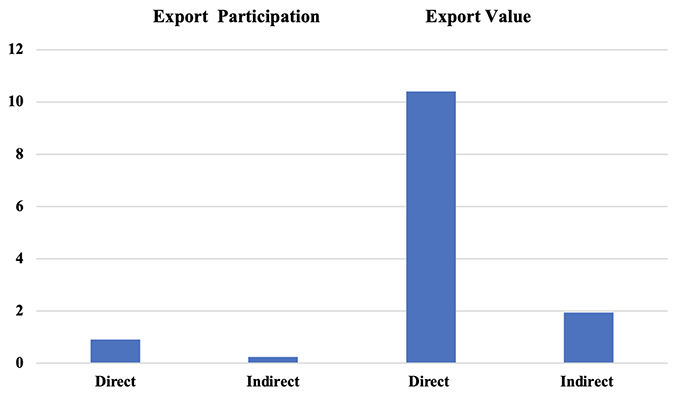
Consistent with Girma et al. (2008), direct subsidies significantly increase export performance. At the firm level, a one standard deviation increase in direct subsidies raises the probability of exporting by about 0.9% (Figure 2). The same increase raises export value by roughly 10%. The effect is clearly stronger on the intensive margin (export volume) than on the extensive margin (export participation). This pattern is consistent with models such as Arkolakis (2010), in which firms incur increasing market penetration costs: subsidies ease financial constraints, allowing firms to further expand sales in export markets rather than merely entering them.
Upstream subsidies: Spillovers along the network
The more novel result concerns upstream subsidies. Exposure to first-tier upstream subsidies significantly increases both export participation and export volume for downstream firms (Figure 2). Although the magnitudes are smaller than for direct subsidies, they remain economically meaningful. Importantly, these upstream effects operate primarily through the intensive margin. In other words, rather than facilitating the entry of new exporters, subsidies to input suppliers help existing exporters sell more. This finding underscores that industrial policy can have multiplier effects through domestic value chains. Subsidies not only affect targeted firms; they reshape competitiveness across interconnected sectors.
Price, quality, and quality-adjusted price
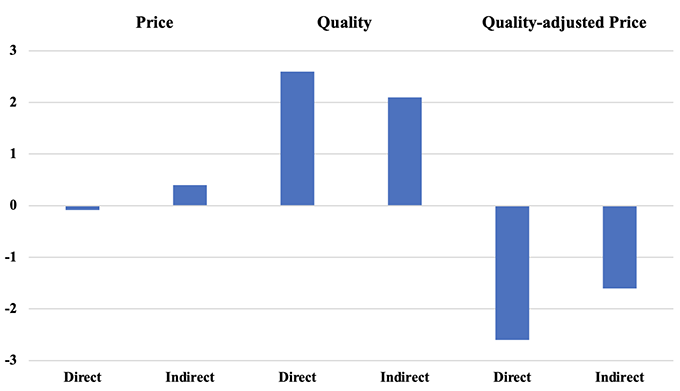
A central concern in policy debates is whether subsidies simply allow firms to undercut competitors on price. The evidence suggests a more nuanced story. Using firm–product–destination data and metrics for quality based on the Khandelwal (2010) framework, we find that:
- both direct and upstream subsidies are associated with higher estimated product quality (Figure 3);
- export prices do not systematically fall due to subsidies; and
- quality-adjusted prices decline.
In other words, subsidies appear to support quality upgrading rather than simple price dumping. Firms receiving subsidies – or those exposed to subsidised inputs – Improve product quality, allowing them to provide products with lower quality-adjusted prices. Once quality improvements are accounted for, effective prices fall.
Mechanisms
This result connects to the broader literature on industrial policy and competitiveness (Aghion et al. 2015, Kalouptsidi 2018, Barwick et al. 2025). It suggests that subsidies may operate by facilitating R&D and input upgrading, rather than merely lowering marginal costs. We identify two main channels: (1) direct subsidies increase firm-level R&D and the use of imported inputs, enhancing technological capability; and (2) upstream subsidies improve the availability and quality of domestic intermediate inputs.
Policy implications
Three implications follow for current debates in industrial policy.
- First, value chains matter. Evaluations that focus solely on direct recipients may underestimate the full impact of the subsidy program.
- Second, spillovers complicate trade remedies. Standard countervailing measures target specific firms or products. If distortions propagate through networks, identifying the ultimate incidence becomes more challenging.
- Third, quality upgrading is central. The evidence suggests that subsidies in China during 1998–2013 were associated not only with larger export volumes but also with higher product quality.
Concluding remarks
Industrial policy has re-entered the global policy mainstream. As countries expand subsidies to secure supply chains and technological leadership, understanding how such policies operate through production networks is essential. Evidence from China suggests that industrial subsidies can propagate along domestic value chains, boosting export performance and supporting quality upgrading. Whether other economies can replicate these effects - and at what cost – remains an open question. What is clear is that industrial policy cannot be analysed on a firm-by-firm basis alone. In an interconnected economy, subsidies travel through supply chains.
Editor’s note: The main research on which this column is based (Cheng et al. 2025) first appeared as a Discussion Paper of the Research Institute of Economy, Trade and Industry (RIETI) of Japan.
This article first appeared on VoxEU on March 25, 2026. Reproduced with permission.
