



Do geopolitical shocks to supply chains make firms retreat from globalisation? Using new survey data from 1,855 manufacturing firms in Japan, this column shows that firms support diplomatic solutions regardless of whether supply chain disruptions originate from an ally or a non-ally country. Geopolitical shocks are associated with lower support for diversification subsidies, compared to shocks stemming from natural disasters. Overall, it finds support for the commercial peace conjecture that firms seek diplomatic solutions to mitigate geopolitical risks.
Governments around the world have tightened restrictions on trade and investment based on economic-security justifications. The COVID-19 pandemic and rising geopolitical tensions, such as those caused by the US-China trade war (2018) and Russia’s invasion of Ukraine (2022), have accelerated the turn to protectionism. Industrial policy is also experiencing a revival: subsidy programmes for firms to diversify or nationalise their supply chains (‘supply chain resilience’) have become ubiquitous among advanced industrialised countries.
While these restrictions are costly to firms, firms’ positions on economic-security restrictions vary. The lack of unified opposition to protectionism among businesses challenges the commercial peace conjecture that economic interdependence contributes to peace by raising the costs of conflict for businesses (Gartzke 2007, McDonald 2009). Do geopolitical shocks to supply chains make firms more supportive of protectionist policies? When do firms support diplomatic solutions to deescalate geopolitical tensions and when do they support protectionism? How much are firms willing to shoulder the cost of diversification to achieve resilient supply chains?
Economists have investigated firms’ economic responses to geopolitical shocks to their supply chains. Handley et al. (2024) and Alfaro and Chor (2023, 2025) document that American firms are reallocating supply chains from China to friends and allies (‘friend-shoring’) and Zeng and Kim (2025) show that Chinese firms are also decoupling from the US.
Firms’ capacities to adjust do not translate into policy preferences
Yet, we cannot jump to the conclusion that geopolitical shocks make firms retreat from globalisation, because supply-chain reallocation reflects firms’ capacities to adjust to shocks but not necessarily their policy preferences to address shocks. Evidence from our firm-level survey in Japan conducted during Trump 2.0 tariff negotiations illustrate this point: larger firms are more likely to be ‘planning’ or ‘implementing’ supply-chain adjustment measures, such as investment expansion into the US and diversification to a third country, in response to the anticipated tariff shock (RIETI 2025, Ito et al. 2026). Firms that switched their supply chains due to geopolitical shocks in the past are more likely to support diplomacy to address supply chain disruptions over protectionism or diversification subsidies. In sum, these heterogeneous economic adjustment strategies do not translate into firms’ policy preferences.
Experimental evidence from Japanese manufacturing firms
To fill this gap in understanding, we fielded a large-scale survey of manufacturing firms in Japan, in collaboration with the Research Institute of Economy, Trade, and Industry (Naoi et al. 2026). We reached out to 15,000 manufacturing firms and received 1,855 responses (12.4% response rate). The survey embedded an experiment: it randomly assigned respondents to scenarios where the supply chains of important goods were disrupted. The scenarios varied on which country caused the supply chain disruption and who was affected by it. A supply chain shock originating in a natural disaster served as a control.
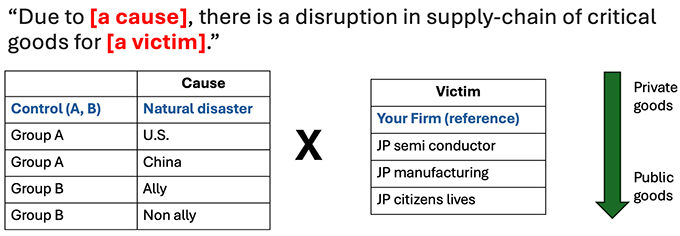
After reading each supply chain disruption scenario, respondents were asked to choose among the three policy options: coordination of interests through diplomacy, protectionism (tightening restriction), and diversification subsidies. The survey also asked respondents how much they were willing to share the cost of diversification subsidies with the government for randomly assigned scenarios of supply chain disruptions.
Diplomatic solution was popular, as were the diversification subsidies
Overall, 47.5% of firms chose diplomacy, 46.5% chose diversification subsidies, and a small fraction of firms (6%) chose protectionism.
Commercial peace: Diplomacy is the preferred solution to mitigate geopolitical risks
Figure 2 summarises the firms’ policy choices. We find that supply chain disruptions due to geopolitical causes are associated with 5.5 to 6.8 points higher support for diplomatic solutions and 7.1 to 7.4 points lower support for the diversification subsidies relative to the control condition (natural disaster). Contrary to the democratic peace conjecture, businesses support diplomacy to mitigate geopolitical risks regardless of whether the disruption originated from an ally or a non-ally.
Neither do Japanese manufacturing firms appear to discriminate between disruptions caused by the US versus China in their preference for diplomatic solutions or diversification subsidies. A disruption that originates in China increases support for protectionism by 2 points, although only a small fraction of firms we surveyed (6%) supported this policy option.
Overall, the results are consistent with the commercial peace conjecture that businesses support diplomatic solutions to mitigate geopolitical shocks over diversification subsidies or protectionism, relative to disruptions originating from natural disaster.
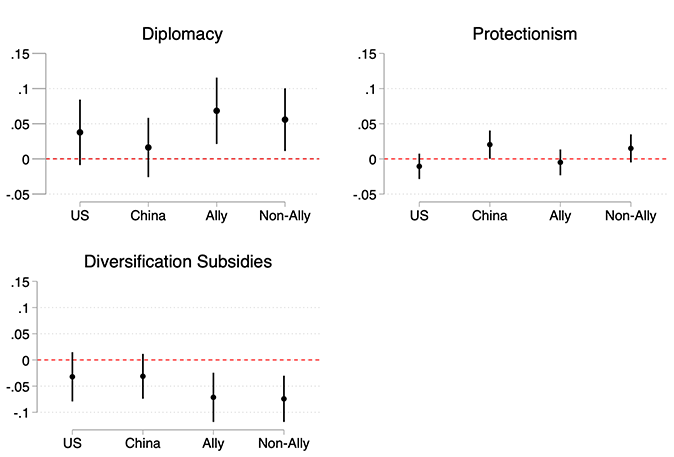
Source: Survey on Changes in World Affairs and Oversea Business Activities (RIETI 2025).
Why diversification subsidy is popular, but corporate economic-security tax is not
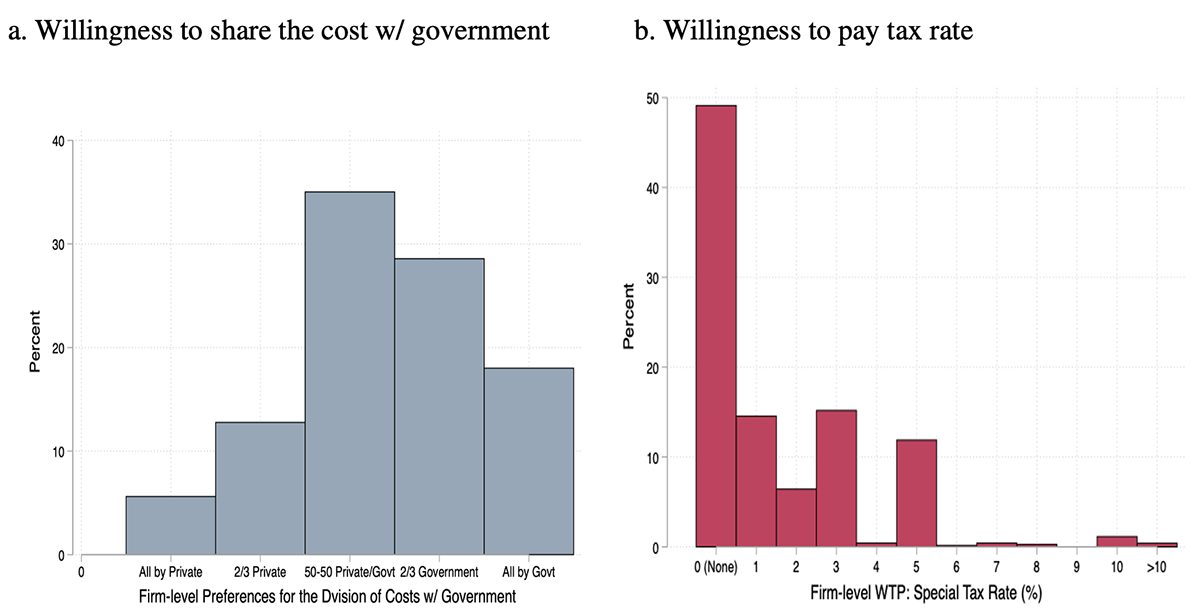
Next, we investigate the popularity of diversification subsidies (chosen at 46.5%). For the different supply chain disruption scenarios, we ask how much firms are willing to share the cost of a diversification subsidy programme with the government (Figure 3a) and what is the acceptable tax rate for an economic national security tax to build resilient supply chains (Figure 3b). Firm respondents were asked to choose on the five-point Likert scale, ranging from 1 (“Private firms should shoulder 100%”) to 5 (“Government should shoulder 100%”), where 3 indicates “Private firms and government split the cost 50–50”.
[Click to enlarge]
Firms’ willingness to pay varies between the two policy tools to finance resilient supply chains. For the diversification subsidy programme, around a half of firm respondents are willing to shoulder the cost of diversification subsidies at 50% or higher proportion with the government. By contrast, for corporate tax on economic national security, half the firm respondents are not willing to accept any positive tax rate.
A possible explanation for this divergence is that firms’ participation in the diversification subsidy programme is voluntary, and firms do so only when its benefits outweigh the costs. In contrast, economic-security tax is a mandatory contribution regardless of whether firms benefit or lose from the diversification. The stark difference between the two policy tools may help explain why diversification subsidy programmes are ubiquitous among advanced industrialised nations.
Greater demand for the government to pay for diversification from the ally
Figure 4 summarises the results on the willingness to share the cost of diversification subsidies. The left panel shows the results for global firms, and the right panel shows the results for domestic firms.
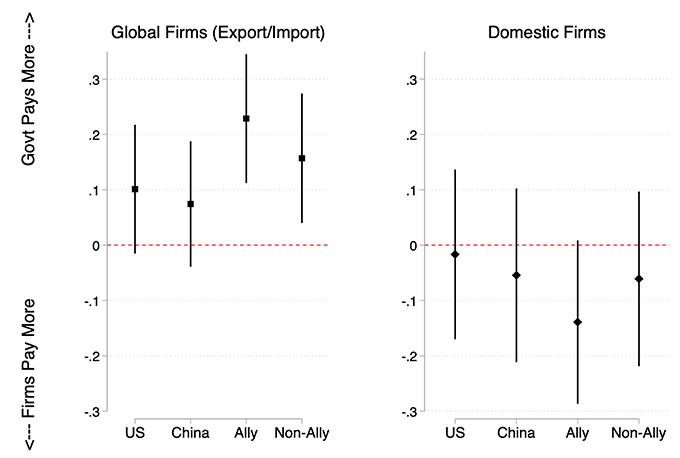
Source: Survey on Changes in World Affairs and Oversea Business Activities (RIETI 2025).
The results suggest that geopolitical shocks originating in an ally country and a non-ally country are similarly associated with a lower willingness of global firms to shoulder the cost and greater demand for the government to do so. The finding challenges the conventional wisdom that disruptions from a non-ally would be associated with higher demand for the government to step in national security is a public good. The findings also challenge another commonly held view that global firms demand government involvement less than domestic firms.
Our results are consistent with the widespread use of subsidy programmes among advanced economies. They further suggest that geopolitical shocks might generate structural shifts in subsidy programmes away from those targeting declining industries (Beason and Weinstein 1996, Cabellero et al. 2008) to those targeting winners in the global economy.
Not all good news: What’s next?
Finally, our scenario of a supply-chain disruption originating from China mobilises in our results a small (2 point) but statistically significant increase in firms’ support for protectionism. While the effect size is small, a promising line of future research may be to investigate the demand-side mechanism for the rising economic-security restriction, that is, what drives firms to demand that their government restrict globalisation.
This article first appeared on VoxEU on May 1, 2026. Reproduced with permission.
