


| Author Name | Willem THORBECKE (Senior Fellow, RIETI) |
|---|---|
| Creation Date/NO. | September 2026 |
| Download / Links |
This Non Technical Summary does not constitute part of the above-captioned Discussion Paper but has been prepared for the purpose of providing a bold outline of the paper, based on findings from the analysis for the paper and focusing primarily on their implications for policy. For details of the analysis, read the captioned Discussion Paper. Views expressed in this Non Technical Summary are solely those of the individual author(s), and do not necessarily represent the views of the Research Institute of Economy, Trade and Industry (RIETI).
The Swiss and Japanese economies share many common characteristics. Both Swiss and Japanese students excel at math. In the 2025 Programme for International Student Assessment tests administered by the OECD, Swiss students ranked ninth out of 91 countries and Japanese students ranked fifth in mathematics. Both economies invest in research and development. Both export sophisticated products. Switzerland’s export basket since 2001 ranks as the 3rd most sophisticated out of 146 exporters according to the Atlas of Economic Complexity. Japan’s export basket since 2001 ranks as the most sophisticated.
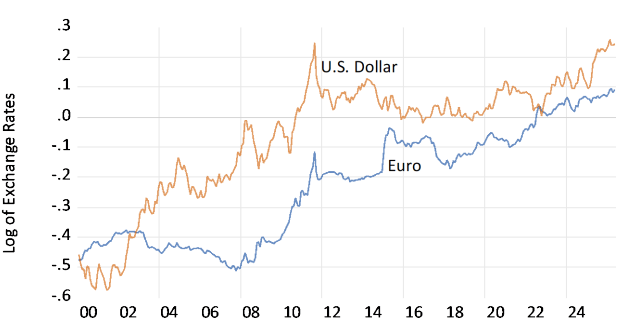
Safe haven capital inflows and current account surpluses have led to continuous appreciations of the Swiss franc (CHF). Figure 1 shows that the CHF has appreciated by 51% versus the euro and 73% versus the U.S. dollar between January 2001 and May 2026.
Many researchers have reported that an appreciating franc exerts only a limited impact on the volume of Swiss exports. This is because, as the IMF (2013) stated, Swiss “. . .exporting industries may be built around production of very specific items, which are particularly valued for their brands or special characteristics and hence face limited price competition” (IMF, 2013, p. 18).
The driver of Switerland’s trade surplus has been the pharmaceutical sector (Sauré, 2015). Sauré found that the exchange rate has no impact on pharmaceutical trade. Auer and Sauré (2011) noted that one reason the exchange rate does not impact Swiss sectors such as pharmaceuticals and chemicals is that producers face limited competition in these goods.
China, however, has emerged as a formidable competitor in the pharmaceutical and chemical industries. Barwick et al. (2026) documented that by 2020 China had surpassed the U.S. and the EU in global clinical trials. They also showed that Chinese scholars now publish over 50,000 biomedical papers per year. China has also been able to manufacture goods at low prices. As Chinese firms have reached the technological frontier in many areas of pharmaceutical and chemical production, they may challenge Swiss companies in these industries.
This paper investigates whether Swiss exports are now sensitive to exchange rates. Both time series and panel data evidence indicate that Swiss franc appreciations cause large decreases in both total exports and in chemical and pharmaceutical exports. A 10% appreciation is associated with decreases of close to 10% in both total exports and pharmaceutical exports. Unlike findings using earlier data, these results indicate that appreciations reduce the price competitiveness of even Switzerland’s most advanced sectors.
The results also indicate that appreciations reduce stock prices in the lion’s share of Swiss sectors. This includes both the chemical and the pharmaceutical sectors. Thorbecke and Kato (2018) found that the pharmaceutical sector was not affected by exchange rates over the 2001-2016 period.
Swiss firms in 2026 are vocal about the dangers of the strong franc. Swiss industries including pharmaceuticals, watches, luxury goods, machinery, electrical engineering, metals, and chemicals have complained that the strong franc weakens their competitiveness (Ruehl and Smith, 2026). Swiss chocolate maker Johannes Läderach said that the strong franc is the greatest threat for the Swiss economy (Bassin, 2026).
The Swiss private sector has been resourceful in fighting a strong franc. Novartis increases productivity by keeping workers happy (e.g., by providing daycare facilities). ABB seeks to cut costs through continual improvements (kaizen) by encouraging criticisms and suggestions from workers. PB Swiss Tools’ managers and workers agreed together to fight the appreciating franc by working 43 hours per week instead of 40. Firms in other countries should learn from how Swiss firms maintain resilience in the face of volatile exchange rates.
- Reference(s)
-
- Auer, R., and Sauré , P., 2011. Export Basket and the Effects of Exchange Rates on Exports – Why Switzerland is Special. Federal Reserve Bank of Dallas Globalization and Monetary Policy Institute Working Paper No. 77.
- Barwick, J., Xia, H., and Xia, T. 2026. From Free Rider to Innovator: The Rise of China's Drug Development. NBER Working Paper 34977.
- Bassin, Aline. 2026. Johannes Läderach: La force du Franc Reste la Plus Grande Menace Pour L’économie Suisse. Le Temps. 3 April 2026.
- IMF. 2013. Switzerland Selected Issues Paper. IMF Country Report, No 13-129. Available at: http://www.imf.org/external/pubs/ft/scr/2013/cr13129.pdf .
- Ruehl, Mercedes and Smith, Ian. 2026. Franc’s Relentless Rise Alarms Swiss Companies. Financial Times, 15 February.
- Sauré, P. 2015. The Resilient Trade Surplus, the Pharmaceutical Sector, and Exchange Rate Assessments in Switzerland. Peterson Institute Working Paper Series WP 15-11.
- Thorbecke, W., and Kato, A. Exchange Rates and the Swiss Economy. Journal of Policy Modeling, 40, 1182-1199.
