



| Author Name | Willem THORBECKE (Senior Fellow, RIETI) |
|---|---|
| Creation Date/NO. | May 2026 |
| Download / Links |
This Non Technical Summary does not constitute part of the above-captioned Discussion Paper but has been prepared for the purpose of providing a bold outline of the paper, based on findings from the analysis for the paper and focusing primarily on their implications for policy. For details of the analysis, read the captioned Discussion Paper. Views expressed in this Non Technical Summary are solely those of the individual author(s), and do not necessarily represent the views of the Research Institute of Economy, Trade and Industry (RIETI).
The Bank of Japan (BoJ) implemented quantitative and qualitative easing (QQE) in 2013. It also set a two percent inflation target. The monetary base increased fourfold over the next ten years. The BoJ initiated yield curve control (YCC) in 2016. YCC involved fixing the uncollateralized overnight call rate at negative 0.1 percent and establishing a band of 25 basis points around zero for 10-year Japanese government bonds (JGBs).
The BoJ has since started to normalize monetary policy. Governor Ueda signaled that the BoJ would abandon ultra-low interest rates and normalize monetary policy if a virtuous cycle between wages and prices developed. In this cycle, as the labor market tightens and nominal wages rise, consumer spending increases. This in turn raises prices and triggers further wage increases. Believing that inflationary dynamics had improved, the BoJ raised its target for the overnight call rate to 0.25 percent in July 2024, 0.50 percent in January 2025 and 0.75 percent in December 2025. It also allowed the interest rate of 10-year JGBs to rise from zero in August 2021 to over two percent in February 2026.
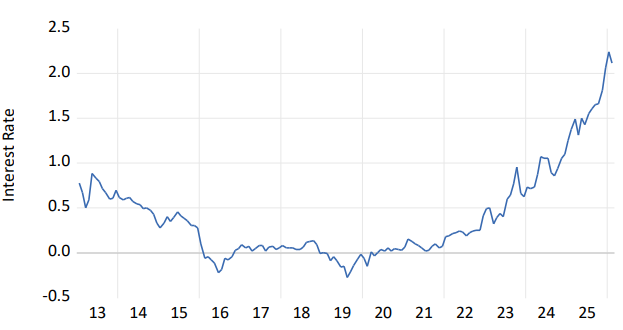
Figure 1 plots yields on 10-year JGBs between January 2013 and February 2026. Yields averaged 0.52 percent between 2013 and 2015. They were frequently negative between 2016 and 2020. They then started increasing in August 2021 and reached 2.11 percent in February 2026.
In countries where interest rates are positive, central bank interest rate increases often lower stock prices. For instance, Bernanke and Kuttner (2005) reported that an unexpected 25-basis-point increase in the Federal Reserve’s target for the federal funds rate decreases aggregate stock returns by one percent. They also found that many individual industries are affected by funds rate changes. As Bernanke and Kuttner discussed, the impact of interest rates on stock prices constitutes a key channel of monetary policy transmission.
This paper uses Krippner’s (2013) shadow short-term rate and daily data to investigate how Japanese monetary policy impacts stock returns. Since interest rates were sometimes zero or negative, Krippner’s (2013) shadow rate provides an alternative measure that moves more over time. Many authors (e.g., Fukuda, 2025, Inoue and Okimoto, 2022, and Yoshida and Zhai, 2025) have found that Krippner’s rate is a useful measure of monetary policy.
The paper examines three periods. The first is from 2013 to 2017 when Abenomics and QQE emerged. The second is from 2017 to 2021 and includes the COVID-19 pandemic episode. The third begins in August 2021 as interest rates on 10-year JGBs turned positive. The findings indicate that monetary policy lowered stock returns during the period beginning in August 2021 when interest rates were positive but did not lower them before. Thus, after August 2021 monetary policy affected stock returns as it does in countries with positive interest rates. These results indicate that, in a positive interest rate environment, the impact of interest rates on stock prices can help to transmit monetary policy shocks to the rest of the Japanese economy.
- Reference(s)
-
- Bernanke, B. and Kuttner, K. 2005. What Explains the Stock Market's Reaction to Federal Reserve Policy? Journal of Finance, 60, 1221-1257.
- Fukuda, S. 2025. Short-run and Long-run Consequences of Unconventional Monetary Policy in Japan. Journal of the Japanese and International Economies 77, Article Number 101375.
- Inoue, T., and Okimoto, T. 2022. International Spillover Effects of Unconventional Monetary Policies of Major Central Banks. International Review of Financial Analysis 79, Article Number 101968.
- Krippner, L. 2013. Measuring the Stance of Monetary Policy in Zero Lower Bound Environments. Economics Letters, 118, 135-138.
- Ueda, K. 2025. Japan's Labor Market under Demographic Decline: Evolving Dynamics and Macroeconomic Implications. Remarks at the Jackson Hole Economic Policy Symposium, 23 August. Available at: https://www.boj.or.jp/en/about/press/koen_2025/ko250824a.htm.
- Yoshida, Y., and Zhai, W. 2025. Can Exchange Rate Pass-throughs Be Perverse? A Robust Multiple-prior Bayesian SVAR Approach. Journal of International Money and Finance 154, Article Number 103312.
