



| Author Name | Shiro ARMSTRONG (Non-Resident Fellow, RIETI) / URATA Shujiro (Senior Research Advisor, RIETI / Waseda University) |
|---|---|
| Creation Date/NO. | July 2026 |
| Download / Links |
This Non Technical Summary does not constitute part of the above-captioned Discussion Paper but has been prepared for the purpose of providing a bold outline of the paper, based on findings from the analysis for the paper and focusing primarily on their implications for policy. For details of the analysis, read the captioned Discussion Paper. Views expressed in this Non Technical Summary are solely those of the individual author(s), and do not necessarily represent the views of the Research Institute of Economy, Trade and Industry (RIETI).
Industrial policy has returned to the centre of economic policymaking across the advanced industrial world. Once dismissed as distortionary and largely confined to late-industrialising economies, state-led intervention has been revived in Europe, North America and East Asia, driven by the disruptions of the Global Financial Crisis, the COVID-19 pandemic, intensifying US–China rivalry, the urgency of decarbonisation and the weakening of multilateral trade disciplines. This paper examines Japan’s place at the fault line of these changes. It argues that Japan’s current industrial policy draws on elements of its postwar developmental state—state coordination, sectoral targeting and public support for strategic industries—but operates in a fundamentally different economic and geopolitical environment. Whereas earlier policy pursued catch-up growth and export competitiveness, today’s agenda is shaped by supply chain vulnerability, technological competition, energy insecurity and the erosion of the rules-based order. Japan’s economic security agenda seeks both strategic autonomy and strategic indispensability, but in doing so it generates trade-offs between resilience, efficiency, fiscal sustainability and openness.
Historical background
Japan’s postwar industrial policy originated in the reconstruction of the late 1940s and early 1950s, when the dissolution of the zaibatsu, land and labour reform, macroeconomic stabilisation and the establishment of MITI in 1949 reorganised a devastated economy. The Korean War provided an external stimulus that accelerated recovery, and rationalisation policies—supported by tax incentives, fiscal investment and foreign exchange controls—marked the emergence of a targeted approach in which the state actively supported sectors that were deemed as critical. The high-growth period from the late 1950s to the early 1970s is most closely associated with the developmental state, as import protection, low-interest loans, subsidies and tax incentives were directed toward steel, shipbuilding, petrochemicals and automobiles. The effectiveness of this targeting remains contested: while accounts such as Johnson’s credit MITI’s coordination for Japan’s “miraculous” growth, later sectoral studies find that support often flowed to inefficient industries and that the contribution of policy, as distinct from broader economic conditions, is difficult to isolate. The oil crises of the 1970s shifted policy toward knowledge-intensive and high value-added sectors, and it was in this period that the concept of economic security first entered Japanese policymaking, framed around free trade, diplomatic relations and energy and food security. The 1990s and 2000s saw a retreat from the developmental state and a turn to market-led restructuring, before the Washington Consensus began to break down in the mid-2010s.
The new economic security environment
Five related trends underpin the revival. The rise of China has rearranged the global trading order and deepened Japan’s dependence on Chinese production in sectors such as electronics and medical goods, exposing it to strategic risk—as the 2010 rare earth episode demonstrated. The retreat of the United States from its role as anchor of the multilateral system, from withdrawal from the Trans-Pacific Partnership to the more transactional posture of successive administrations, has weakened the institutional foundations on which Japan relied. The intensification of US–China strategic competition has constrained Japan’s policy choices and led to the pursuit of bilateral arrangements that operate outside traditional WTO rules. The emergence of dual-use digital and cyber technologies has made control over semiconductors, artificial intelligence and related fields a primary arena of great-power competition, prompting Japan to expand its export controls. And the COVID-19 pandemic exposed the fragility of the tightly integrated, just-in-time supply chains on which Japanese industry depends. These shifts are reflected in a marked global increase in harmful trade interventions, of which industrial policy now comprises a substantial share.
[Click to enlarge]
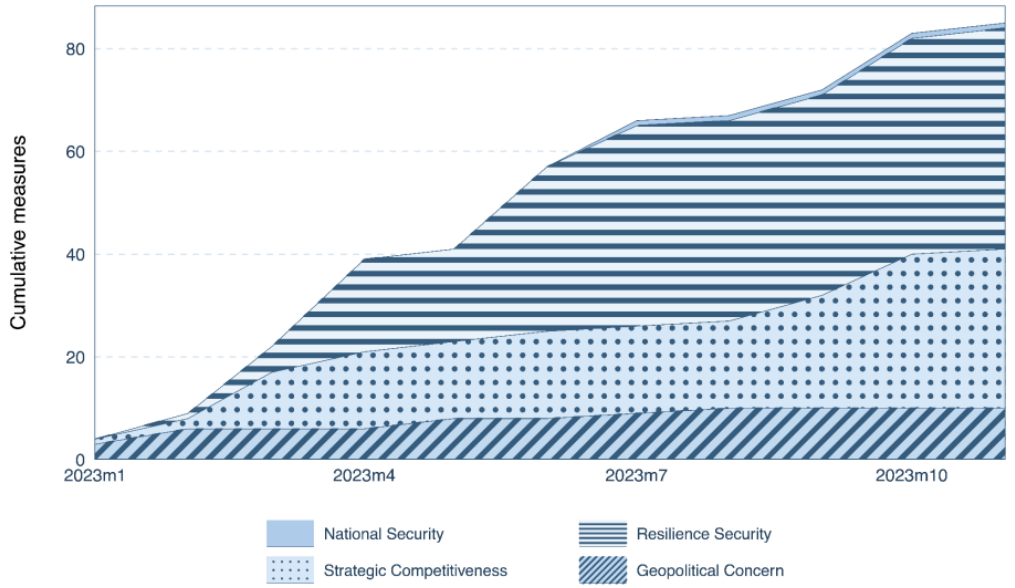
Japan’s strategic calculus is shaped by its position between the United States and China and its continued reliance on global markets. Policymakers have emphasised supply chain resilience for critical goods such as semiconductors, pharmaceuticals and critical minerals, pursued through selective onshoring, diversification, stockpiling and partnerships with the United States, Australia and the European Union. As Figure 1 shows, the vast majority of Japan’s harmful trade interventions are motivated by resilience security and strategic competitiveness rather than national security and geopolitical concerns. This pattern contrasts sharply with the United States and the wider G7, where such measures are distributed more evenly across motivations: Japan stands out for deploying protectionist instruments to advance domestic economic goals. Yet Japan has not abandoned the rules-based order, having earlier led the conclusion of the CPTPP and joined RCEP, and continuing to cooperate with like-minded partners on standards and investment.
Frameworks, instruments and trade-offs
The centrepiece of the contemporary agenda is the Economic Security Promotion Act (2022), built around four pillars: securing critical goods, protecting key infrastructure, supporting advanced technologies and restricting the disclosure of sensitive intellectual property. Policy is most heavily concentrated in semiconductors, where subsidies have funded both TSMC’s Kumamoto facility, which produces legacy chips based on a familiar catch-up logic, and the state-backed venture Rapidus, which aims to manufacture next-generation 2-nanometre chips by 2027—a far more speculative bid to build capability at the technological frontier. The agenda extends to green transformation, critical minerals and rare earth stockpiling, defence, and a widening set of strategic fields under Prime Minister Takaichi, operationalised through a whole-of-government institutional architecture. These commitments amplify an already heavy fiscal burden in an economy carrying public debt exceeding 200 per cent of GDP amid ageing and near-zero growth, and raise the danger of subsidy lock-in and a cross-border subsidy race. Crucially, the paper argues that treating efficiency and security as substitutes is mistaken: deep integration constrains coercion, expands Japan’s options and makes prosperity itself the greatest hedge against geopolitical risk.
Conclusion
Japan offers both a model and a cautionary tale. Its policies demonstrate how advanced economies are adapting to global disorder, yet they have generated new fiscal pressures and raise questions about the balance between free trade and resilience. Managing the new industrial policy requires stronger international disciplines on subsidies—advanced through plurilateral and regional agreements such as the CPTPP and RCEP and, ultimately, a restored WTO—to limit negative spillovers and prevent a beggar-thy-neighbour race to the bottom. Whether Japan can reconcile technology, industry and international cooperation while preserving openness around the axis of economic security will determine the sustainability of its prosperity.
- Reference(s)
-
- Evenett, Simon, Adam Jakubik, Fernando Martín, and Michele Ruta. 2024. "The Return of Industrial Policy in Data." The World Economy 47, no. 7: 2762–88.
