



Summary
- At the Promotion Committee for the Privatization of the Four Highway-related Public Corporations (an advisory committee to the Premier, hereinafter reffered to as "Advisory Committee"), debates have been proceeding based on the basic idea that the four highway entities shall be privatized and shall go public, that the privatized highway entities shall receive no additional public funds, and that the entities shall permanently collect tolls on the premise of maintaining the current level of toll rates. The debates, however, surprisingly lack analysis on how to correct the current high-cost structure that brings about extremely high logistics costs in Japan,thus accelerating the hollowing out of Japanese industry.
- Today's financial deterioration of toll highway management is primarily attributable to undercapitalization (i.e.,insufficient injection equity money.) International comparison clearly shows that the Japanese toll highways are less capitalized than other countries. China, which made the same mistake in operating state-owned enterprises (SOEs), has learned its lesson and shifted to a policy to tackle the "over-debt problem" of SOEs by way of "debt-for-equity swaps"and strengthening capital bases for future projects.
- Toll highway users are being forced to pay more than the benefits they actually receive, effectively compensating for insufficient infusion of state funds. Introducing a permanent toll collection system without any reform on the toll rates is unfair and may accelerate the hollowing out of Japanese industry. Japan should tackle this pressing issue in a straightforward manner, providing necessary funds to strenghen the capital base of highway entities.
- While price destruction proceeds on a freer side of the Japanese economy, price adjustment has hardly taken place in the other side, that is, industries under strong government influence. To revive the nation's economy, it is vital to correct this dual structure. By rectifying the high-cost structure in a way to better reflect users' viewpoints, the ongoing reform on highway management can lead to the reform of the high-cost structure of other logistics a nd distribution sectors.
- Poor capitalization of public entities and the problem of bad loans held by special purpose public corporations - or the souring of FILP assets - are two sides of the same coin. Even if the government opts to implement a straightforward solution that would result in an increase in fiscal burden, market players would take it simply as the surfacing of Japan's hidden "off-the-book debts" that they have long discounted. By clearly demonstrating that the government is taking up additional fiscal burden as an investment for industrial revitalization, it can avoid additional "Japan selling."
The launch of the Advisory Committee for the Privatization of the Four Highway-related Public Corporation, a government advisory panel to the Prime Minister, has activated debates on the reform of Japan's highway management both within and outside the committee. The mass media are generally supportive of pro-reform committee members who are fighting against the resistance forces, namely, pro-road construction lawmakers who are firmly against the ongoing reform initiatives. However, the big mystery is that the ongoing debates at the committee completely lack an examination of what to do with the current costly highway tolls. Why is this happening?
Reform Debates in the Total Absence of Viewpoints of Changing Toll Rates
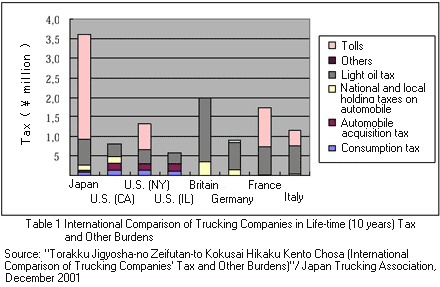
There are two major reasons why I insist on this particular point. First the aggravating condition of the hollowing out of Japanese industry. It is widely viewed that Japan's high-cost structure - in which the high costs of logistics, electricity, gas and other infrastructure push up the cost of every business in Japanese economy - is primarily responsible for driving many Japanese companies to relocate their production bases abroad. Above all, costly highway tolls have been perceived as one of the most serious problems. (See Table 1)
[Summary] (1) At the Promotion Committee for the Privatization of the Four Highway-related Public Corporations (an advisory committee to the Premier, hereinafter reffered to as "Advisory Committee"), debates have been proceeding based on the basic idea that the four highway entities shall be privatized and shall go public, that the privatized highway entities shall receive no additional public funds, and that the entities shall permanently collect tolls on the premise of maintaining the current level of toll rates. The debates, however, surprisingly lack analysis on how to correct the current high-cost structure that brings about extremely high logistics costs in Japan,thus accelerating the hollowing out of Japanese industry . (2) Today's financial deterioration of toll highway management is primarily attributable to undercapitalization (i.e.,insufficient injection equity money.) International comparison clearly shows that the Japanese toll highways are less capitalized than other countries. China, which made the same mistake in operating state-owned enterprises (SOEs), has learned its lesson and shifted to a policy to tackle the "over-debt problem" of SOEs by way of "debt-for-equity swaps"and strengthening capital bases for future projects. (3) Toll highway users are being forced to pay more than the benefits they actually receive, effectively compensating for insufficient infusion of state funds. Introducing a permanent toll collection system without any reform on the toll rates is unfair and may accelerate the hollowing out of Japanese industry. Japan should tackle this pressing issue in a straightforward manner, providing necessary funds to strenghen the capital base of highway entities. (4) While price destruction proceeds on a freer side of the Japanese economy, price adjustment has hardly taken place in the other side, that is, industries under strong government influence. To revive the nation's economy, it is vital to correct this dual structure. By rectifying the high-cost structure in a way to better reflect users' viewpoints, the ongoing reform on highway management can lead to the reform of the high-cost structure of other logistics a nd distribution sectors. (5) Poor capitalization of public entities and the problem of bad loans held by special purpose public corporations - or the souring of FILP assets - are two sides of the same coin. Even if the government opts to implement a straightforward solution that would result in an increase in fiscal burden, market players would take it simply as the surfacing of Japan's hidden "off-the-book debts" that they have long discounted. By clearly demonstrating that the government is taking up additional fiscal burden as an investment for industrial revitalization, it can avoid additional "Japan selling." The launch of the Advisory Committee for the Privatization of the Four Highway-related Public Corporation, a government advisory panel to the Prime Minister, has activated debates on the reform of Japan's highway management both within and outside the committee. The mass media are generally supportive of pro-reform committee members who are fighting against the resistance forces, namely, pro-road construction lawmakers who are firmly against the ongoing reform initiatives. However, the big mystery is that the ongoing debates at the committee completely lack an examination of what to do with the current costly highway tolls. Why is this happening? Reform Debates in the Total Absence of Viewpoints of Changing Toll Rates There are two major reasons why I insist on this particular point. First the aggravating condition of the hollowing out of Japanese industry. It is widely viewed that Japan's high-cost structure - in which the high costs of logistics, electricity, gas and other infrastructure push up the cost of every business in Japanese economy - is primarily responsible for driving many Japanese companies to relocate their production bases abroad. Above all, costly highway tolls have been perceived as one of the most serious problems. (See Table 1) The rise of China as an economic power has been heightening the sense of concern in Japan. The highway reform is directly linked to the problem of high-cost structure. In the ongoing debates on highway reform, however, no one has questioned the rational of maintaining the current level of highway tolls in view of the future of Japan's industrial structure. Why is this important perspective completely absent from the debates?
It Is No Wonder That Undercapitalized Highways Are Costly
Second the financial problems of Japan's four major highway-managing public corporations is resemble the problem that plagued Chinese state-run enterprises in the past.
Major factors often cited as responsible for pushing up highway tolls and jeopardizing the financial future of the highway-managing public corporations include: 1) the "pork barreling" of the road constructionenabled by "toll pooling system" with which unprofitable routes are to be internally subsidized by profitable ones, 2) the exorbitant purchasing prices of lands and high construction costs, and 3) the parasitic nature of numerous "family" subsidiaries dangling under the four major highway-managing public corporations. These are fair-enough points and I do hope that the Advisory committee will address them. But an important point is still lacking. That is what to do with funding structure for the road construction.
In the 45-year history of the Japan Highway Public Corporation, its, use of state funds (capital expenditures), only accounted for average 9.5 percent of total construction costs. In contrast, roughly 30 percent of toll highway construction costs are covered by state funds in France and Italy. Furthermore, the United States, Germany, the Netherlands and Belgium cannot be directly compared because highway construction in those countries is fully financed by state funds and no tolls are charged (according to an article written by Mr. Goro Adachi to "Watashi no Shiten (My Viewpoint)" column of daily Asahi Shimbun dated Dec. 8, 2001).
State funds in this context are equivalent to capital in a private-sector company. When road construction and management - a large-scale apparatus industry - is operated under an extremely undercapitalized condition, a level less than one third of the average overseas, it is no wonder that tolls are raised and the cost-and-profit conditions of the project deteriorate.
For many years, Japan's highway construction has been poorly capitalized and has overly borrowed funds from the FILP, thereby, expanding the scale of highway construction projects, while keeping state expenditures to a minimum. This scheme may be an outcome of a compromise between the Ministry of Finance and politicians' pressure which demands more contracts for constituencies at home and earliest access to the national highway network for rural areas. In the meantime, however, the mounting burden of repaying debts and interests has resulted in exorbitant highway tolls, which in return push up overall logistics costs and accelerate the industrial hollowing out. (The government has made the same mistake in airport construction and other major infrastructure projects, replacing necessary capital expenditures with over borrowing from FILP and overly relying on beneficiary users under the name of "beneficiary-payment principle. " The Kansai International Airport, a typical project dependant on FILP funds, is now going to bankruptcy even with such over "beneficiary-payment.")
China Learned Bitter Lessons After Getting Burned from State-owned Enterprises
In the 1980s through mid-1990s, state-owned enterprises (SOEs) in China were treading a similar path. China was then hard up for money but wanted to move quickly to realize economic growth. Under these circumstance, SOEs pushed ahead with new investment projects, ranging from infrastructure development to factory construction, as long as they managed to raise enough "funds." This is nothing but enforcing investment plans by undercapitalized entities. In an extreme example, a whole new apparatus industry venture was established that was fully financed by bank loans.
Such a reckless attempt came to its natural end. With losses quickly piling up, even a brand new state-of-the-art factory was quickly forced to close down. Bank loans deservedly went sour. A substantial portion of the massive NPLs held by Chinese state-owned banks is attributable to these doomed-to-fail investments made in the 1980s. In the mid-1990s, the Chinese government noticed something had gone wrong and realized why, but too much harm was already done.
Japan's highway construction are quite similar. Based on overly optimistic fabricated demand estimations and with debt-rich, capital-poor fund structures, a number of road construction projects were carried out. One can hardly distinguish "TheHonshu-Shikoku Bridges" or "the Tokyo Bay Aqualine (bridge and road system)" from the textbook cases of Chinese SOEs' failures. Japan Highway Public Corp. is not in immediate danger of bankruptcy thanks to ample profits from the Tomei Expressway. Based on international comparison, however, the company is obviously undercapitalized and burdened with excessive debts.
The Advisory Committeeare trying to map out reform plans on the presupposition that all the four public highway corporations will be privatized, that the post-privatization entities be listed in stock markets, and that no more fiscal expenditures be provided. Also, debates at the committee seem to be proceeding in the direction of allowing the highway-operating entities to permanently collect tolls on the premise of maintaining the current toll levels. But isn't there something wrong with this?
Recapitalization and Debt Securitization: China's Answer
The mountains of non-performing loans (NPLs,) which were left behind by undercapitalized and debt-ridden state-owned enterprises have taught the Chinese government that securing an adequate capital base is indispensable to sound management of a company. An administrative order concerning capital requirements for investment projects, issued by the Chinese State Council in 1996, has provided that in case of an investment project with a long leading period, such as a construction of transportation infrastructure, the government shall not approve it unless its undertaking entity clears a 35 percent threshold in capital-to-asset ratio. (Coincidentally, the threshold figure is nearly equivalent to the earlier-mentioned international level.)
As means to dispose of NPLs held by financially insolvent SOEs, the Chinese government either liquidated or relieved them from excessive debts by carrying out debt-for-equity swaps. As it continues to face fiscal constraints, China is still putting off the eventual liquidation of losses by transferring soured assets held by one entity to specific purpose liquidation organizations by their book value. However, it has removed NPLs worth some 400 billion yuan (some ¥6 trillion) from financially-troubled yet hopeful state-owned enterprises.
While disposing over-debt problems arising frompast failures on one hand, the Chinese government is now moving to ensure that those enterprises maintain an adequate capital-to-asset ratio on the other hand, this is a coherent straightforward approach. The same is necessary in reforming Japan's highway system -- injecting additional fiscal expenditures - whether by the central government or by concerned local governments - to revamp the overall capital base of highway-managing public corporations. To be sure, those fiscal expenditures are not meant to finance construction of new highways but to improve the balance sheets of highway-managing public corporations.
Not to Reduce Toll Rates As Preset Policy
Remarks by members of the Advisory committee tend to make arguments like while : "making highways free of charge is an unacceptable option in view of listing shares of post-privatization highway corporations, and the beneficiary-payment principle is a reasonable choice considering expected convenience of users" and "nothing is wrong about charging a particular group people who benefit from road construction projects." It seems that the listing of post-privatization highway corporations is an established policy and the stage is set for maintaining the current toll collection system on a permanent basis. As to the level of highway tolls, no in-depth discussions that go beyond keeping the status quo have been made. Does this mean that users are to continue to shoulder "beneficiaries' share of burden" at the current level of highway tolls? Let's put the privatization policy aside for now. But, when was it decided that post-privatization highway corporations should go public? In the first place, is it feasible to list those undercapitalized corporations without improving their financial health?
It is true that redressing the current undercapitalized situation requires massive financial resources. Worse than that, fiscal expenditures of this kind, despite their scale, would generate no additional road construction. Such a straightforward solution is bound to antagonize both promoters of highway construction and those prioritizing financial viability. The Ministry of Finance may conclude that asking highway users to pay the costs of their benefits makes more sense than asking taxpayers - including those who do not use highways - to bear the burden.
But here, I would like call attention to the fifth clause of the Chinese State Council's instruction in the foregoing Table 2, which stipulates that the state shall be able to help elevate the investing and lending capacity of economically left-behind areas so as to promote development of those areas by adequately increasing the capital expenditure by the government, or by increasing the ratio of favorable (low interest-rate) loans among overall borrowing, or by extending the redemption period for loans.
Constructing a highway in a remote rural area is not wrong in itself. The problem is that the construction of such a highway is being carried out with a capital structure that is economically nonviable. Likewise, exorbitant costs purchasing lands make the construction of the remaining segments of the highway loops in and around Tokyo equally nonviable. Capital-to-asset ratios must be increased for both the urban highway loop projects and remote highway construction plans in order to make ends meet. If it is perceived that a particular highway is so badly needed, it should be constructed with the full recognition of its costs. This is how infrastructure projects are supposed to be.
The toll pooling system - a notorious cross subsidy scheme of benefiting users in unprofitable areas at the cost of those in profitable areas - has enabled the construction of economically nonviable highways. Those using unprofitable rural highways are very limited in number, whereas vast majority of highway users continue to bear burdens far greater than they deserve. Members of the Advisory Committee have been criticizing the toll pooling system. But what is the difference if the current toll collection system is to stay permanently, continuing to charge urban highway users under the name of "beneficiary-payment principle."
Shouldn't Japan Revive Industry?
A greater problem is the consequence of evading the ordeal of rectifying the high-cost structure in terms of its influence on the national economy. It is only several years ago that the need of rectifying Japan's high-cost structure, exemplified by outrageous logistics costs, was actively debated. The Japanese industry, which has been forced to bear unreasonably heavy burdens, might as well raise objections to the Advisory Committee that pays no regard to the request still fresh in memory. Strangely enough, however, no such voices are heard. Instead, many companies are silently leaving Japan to survive. And those are factories which would have been highway users and taxpayers in the future should they stay in Japan.
Of course, the highway problem is not the only reason. Other inefficient and costly infrastructures are just as blamable for the ongoing industrial exodus. The utility industries such as electricity and gas suppliers, according to a friend of mine in the industry, are feeling the impact of the escalating hollowing out of industry as the number of large-lot industrial users is conspicuously falling. Infrastructure sector companies, that have long been passing their high costs onto users, are now beginning to have a boomerang effect against their own interests.
Highways are heading for the same fate. By ignoring users' benefits, both highway construction advocators and promoters of pro-austerity policy would be not only putting the noose around their own neck but also suffocating the whole economy. Highway reform should be carried out in a better-balanced way by taking the user's interests into consideration and contemplating Japan's future based on the long-term perspectives. Even if it involves massive fiscal burdens, expenditures to revamp highway management should be deemed as necessary "investment" to revive the Japanese industry.
If the reform of the highway toll system proceeds, it may lead to cost reductions in other transportation means. For some reasons, the distribution and transportation sectors - whether railway operators or bus companies - seem to have pursued and managed to enjoy co-existence and co-prosperity by letting the most costly transportation means become a "price leader" with the rest following the trend. Freights and fares (with rare exceptions of "takkyubin" home parcel delivery service and some taxies) have never been reduced in Japan. It is about time to reverse the gears.
Cost Reform in Sectors Under Strong Government Influence Is Pressing Issue for Japanese Economy: New "Dual Structure" Problem
The expanding production abilities in China and the prolonged deflationary trend have caused drastic price reduction in business sectors directly linked to international trade such as the clothing, home electronic appliances and restaurant industries. Companies in those sectors are suffering sales declines and having management difficulties, but the price reduction has brought to consumers substantial benefits - an increase in real income as a result of falling prices - and the scale of such benefits is probably far greater than what might be indicated by official statistics. The ten years subsequent to the burst of the economic bubble are often referred to as the "lost decade." Things would have been far more dissipated, if it were not for the effective increase of people's income brought by the price adjustment.
The need may arise to reduce wages, or labor's share of national income, that have increased in real terms. It is an indispensable, albeit painful, adjustment process that Japan must go through to remain a major economic power in East Asia. If reasonable price adjustment continues, the pain can be alleviated to some extent.
The problem is that no signs of such adjustment are emerging in the other half of the Japanese economy that is under strong influence of the government. And this is causing a serious distortion of the Japanese economy.
Four decades ago, Japan had a situation in which wholesale, retail and other service industries were unable to improve labor productivity and continued to pass on their increased costs to their customers while export-oriented manufacturers were fast improving in productivity. At that time, concerns began to grow that such a dual structure, if left unaddresed, would cause inflation and spoil the high economic growth. Thus, the government embarked on measures to promote rationalization of the distribution and service sectors.
Today's Japan is facing a new "dual structure" problem with one half of the economy - sectors under strong government influence - plagued by Japanese-style socialism. Reform of those sectors must be implemented so that efficiency improvement can proceed in the whole economy. Otherwise, the inefficient half of the economy would continue to put shackles on competitive industries, further accelerating the hollowing out of the industry. As the malady is wide spread among industries over which the government asserts strong influence, the problem surely does not end just with highway management. Still, reforming the highway system can be a starting point of the logistics sector reform.
Public Corporation Problem and Problem of Soured FILP Funds Are Two Sides of Same Coin
The problem of undercapitalization and excessive debts, which is heavily weighing on the management of public and semi-public corporations, and the problem of soured FILP funds are two sides of the same coin. Among failing infrastructure projects are the Honshu-Shikoku Bridge, the Tokyo Bay Aqualine bridge-and-road system, and the Kansai International Airport to name just few. Bureaucratic insufficiency was certainly one reason and thus, it is necessary to privatize insufficient public and semi-public corporations. Japanese people are fed up with the opaque and unfair toll pooling system, public and semi-public entities having too many employees, and the vicious tenacity of their numerous "family" subsidiaries in attempting to protect their vested interests. In this regard, expectation is high on the Advisory committee to change this situation.
If their doomed-to-fail undercapitalized situation remains unchanged, the privatization of those public and semi-public corporations would not be able to bring its intended results. Trying to make both ends meet without addressing the root problem is tantamount to overlooking the forest for the trees and this may result in absurd decisions to freeze construction with no room for argument and/or to maintain toll collection system permanently which would lead to hideous consequences.
The government should create an expense item,a "fund for maintaining industrial base and rectifying high-cost structure," within its budget for roads and other infrastructure, and seriously consider ways to revamp the capital base of each project. Airport construction and management, laden with the problem of the Kansai International Airport, should be dealt with in the same manner.
The prospect is too deadly for taxpayers if they are forced to compensate each time when those public and semi-public projects fail. A more positive goal, such as investment for maintaining industrial base and rectifying the high-cost structure, should be set out. And the government should utilize a debt-for-equity swaps such as a scheme to revamp the finacial structureof those corporations before they actually fail.
Such a scheme would surely increase the government's debt burdens. But financial market players have long been aware of the problem of NPLs held by special public corporations (soured or souring FILP funds) and they are already discounting them as the government's hidden debts. From their point of view, any additional fiscal burdens stemming from the implementation of a straightforward solution to this problem is nothing but the surfacing of the "off balance" debts. Taking up fiscal burdens under the clear objective of correcting the high-cost structure, the government can send a positive signal that Japan is finally ready to squarely address its problems. Thus, it would not necessarily lead to another spree of "Japan selling."
Footnote
Visiting the homepage of the Prime Minister's Official Residence, I have finally realized why there are no debates on highway toll rates.
The Program for Readjustment and Rationalization of the Public Corporations, approved by the Cabinet in December 2001, stipulates that "the new organization (replacing the four public highway corporations) shall be presupposed on its privatization," that "no more government funds shall be injected from fiscal 2002," and that "the redemption period based on the current toll rate shall be no more than 50 years and is aimed to be reduced by reflecting such factors as cost reduction effects."
The Promotion Committee for the Privatization of the Four Highway-related Public Corporations Establishment Law, enacted recently in response to the above Cabinet decision, provides that the duty of the committee is to "examine as a whole both new organizational modalities premised on the privatization replacing (the four existing public highway corporations) ... and ways to ensure the economic viability." Also, in his remarks on April 9 during Lower House committee deliberations on the bill, Prime Minister Junichiro Koizumi said that the new privatized highway-managing entities should eventually seek to go public.
So, this is a done deal. Is it too late to raise objections? The problem is too grave to leave it as it is.
